Polynomials of Higher Degree (VCE SSCE Mathematical Methods): Revision Notes
📚Revision Notes
Polynomials of Higher Degree
What is a quartic function?
A quartic function is a polynomial of degree 4. You can recognise these functions because the highest power of is 4.
The standard form of a quartic function is:
where
The coefficient must not equal zero, otherwise the term disappears and the function would no longer be quartic. The other coefficients (, , , and ) can be any real numbers, including zero.
What does a quartic function look like?
Quartic functions can take many different shapes. Their graphs can have various numbers of turning points and can intersect the x-axis in different ways. Here are some common examples:
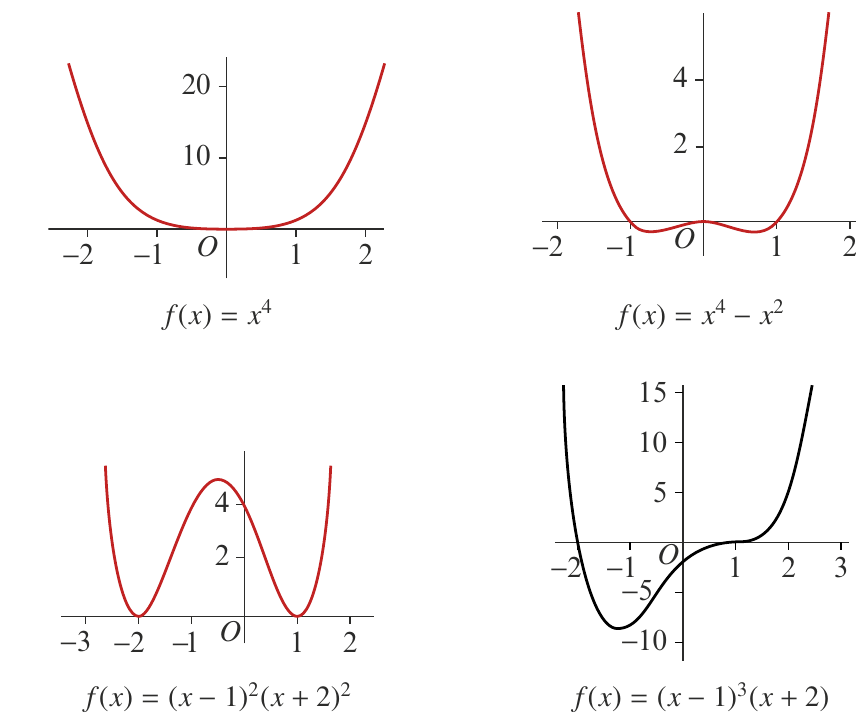
These graphs show the variety of shapes that quartic functions can produce:
- creates a smooth U-shaped curve (similar to a parabola but steeper at the edges)
- creates a W-shaped curve with two valleys
- touches the x-axis at two points but doesn't cross it
- shows mixed behavior - crossing at one point and having a steeper approach at another
General properties of polynomial functions
When working with polynomials of any degree, there are important properties to understand about their graphs.
Number of x-intercepts
Important
For a polynomial of degree , there are at most n solutions to the equation . This means the graph of can cross or touch the x-axis a maximum of times.
For example:
- A quartic function (degree 4) can have 0, 1, 2, 3, or 4 x-intercepts
- A cubic function (degree 3) can have 1, 2, or 3 x-intercepts
- A quadratic function (degree 2) can have 0, 1, or 2 x-intercepts
Even vs odd degree polynomials
The degree of a polynomial determines whether its graph must cross the x-axis:
Important
Even degree polynomials (like quartics, degree 4) may have no x-axis intercepts at all. For example, never touches the x-axis because is always positive.
Odd degree polynomials (like cubics, degree 3) must have at least one x-axis intercept. The graph has to cross the x-axis somewhere, though it might cross multiple times.
This difference occurs because even degree polynomials can have the same end behavior on both sides (both ends going up or both going down), while odd degree polynomials must have opposite end behaviors (one end up, one end down).
Working with quartic expressions
The same techniques you learned for cubic functions work for quartic functions and other higher degree polynomials.
Creating sign diagrams
Note
A sign diagram helps you understand where a function is positive or negative. To create one for a quartic expression:
- Find all the x-values where the expression equals zero (the zeros or roots)
- Mark these values on a number line
- Test the sign of the expression in each interval between these values
- Record whether the expression is positive (+) or negative (-) in each region
Factorising quartic expressions
You can factorise quartic expressions using:
- The factor theorem: If , then is a factor of
- Polynomial division: Once you find one factor, divide to find the remaining factors
- Pattern recognition: Sometimes you can spot factorisable patterns
Worked example: Sign diagrams for quartic expressions
Example
Worked Example: Creating Sign Diagrams
Let's create sign diagrams for two different quartic expressions.
Part a:
This expression is already factorised, so we can identify the zeros directly.
The zeros occur when each factor equals zero:
- gives
- gives
- gives
- gives
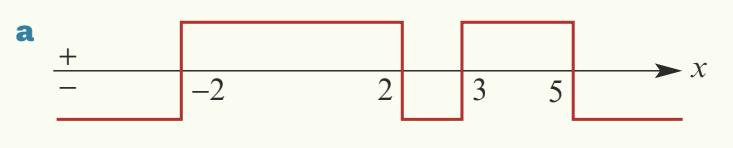
Now test the sign in each interval:
For : All factors are negative except , giving positive overall
For : The factor becomes positive, changing the sign to negative
For : The factor becomes negative, changing the sign to positive
For : The factor becomes positive, changing the sign to negative
For : The factor becomes positive, making all factors contribute to positive
The sign diagram shows positive, negative, positive, negative, positive as we move from left to right.
Part b:
This expression needs factorising first. Let's use the factor theorem.
Test :
Since , we know is a factor.
Using polynomial division to find the other factor:
Now factorise by grouping:
Therefore:
The factor is always positive (since , so ).
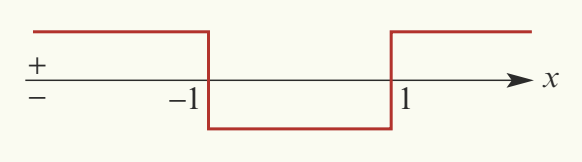
The zeros are at and .
For : Both and are negative, giving positive overall
For : becomes positive while stays negative, giving negative overall
For : Both factors are positive, giving positive overall
The sign diagram shows positive, negative, positive.
Worked example: Sketching a quartic function
Example
Worked Example: Sketching a Quartic Graph
Let's sketch the graph of .
Step 1: Factorise the expression
Notice that this looks like a quadratic in :
This is a perfect square:
We can factorise further:
Step 2: Find the intercepts
x-intercepts: Set
This gives and
Note that both factors are squared, so the graph touches the x-axis at these points but doesn't cross it.
y-intercept: Set
The y-intercept is at
Step 3: Consider the shape
Since both and are squared factors, the function doesn't change sign at or . The graph touches the x-axis at these points and bounces back.
For large positive or negative values of , the term dominates, so the graph rises steeply on both sides.
Step 4: Sketch the graph
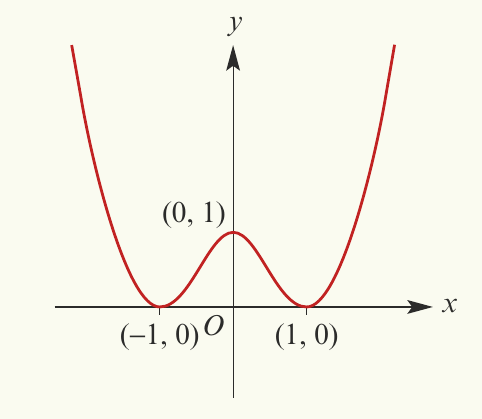
The graph shows:
- x-intercepts at and where the curve touches but doesn't cross
- y-intercept at
- The characteristic W-shape of a quartic with two repeated roots
- Both ends of the graph rising towards positive infinity
Key features to remember when sketching quartics
When you're asked to sketch a quartic function in factorised form , follow these steps:
Note
1. Find the y-axis intercept
Set and calculate the y-value.
2. Find the x-axis intercepts
Set each factor equal to zero and solve. These are the points where the graph crosses or touches the x-axis.
3. Create a sign diagram
This helps you understand where the function is positive or negative.
4. Consider end behavior
For a quartic with positive leading coefficient ():
- As increases to the right of all intercepts, becomes large and positive
- As decreases to the left of all intercepts, becomes large and positive
For a quartic with negative leading coefficient ():
- Both ends go towards negative infinity
5. Check for repeated factors
If there's a repeated factor raised to an even power, the graph touches the x-axis at that point but doesn't cross it. The y-values have the same sign immediately to the left and right of that intercept.
If a factor is raised to an odd power, the graph crosses the x-axis at that point.
Summary
Key Points to Remember:
- A quartic function has the form where
- A polynomial of degree has at most n x-axis intercepts
- Even degree polynomials may have no x-axis intercepts, but odd degree polynomials must have at least one
- Quartic functions can have zero, one, two, three, or four x-intercepts
- When a factor is repeated to an even power, the graph touches the x-axis without crossing (the sign stays the same on both sides)
- Use the factor theorem and polynomial division to factorise quartic expressions
- Sign diagrams help you understand the behavior of the function in different intervals