Solution of Literal Equations and Systems of Equations (VCE SSCE Mathematical Methods): Revision Notes
📚Revision Notes
Solution of Literal Equations and Systems of Equations
Understanding literal equations
A literal equation is an equation that contains multiple letters or symbols representing different values. When solving literal equations, you're asked to rearrange the equation to isolate one particular variable in terms of the others.
While linear literal equations involve straightforward rearrangement, non-linear literal equations require additional techniques. These equations may contain powers, roots, or products of variables.
Note
Although computer algebra systems (CAS) can solve these equations quickly, understanding the manual solving process helps build strong algebraic skills and deepens your mathematical reasoning.
Solving literal equations with power functions
When working with literal equations involving powers, you need to understand how different types of powers behave. The key distinction is between odd and even powers.
Properties of odd powers
If is an odd natural number, then the equation is equivalent to:
This means there is only one solution. For example, if , then (only one answer).
Properties of even powers
If is an even natural number, then the equation is equivalent to:
This means there are two solutions: one positive and one negative. For example, if , then (two answers: and ).
Important
When dealing with even powers, you must always remember to include both the positive and negative solutions. A common error is forgetting the negative solution.
For instance, the equation has solutions and , which we write as .
Example
Worked Example: Solving literal equations with the quadratic formula
Let's solve for .
This is a quadratic equation in standard form, so we can apply the quadratic formula with , , and :
Notice that real solutions only exist when the discriminant is non-negative. This means we need:
This inequality holds when or .
Example
Worked Example: Factorising cubic equations
Solve for .
First, factor out the common term :
Now factorise the quadratic expression. We need two numbers that multiply to give and add to give . These are and :
Using the null factor law, we get three solutions:
Example
Worked Example: Equations with even powers
Solve for , where .
Since we have an even power, we need both positive and negative solutions:
We can write this more concisely as .
Example
Worked Example: Equations requiring multiple steps
Solve for .
Divide both sides by :
Since is an odd power (the fifth root), we raise both sides to the fifth power:
This can also be written as:
Example
Worked Example: Cubic equations in transformed form
Solve for .
Divide both sides by :
Since this involves an odd power (cube), take the cube root of both sides:
Subtract from both sides:
Solving simultaneous equations
When two curves intersect, their coordinates satisfy both equations at the same time. To find these points of intersection, we solve the equations simultaneously using the substitution method.
Note
The general approach for solving simultaneous equations:
- Express one variable in terms of the other using one equation
- Substitute this expression into the second equation
- Solve for the remaining variable
- Substitute back to find the other coordinate
- State the intersection points as coordinate pairs
Example
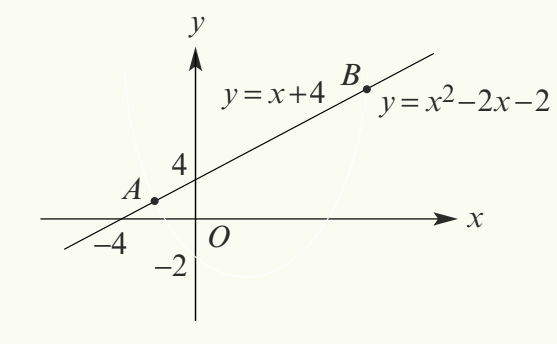
Worked Example: Parabola and straight line intersection
Find where the parabola intersects the straight line .
Since both expressions equal , we can equate them:
Rearrange to standard form:
This doesn't factorise easily, so we use the quadratic formula with , , and :
Now we find the corresponding -coordinates using :
When :
When :
Therefore, the points of intersection are:
Example
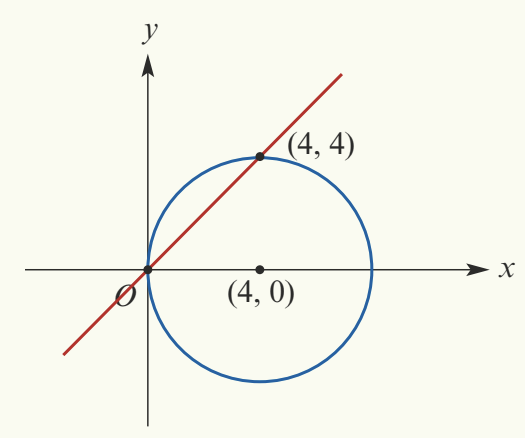
Worked Example: Circle and line intersection
Find where the circle intersects the line .
First, rearrange the line equation to make the subject:
Substitute this into the circle equation:
Expand the bracket:
Simplify:
Factor:
Therefore:
Since , the points of intersection are and .
Example
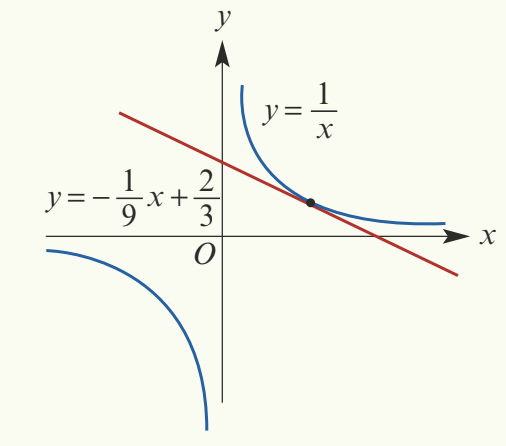
Worked Example: Hyperbola and line tangency
Find where the line meets the curve .
Rearrange the line equation:
And the curve equation:
Equate the expressions for :
Multiply through by to clear fractions:
Rearrange:
This is a perfect square:
Therefore (a repeated root, indicating the line is tangent to the curve).
When :
The point of contact is .
Using technology to verify solutions
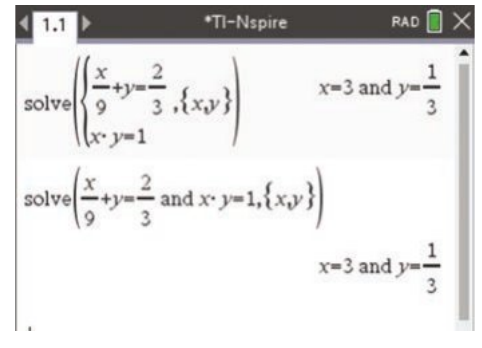
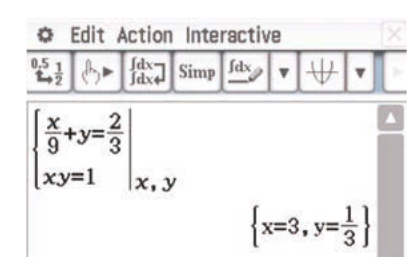
Computer algebra systems and graphing calculators can quickly solve systems of equations. On a TI-Nspire or Casio ClassPad, you can use the "Solve System of Equations" function to verify your algebraic work.
Note
While these tools are helpful for checking answers, understanding the manual solving process is essential for developing algebraic reasoning skills.
Summary
Key Points to Remember:
-
Odd powers give one solution: When solving where is odd, there is only one real solution:
-
Even powers give two solutions: When solving where is even and , there are two solutions: . Never forget the symbol!
-
Substitution is key for simultaneous equations: To find intersection points, express one variable in terms of the other, then substitute into the second equation
-
Check your discriminant: For quadratic literal equations, real solutions only exist when
-
Repeated roots indicate tangency: When a system of equations produces a repeated solution (perfect square), the curves touch at exactly one point rather than crossing