The Bisection Method (VCE SSCE Mathematical Methods): Revision Notes
📚Revision Notes
The Bisection Method
What is the bisection method?
The bisection method helps us find approximate solutions to equations of the form , where is a polynomial function. This numerical technique is particularly useful for higher degree polynomials where finding exact solutions algebraically becomes very difficult or impossible.
For polynomials of degree 5 and higher, there is no general formula to find all solutions. Even when exact solutions exist, they can be extremely complex. The bisection method provides a practical way to find numerical approximations to any desired level of accuracy.
Note
Numerical methods like the bisection method are essential tools in mathematics and engineering because many real-world equations cannot be solved using algebraic formulas alone. They allow us to find solutions to virtually any equation, regardless of complexity.
Why do we need the bisection method?
Consider the cubic function . The equation has only one real solution. The exact solution is:
This exact form is extremely complicated to calculate by hand. Instead, we can use the bisection method to find a numerical approximation that is accurate enough for practical purposes.
Important
While exact solutions may exist mathematically, they are often too complex to be practical. The bisection method provides a straightforward way to find solutions that are accurate enough for real-world applications, without the need for complicated algebraic manipulations.
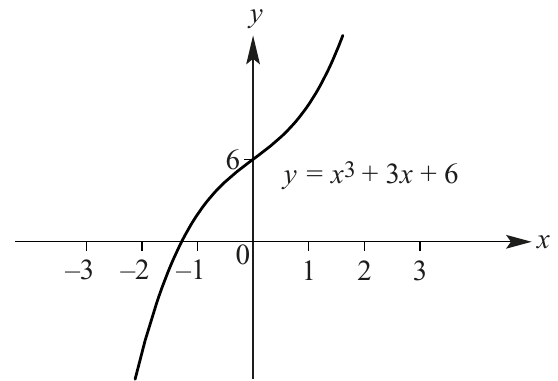
The general bisection algorithm
The bisection method works by repeatedly halving an interval that contains the solution. Here's how it works:
Starting point: We need an equation that has one solution in the interval .
Key observation: The sign of must be opposite to the sign of . This is because , so the function must change from positive to negative (or vice versa) as we move from to .
Note
Understanding the Sign Change
When a continuous function crosses the x-axis (where ), it must change from positive to negative or from negative to positive. This sign change is the key property that makes the bisection method work. If and have opposite signs, we are guaranteed that a root exists between them.
The algorithm steps:
-
Calculate the midpoint:
-
Evaluate the function at the midpoint: find
-
Determine which half contains the solution:
- If , choose the interval
- Otherwise, choose the interval
-
Repeat the process with the new interval until the required accuracy is reached
This process works because at each step, we're identifying which half of the interval contains the sign change, and therefore contains the root.
Using a spreadsheet for the bisection method
Let's work through a complete example using the function to solve the equation .
Example
Worked Example: Finding a Root Using the Bisection Method
Initial observation:
We note that and
Since the function values have opposite signs, we know there is a solution in the interval .
Step 1:
Starting with the interval :
Since and , the solution lies between and .
Step 2:
New interval:
The solution lies between and .
Step 3:
New interval:
The solution lies between and .
Step 4:
New interval:
At this point, we know the solution is in the interval .
Continuing with the spreadsheet:
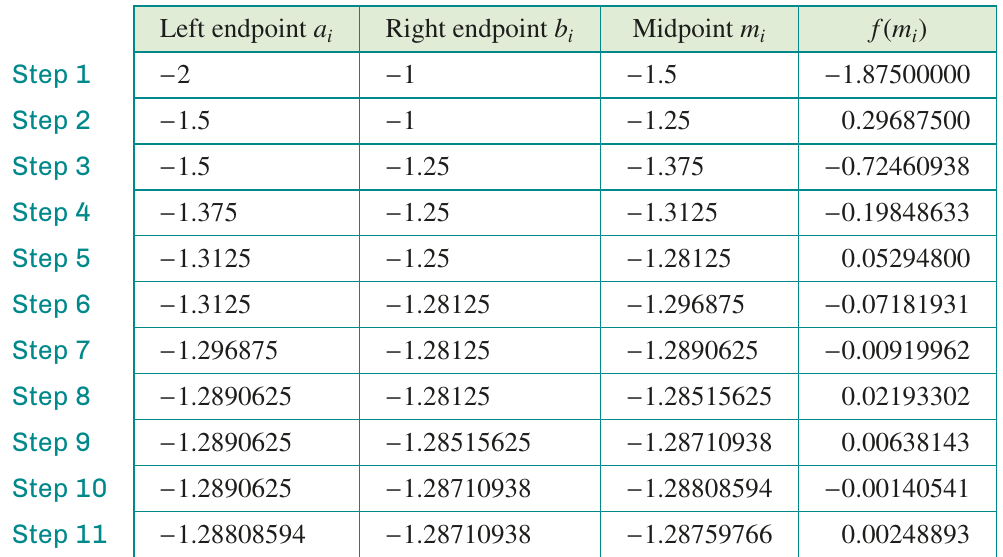
From the table, we can see that after 11 iterations, the midpoint value is approximately .
Conclusion: The solution is -1.29 correct to two decimal places.
Understanding error reduction
An important property of the bisection method is that the error decreases predictably:
-
If the starting interval has length unit, the error is at most after one step
-
After steps, the error is at most
This means each iteration halves the maximum possible error, allowing us to achieve any desired accuracy by performing enough iterations.
Note
The predictable error reduction is one of the bisection method's greatest strengths. Unlike some other numerical methods, we can always calculate exactly how many iterations we need to achieve a desired accuracy level.
Using pseudocode for the bisection method
Computers cannot understand natural language instructions directly. Instead, we need to write instructions in a programming language. Pseudocode is an informal way of writing algorithms that is closer to natural language but structured enough to be translated into actual programming code.
Example
Worked Example: Writing a Bisection Algorithm in Pseudocode
Problem: The equation has one real solution in the interval . Write an algorithm using pseudocode to find this solution correct to within .
Pseudocode solution:
define f(x):
    return x³ + 3x + 6

a ← -2
b ← -1
m ← -1.5

while b - a > 2 × 0.01
    if f(a) × f(m) < 0 then
        b ← m
    else
        a ← m
    end if
    m ← (a + b)/2
    print a, m, b, f(a), f(m), f(b)
end while

print m
Explanation of the pseudocode:
-
We first define the function
-
We assign initial values: left endpoint , right endpoint , and midpoint
-
We use a while loop because we don't know in advance how many iterations will be needed. The loop continues until (meaning the interval is small enough)
-
Inside the loop:
- We use an if-then block to update either the left endpoint or the right endpoint based on which half contains the solution
- We recalculate the midpoint
- We print the current values at the end of each iteration
-
After the loop completes, we print the final value of , which is our approximate solution
Execution results
The following table shows what happens when we run this algorithm:
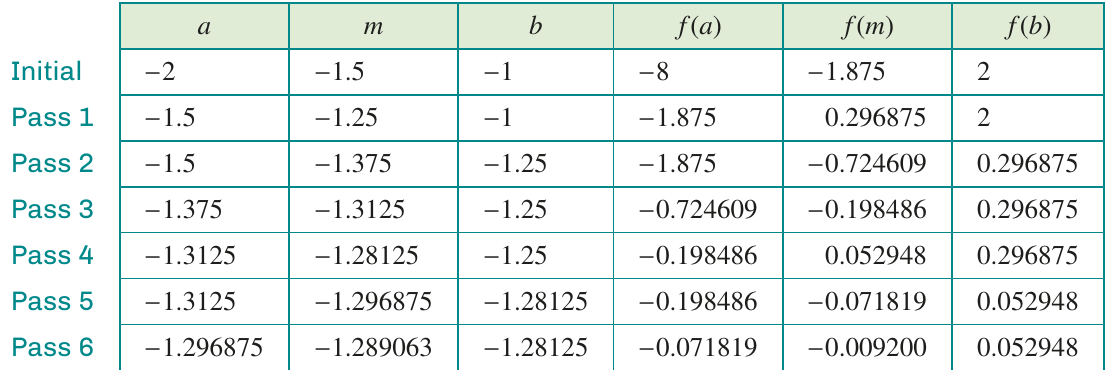
Analysis:
- The initial row shows our starting values
- Each subsequent row shows the values after each pass through the loop
- After the 6th pass, we have , so we exit the loop
- The final value of is -1.289063
To achieve greater accuracy, we would change the condition in the while loop to require a smaller interval width.
Important
Critical Consideration for Programming
The stopping condition ensures that our interval is small enough to guarantee the solution is accurate to within . When implementing the bisection method, always carefully choose your stopping condition based on the required accuracy.
Summary
Key Points to Remember:
- The bisection method finds approximate solutions to equations of the form by repeatedly halving an interval
- You need a starting interval where and have opposite signs
- At each step, calculate the midpoint and check which half-interval contains the sign change
- The error approximately halves with each iteration, making it predictable and reliable
- The method can be implemented using spreadsheets or programmed using pseudocode and programming languages
- The bisection method always converges to a solution if one exists in the initial interval