Multi-Stage Experiments (VCE SSCE Mathematical Methods): Revision Notes
📚Revision Notes
Multi-Stage Experiments
What are multi-stage experiments?
Many probability problems involve experiments that happen in multiple sequential steps, called multi-stage experiments. These are experiments that can be thought of as occurring in more than one stage.
Examples of multi-stage experiments:
- Tossing two coins (or tossing one coin twice)
- Rolling two dice (or rolling one die twice)
- Tossing three coins
Note
In multi-stage experiments, we analyze each stage of the experiment separately first, then combine the results to find all possible overall outcomes. This systematic approach helps us avoid missing any possibilities.
In these experiments, we need to consider the possible outcomes at each stage separately, and then combine them to find all possible overall outcomes.
Organizing outcomes with tree diagrams
When working with multi-stage experiments, tree diagrams provide a systematic and visual way to list all possible outcomes. A tree diagram uses branches to represent the possible results at each stage of the experiment.
Two-stage experiment: Tossing two coins
Let's consider tossing two coins. We can think of this in two stages:
- Stage 1: The outcome from the first coin
- Stage 2: The outcome from the second coin
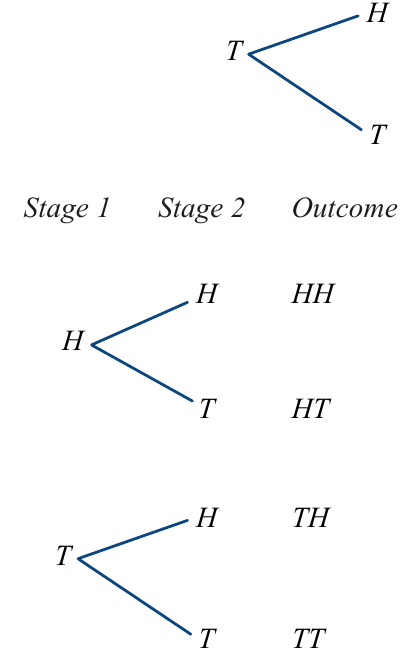
How to read a tree diagram:
- Each complete path from the start to the end represents one possible outcome
- We read along the branches from left to right
- The order of outcomes matters (HT is different from TH)
For two coin tosses, the sample space (the set of all possible outcomes) is:
This gives us 4 equally likely outcomes.
Note
Notice the pattern: with one coin, there are 2 outcomes (H or T). With two coins, there are 4 outcomes. Each additional coin doubles the number of possible outcomes.
Calculating probabilities in multi-stage experiments
When all outcomes in a multi-stage experiment are equally likely, we can calculate the probability of an event using this formula:
Important
This formula only works when all outcomes are equally likely! For fair coins and fair dice, this condition is satisfied, but always check this assumption before applying the formula.
Example
Worked Example: Two Fair Coins
Find the probability that when a fair coin is tossed twice:
a) One head is observed
First, identify which outcomes give exactly one head:
'one head' =
There are 2 outcomes with exactly one head, and 4 total outcomes in the sample space.
b) At least one head is observed
Identify which outcomes have at least one head (one or more heads):
'at least one head' =
There are 3 outcomes with at least one head.
c) Both heads or both tails are observed
Identify which outcomes show matching results:
'both heads or both tails' =
There are 2 outcomes where both coins match.
Using tables for two-stage experiments
For some two-stage experiments, a table can be more convenient than a tree diagram. This works particularly well when both stages have several possible outcomes, such as rolling two dice.
Two dice experiment
When rolling two dice (or rolling one die twice), there are 6 possible outcomes on die 1 and 6 possible outcomes on die 2. We can display all possible combinations in a table:
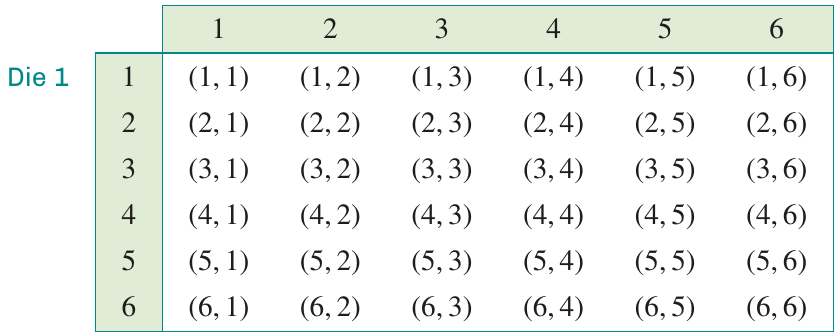
The table shows all 36 equally likely outcomes as ordered pairs , where:
- is the result on die 1 (the first die or first roll)
- is the result on die 2 (the second die or second roll)
Note
When to use tables vs. tree diagrams:
- Tables are ideal for two-stage experiments where each stage has multiple outcomes (like two dice with 6 outcomes each)
- Tree diagrams work best for experiments with fewer outcomes per stage, or for three or more stages
- For two dice, a table is much clearer than a tree diagram with 36 branches!
Example
Worked Example: Two Fair Dice
Find the probability that when two fair dice are rolled:
a) The same number shows on both dice (a double)
Looking at the table, the outcomes where both dice show the same number are:
'double' =
There are 6 doubles and 36 total outcomes.
b) The sum of the two numbers is greater than 10
We need outcomes where the sum exceeds 10. Looking at the table:
- : sum is 11 ✓
- : sum is 11 ✓
- : sum is 12 ✓
'sum greater than 10' =
There are 3 such outcomes.
Three-stage experiments
When an experiment involves more than two stages, tree diagrams become essential for organizing all possible outcomes. Tables don't work well for experiments with more than two stages.
Three coin tosses
Consider tossing a coin three times. The tree diagram extends to three stages:
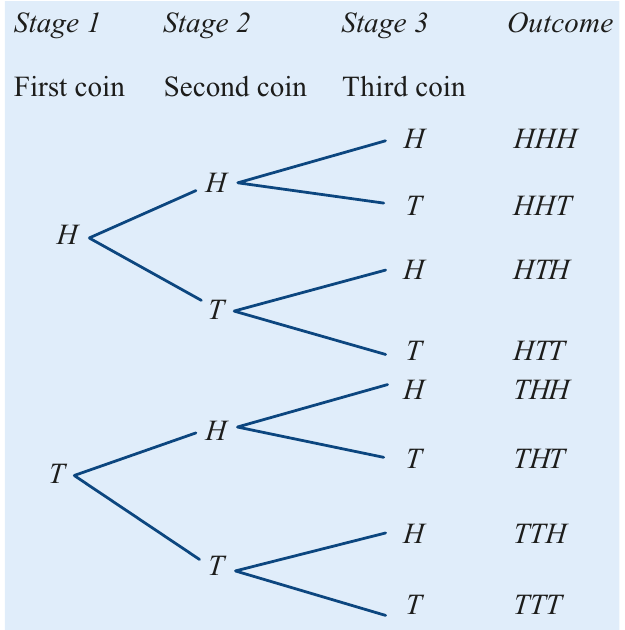
The sample space for three coin tosses is:
This gives us 8 equally likely outcomes.
Important
Pattern to notice: Each additional coin doubles the number of outcomes:
- 1 coin: 2 outcomes
- 2 coins: 4 outcomes
- 3 coins: 8 outcomes
- In general: coins give outcomes
This exponential growth means that four coins would give 16 outcomes, five coins would give 32 outcomes, and so on!
Example
Worked Example: Three Coin Tosses
Find the probability that when a coin is tossed three times:
a) One head is observed
Identify outcomes with exactly one head:
'one head' =
b) At least one head is observed
Identify outcomes with one or more heads:
'at least one head' =
There are 7 outcomes with at least one head.
Exam tip: It's often easier to calculate 'at least one' probabilities by finding the complement. The only outcome without any heads is TTT, so:
c) The second toss results in a head
Identify outcomes where the middle position is H:
'second toss is a head' =
Note: The probability for any specific position being heads is always , regardless of the other tosses.
d) All heads or all tails are observed
Identify outcomes where all three tosses match:
'all heads or all tails' =
Key techniques for multi-stage experiments
Choosing your method:
- Two stages: You can use either a tree diagram or a table
- Three or more stages: Always use a tree diagram
Reading tree diagrams:
- Start at the left (the beginning of the experiment)
- Follow each complete path to the right
- Record the outcome by reading the labels on each branch
- Make sure to maintain the correct order
Calculating probabilities:
- List all outcomes in the sample space
- Identify which outcomes satisfy the event condition
- Count the favourable outcomes
- Divide by the total number of outcomes (if equally likely)
Note
Exam tips:
- Always simplify fractions where possible
- For "at least one" questions, consider using the complement
- Check your outcome count matches the expected total (2 coins = 4, 3 coins = 8, 2 dice = 36)
- Write outcomes in a systematic order to avoid missing any
Summary
Key Points to Remember:
-
Multi-stage experiments occur in sequential steps or stages, such as tossing multiple coins or rolling multiple dice
-
Tree diagrams systematically display all possible outcomes by branching at each stage
-
For two-stage experiments, you can use either tree diagrams or tables; for three or more stages, use tree diagrams
-
When outcomes are equally likely, calculate probability as:
-
The sample space grows rapidly: coin tosses give outcomes, and two dice give outcomes
-
For "at least one" problems, the complement method is often quicker than listing all favorable outcomes