Completing the Square and Turning Points (VCE SSCE Mathematical Methods): Revision Notes
📚Revision Notes
Completing the Square and Turning Points
What is completing the square?
Completing the square is a powerful algebraic technique that allows us to rewrite a quadratic function from its polynomial form into its turning point form. This transformation makes it much easier to identify key features of a parabola, particularly its vertex (turning point).
Polynomial form:
Turning point form:
The vertex of the parabola is at the point .
Note
The turning point form immediately reveals the vertex of the parabola, making it invaluable for graphing and understanding quadratic functions. This is why completing the square is such an important technique in algebra.
The completing the square process
Understanding perfect squares
First, we need to recognise the structure of a perfect square. When we expand , we get:
Notice that the constant term is the square of half the coefficient of the middle term (). This pattern is key to completing the square.
Important
Key Pattern Recognition:
In the expansion , the relationship between the middle coefficient and the constant term is crucial:
- Middle coefficient:
- Half of middle coefficient:
- Constant term: (the square of half the middle coefficient)
This pattern is the foundation of the completing the square technique.
When the coefficient of is 1
Let's work through an example:
This expression is not a perfect square, but we can make it one by carefully adding and subtracting a new term.
Example
Worked Example: Completing the Square with
Complete the square for
Step 1: Find half the coefficient of and square it
Half of is , and
Step 2: Add and subtract this value
Step 3: Recognise the perfect square and simplify
So the quadratic can be written as , revealing that the vertex is at (-1, -4).
When the coefficient of is not 1
If the coefficient of is not , we must first factor it out before completing the square.
Example
Worked Example: Completing the Square with
Express in turning point form.
Solution:
Factor out from the first two terms:
Now complete the square inside the brackets. Half of is , and
Therefore, the vertex is at and the axis of symmetry is .
Important
Common Mistake Alert:
When factoring out the coefficient of , remember to only factor it from the and terms, NOT from the constant term. Many students incorrectly factor it from all three terms, which leads to errors in the final answer.
Geometric representation
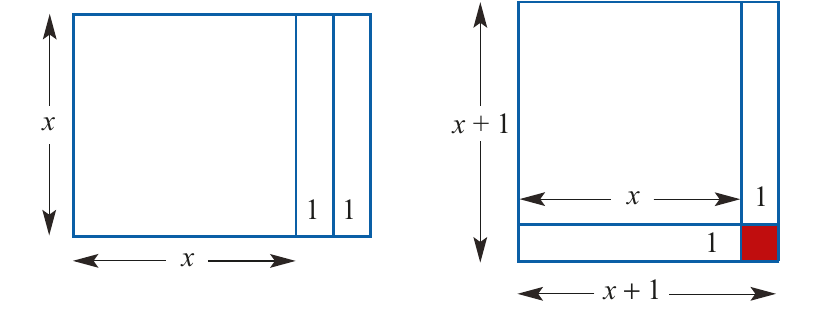
The process of completing the square can be visualised geometrically. For , we can think of this as the area of rectangles that can be rearranged to form a square with a small missing piece.
Note
Visual Understanding:
The diagrams show how by rearranging rectangular areas to form a complete square. The red square represents the unit area we need to add to complete the square.
This geometric interpretation helps explain why we "add and subtract" the same value - we're literally completing a square shape by adding the missing piece, then compensating by subtracting it.
Using technology
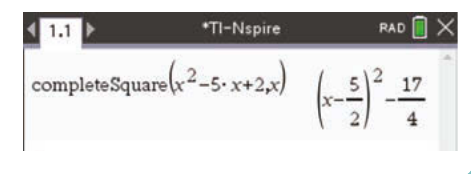
Modern calculators can perform completing the square operations automatically.
Note
Calculator Tip:
On the TI-Nspire calculator, use menu > Algebra > Complete the Square to rearrange expressions like into completed square form. While technology can help verify your work, it's essential to understand the process manually for exams and deeper comprehension.
Solving equations by completing the square
Completing the square is not just useful for graphing - it's also a method for solving quadratic equations. This technique is particularly valuable when factorising is difficult or impossible.
Example
Worked Example: Solving by Completing the Square
Solve by completing the square.
Solution:
First, divide both sides by to make the coefficient of equal to :
Half of is , so we add and subtract :
Take the square root of both sides:
Therefore:
The axis of symmetry formula
There's a shortcut formula for finding the axis of symmetry of any parabola without completing the square.
For a quadratic function , the axis of symmetry has equation:
This gives us the -coordinate of the turning point directly. We can then substitute this value back into the original equation to find the -coordinate.
Important
The Axis of Symmetry Shortcut:
The formula comes directly from the completing the square process. It saves time when you only need the vertex coordinates and don't need the full turning point form of the equation.
Remember: This formula gives you the -coordinate of the vertex, but you still need to substitute back to find the -coordinate!
Example
Worked Example: Using the Axis of Symmetry Formula
Find the turning point of and express it in turning point form.
Solution:
Here, and , so:
When :
The turning point is (3, 11).
In turning point form:
Sketching graphs using completed square form
Once a quadratic is in turning point form, sketching its graph becomes straightforward. The completed square form reveals all the key features needed for an accurate sketch.
Example
Worked Example: Sketching from Completed Square Form
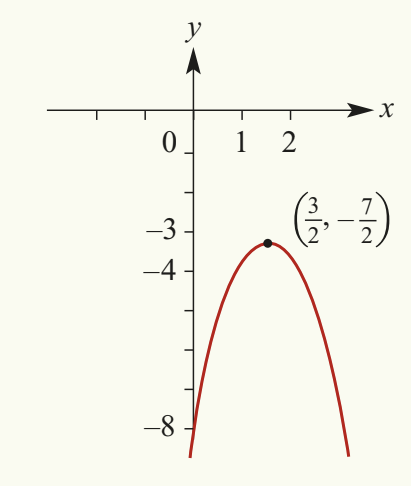
Sketch the graph of using the completed square form found earlier:
Solution:
From the turning point form, we can identify:
- Vertex:
- The coefficient is negative, so the parabola opens downward
- The -intercept occurs when :
- Since the maximum value is , there are no x-intercepts
The graph is a downward-opening parabola with its maximum point at .
Summary
Key Points to Remember:
- Completing the square converts polynomial form to turning point form:
- The key step is to add and subtract where is the coefficient of
- If , factor out a first before completing the square (only from the and terms)
- The axis of symmetry formula provides a shortcut:
- Completing the square can be used to solve quadratic equations, even when factorising is difficult
- The vertex (turning point) is at when the equation is in the form
- In turning point form, the sign of tells you whether the parabola opens upward () or downward ()