Expanding and Collecting Like Terms (VCE SSCE Mathematical Methods): Revision Notes
📚Revision Notes
Expanding and Collecting Like Terms
Introduction
Expanding brackets and collecting like terms are fundamental algebraic skills. These techniques allow us to simplify expressions and prepare them for further work, such as solving equations or sketching graphs. When we expand brackets, we remove them by multiplying out the terms. When we collect like terms, we combine terms that have the same variable parts.
Note
Mastering these skills is essential for all future algebraic work. Take time to understand each step rather than memorizing procedures.
Understanding algebraic terms
An algebraic expression is made up of terms. Terms are the separate parts of an expression that are added or subtracted.
For example:
- The linear expression has two terms: and
- The quadratic expression has three terms: , , and
Like terms are terms that have the same variable parts. For instance, and are like terms because they both contain just . We can combine like terms by adding or subtracting their coefficients.
Basic expansion with single brackets
When expanding a single bracket, multiply the term outside the bracket by each term inside the bracket. Pay special attention to negative signs, as they affect all terms that follow.
Important
Watch out for negative signs! A negative sign outside the bracket will change the sign of every term inside when you expand. This is one of the most common sources of errors.
Example
Worked Example: Basic Expansion
Expand the brackets first, then combine like terms to simplify .
Solution:
Explanation:
- First, expand each bracket by multiplying the term outside by each term inside
- The first bracket gives: and
- The second bracket gives: and
- Then collect like terms: combine the terms and the constant terms
Expanding expressions with variables
When the term outside the bracket contains a variable, multiply it by each term inside the bracket, remembering to add the powers when multiplying terms with the same base.
Example
Worked Example: Variable Coefficients
Expand .
Solution:
Explanation:
- For the first bracket: and
- For the second bracket: and
- Collect like terms: and
Expanding two brackets
When expanding two brackets, each term in the first bracket must multiply each term in the second bracket. The general formula is:
This means we get four terms from multiplying:
- First terms:
- Outer terms:
- Inner terms:
- Last terms:
Note
Some students find it helpful to remember this as "FOIL" (First, Outer, Inner, Last), though the table method below can be even more reliable for complex expressions.
Example
Worked Example: Two Brackets
Expand .
Solution:
Explanation: Multiply each term in the second bracket by each term in the first bracket. Then collect like terms: .
Using a table method
You can also use a table to ensure all terms are multiplied correctly. This visual method helps you keep track of each multiplication.
Example
Worked Example: Table Method
Expand .
Solution:
Explanation: Watch out for negative signs carefully. The term multiplies both terms in the second bracket.
The table method emphasises each multiplication:
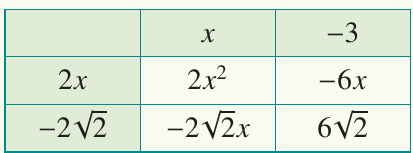
Add all the terms from the table to complete the expansion.
Expanding a binomial by a trinomial
The same principle applies when expanding brackets with more than two terms. Each term in the first bracket multiplies each term in the second bracket.
Example
Worked Example: Binomial × Trinomial
Expand .
Solution:
Explanation:
- Multiply by each term in the trinomial: , ,
- Multiply by each term in the trinomial: , ,
- Collect like terms: and
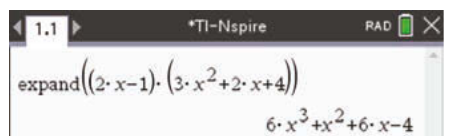
Using technology
You can check your expansion work using a calculator.
Note
Calculator Methods
On a TI-Nspire calculator, use menu > Algebra > Expand to expand expressions automatically.
On a Casio ClassPad, enter the expression, highlight it, and select Interactive > Transformation > expand, then tap OK.
While calculators are useful for checking your work, always understand the method and be able to expand by hand.
Perfect squares
A perfect square is an expression of the form . This is a special case that follows a predictable pattern.
To expand , we can treat it as :
This gives us the perfect square formula:
Important
Perfect Square Formula:
To expand a perfect square:
- Square the first term:
- Square the second term:
- Add twice the product of the terms:
Memory aid: "Square first, square last, twice the product in between"
Example
Worked Example: Perfect Square
Expand .
Solution:
Explanation: Here and . We square both terms and add twice their product. Note that .
Difference of two squares
Another special case occurs when we multiply the sum and difference of two terms: .
Let's expand this:
This gives us the difference of two squares formula:
Important
Difference of Two Squares Formula:
Notice that the middle terms cancel out, leaving just the difference of the squared terms. This pattern is very useful for simplifying calculations.
Memory aid: "Sum times difference gives difference of squares"
Example
Worked Examples: Difference of Two Squares
a) Expand .
Solution:
b) Expand .
Solution:
Explanation for both: We use the formula . In part (a), and . In part (b), and . Remember that .
Summary
Key Points to Remember:
- Terms are the parts of an expression separated by or signs. Always identify like terms before collecting them.
- When expanding brackets, multiply each term outside by every term inside. Watch out for negative signs.
- For two brackets, use . Each term in the first bracket multiplies each term in the second.
- Perfect squares follow the pattern . Remember: square first, square last, twice the product in between.
- Difference of two squares follows . The middle terms always cancel out.
- Use the table method for complex expansions to ensure you don't miss any terms.
- You can use a calculator to check your expansion work, but always understand the method.