Factorising (VCE SSCE Mathematical Methods): Revision Notes
📚Revision Notes
Factorising
Factorising is the process of expressing an algebraic expression as a product of its factors. This is essentially the reverse of expanding brackets. There are four main types of factorisation you need to master.
Note
The four main types of factorisation covered in this topic are:
- Factorisation using common factors
- Grouping of terms
- Difference of two squares
- Factorising quadratic polynomials
Factorisation using common factors
When each term in an algebraic expression contains a common factor, we can extract this factor and place it outside brackets.
To factorise using common factors:
- Identify the largest factor that is common to all terms
- Divide each term by this common factor
- Write the common factor outside brackets, with the remaining expression inside
Example
Worked Example: Factorising with Common Factors
Factorise
Solution:
The common factor has been extracted from both terms. We can check this answer by expanding: ✓
Example
Worked Example: Common Factors with Multiple Variables
Factorise
Solution:
The common factor has been taken outside the brackets.
Important
Exam Tip: Always extract as many common factors as possible to fully factorise the expression. If you can still see a common factor in your answer, you haven't finished factorising!
Example
Worked Example: Identifying All Common Factors
Factorise
Solution:
Here, the common factor is . Notice that both numerical coefficients (7 and 35) share a factor of 7, and both terms contain at least one and one .
Grouping of terms
This method works for expressions containing four terms. We group the terms in pairs and factorise each pair separately.
Example
Worked Example: Factorising by Grouping
Factorise
Solution:
Explanation:
First, we group the four terms into two pairs
Next, we factorise each pair separately
Finally, we notice that is common to both terms, so we extract it
Difference of two squares
This is one of the most important factorisation identities. You'll recall from expanding brackets that:
We can reverse this identity to factorise expressions:
Important
The Difference of Two Squares Identity
This identity only works when we have two perfect squares being subtracted. It does not work for addition.
Example
Worked Example: Difference of Two Squares with Common Factor
Factorise
Solution:
Explanation:
First, we extract the common factor of 3
Then we recognise that is a difference of two squares:
We apply the identity with and
Example
Worked Example: Recognising Perfect Squares
Factorise
Solution:
We first take out the common factor 9, then apply the difference of squares identity to .
Example
Worked Example: Complex Difference of Squares
Factorise
Solution:
Explanation:
We recognise this as a difference of two squares with and
Applying the identity:
Simplifying the brackets gives our final answer
Factorising quadratic polynomials
A quadratic polynomial is an expression of the form where .
Factorising quadratics is the reverse process of expanding two brackets. For example, if we expand:
Then factorising means going backwards from to .
Factorising monic quadratics
A monic quadratic polynomial has a coefficient of 1 for the term (i.e., it's in the form ).
Important
Method for Monic Quadratics
To factorise , find two numbers that:
- Multiply to give (the constant term)
- Add to give (the coefficient of )
Example
Worked Example: Monic Quadratic
Factorise
Solution:
Explanation:
We want
When expanded, this gives
Therefore, we need: and
The values that work are and
Check: ✓ and ✓
Factorising non-monic quadratics
Non-monic quadratics have a coefficient other than 1 for the term. There are two main methods for factorising these.
Method 1: Cross-multiplication
Consider all possible combinations of factors of the term and the constant term. Only one combination will give the correct middle term.
Example
Worked Example: Cross-Multiplication Method
Factorise
Solution:
Method:
We list possible factors of : could be and , or and
We list factors of : could include and , or and , etc.
We try combinations until the cross-products add to give :
- Sum: ✓
Method 2: The ac method (grouping)
This method is more systematic. To factorise :
- Find two numbers that multiply to give and add to give
- Split the middle term using these two numbers
- Factorise by grouping
Example
Worked Example: The ac Method
Factorise using the grouping method
Solution:
First, find and
We need two numbers that multiply to and add to
These numbers are and : and
Now we split the middle term:
Example
Worked Example: Another Non-Monic Quadratic
Factorise
Solution:
and
We need two numbers that multiply to and add to
These are and
Simplifying by extracting common factors first
Sometimes we can make factorising easier by taking out a common factor first.
Note
When you spot a common factor in a quadratic, always extract it first. This can turn a difficult non-monic quadratic into a much simpler monic quadratic!
Example
Worked Example: Extracting Common Factors First
Factorise
Solution:
Explanation:
First, we extract the common factor of 2
This leaves us with a simpler monic quadratic to factorise
We find two numbers that multiply to and add to : these are and
Example
Worked Example: Substitution Technique
Factorise
Solution:
Let to make the expression easier to work with
Substituting back :
This substitution technique is useful when we have a repeated expression in brackets.
Using technology to factorise
Note
Calculator Methods for Factorising
Modern calculators can verify your factorisation or help you factor complex expressions. However, you should still understand the methods by hand!
Using the TI-Nspire calculator:
To factorise an expression like :
- Access the menu
- Select Algebra > Factor
- Enter the expression and specify the variable
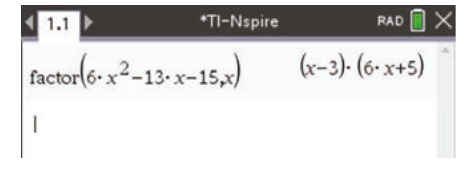
Specifying the variable ensures the calculator factorises over the real numbers.
Using the Casio ClassPad calculator:
- In the main application screen, enter the expression
- Highlight the expression
- Select Interactive > Transformation > factor
The calculator will return the factorised form
Remember!
Summary
Key Points to Remember:
-
Common factors: Always look for and extract the greatest common factor first before using other methods
-
Difference of two squares: The identity only works for subtraction, not addition
-
Monic quadratics: Find two numbers that multiply to and add to in the form
-
Non-monic quadratics: Either use cross-multiplication or find two numbers that multiply to and add to , then factorise by grouping
-
Check your work: You can always verify your factorisation by expanding the brackets to see if you get back to the original expression