Quadratic Equations (VCE SSCE Mathematical Methods): Revision Notes
📚Revision Notes
Quadratic Equations
Introduction
A quadratic equation is an equation that can be written in the standard form , where , , and are constants and . One of the most important methods for solving quadratic equations is factorisation.
When you solve a quadratic equation by factorisation, you're essentially finding the values of that make the equation true. These values are called the solutions or roots of the equation.
The three-step method for solving by factorisation
Solving quadratic equations by factorisation follows a systematic three-step process:
Important
The Three-Step Method for Solving by Factorisation
Step 1: Rearrange to standard form
Write the equation in the form . This means getting all terms on one side of the equation with zero on the other side.
Step 2: Factorise the quadratic expression
Break down the quadratic expression into a product of two brackets (factors). This uses the factorisation techniques you've learned previously.
Step 3: Apply the null factor theorem
Use the null factor theorem: if , then or (or both). This means if a product of factors equals zero, at least one of the factors must equal zero. Set each factor equal to zero and solve for .
Understanding the null factor theorem
The null factor theorem is the key principle that makes solving by factorisation work.
If you have two numbers whose product is zero, then at least one of those numbers must be zero. For example, if , then either:
- , which gives , or
- , which gives
This is why factorisation is such a powerful method for solving quadratic equations.
Note
The null factor theorem only works when one side of the equation equals zero. This is why rearranging to standard form is always the first step!
Worked example: Basic quadratic equation
Let's solve the equation using the three-step method.
Example
Worked Example: Solving a Basic Quadratic Equation
Solve
Step 1: Rearrange to standard form
Step 2: Factorise the quadratic expression
Step 3: Apply the null factor theorem
Solution: x = 4 or x = -3
Worked example: Factorising using the area model
Example
Worked Example: Using the Area Model
Solve
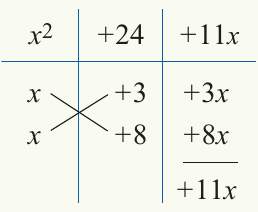
Solution:
The quadratic expression can be factorised by finding two numbers that multiply to give 24 and add to give 11. These numbers are 3 and 8.
Using the null factor theorem:
Alternative factorisation method:
You can also factorise by splitting the middle term:
Checking your answer:
It's always good practice to check your solutions by substituting back into the original equation:
For : ✓
For : ✓
Worked example: Quadratic with leading coefficient greater than 1
Example
Worked Example: Leading Coefficient Greater Than 1
Solve
Solution:
When the coefficient of is not 1, factorisation requires more careful attention. We need to find factors of that add to give 5. These are 8 and .
Using the null factor theorem:
Alternative factorisation method:
Split the middle term:
Note
When the leading coefficient is greater than 1, you multiply the leading coefficient by the constant term to find the pair of numbers that add to give the middle coefficient. This takes extra care with signs!
Applications of quadratic equations
Quadratic equations appear frequently in real-world problems, including applications in geometry, physics, economics, and engineering. Let's look at an example involving geometry.
Worked example: Rectangle problem
Example
Worked Example: Rectangle Dimensions Problem
Problem: The perimeter of a rectangle is 20 cm and its area is 24 cm². Calculate the length and width of the rectangle.
Solution:
Let cm be the length of the rectangle and cm be the width.
From the perimeter information:
From the area information:
Substituting :
Rearranging to standard form:
Factorising:
Therefore: or
Interpretation:
If the length is 6 cm, then the width is cm.
If the length is 4 cm, then the width is cm.
Both solutions represent the same rectangle (just with the dimensions labelled differently), so the rectangle has dimensions 6 cm by 4 cm.
Important
In real-world applications, always check that your mathematical solutions make sense in the physical context. For example, lengths must be positive, time cannot be negative, and quantities like number of people must be whole numbers.
Exam tips
Note
Exam Success Tips
- Always rearrange to standard form first - this is a common source of errors
- Check your factorisation by expanding the brackets
- Remember to set each factor equal to zero separately
- Verify your solutions by substituting back into the original equation
- When the leading coefficient is not 1, take extra care with the signs
- In word problems, check that your solutions make sense in the context (e.g., lengths must be positive)
Remember!
Summary
Key Points to Remember:
- Quadratic equations can be solved by factorisation when the quadratic expression can be written as a product of two linear factors
- Always follow the three-step method: rearrange to standard form, factorise, then apply the null factor theorem
- The null factor theorem states: if , then or (or both)
- A quadratic equation typically has two solutions (though they may be the same)
- Always check your solutions by substituting back into the original equation
- Real-world applications often require interpretation of the mathematical solutions in context