Quadratic Models (VCE SSCE Mathematical Methods): Revision Notes
📚Revision Notes
Quadratic Models
Introduction to quadratic models
Quadratic models allow us to use quadratic functions to solve real-world problems. These models are particularly useful when we need to find the maximum or minimum value of something in a practical situation.
Note
Common applications of quadratic models include:
- Maximising area with limited materials (like fencing)
- Modelling the path of projectiles (like balls or rockets)
- Optimising profit or cost in business scenarios
The key skill is translating a word problem into a quadratic function, then using algebraic techniques to find the optimal value.
Finding maximum area with limited fencing
Let's explore how to use quadratic functions to solve optimization problems. The technique involves defining appropriate variables, expressing the quantity to be optimized as a function, and then using completing the square to find the maximum or minimum value.
Example
Worked Example: Vegetable Garden Fence
Problem: Jenny has 20 metres of fencing wire to enclose a rectangular vegetable garden. She will use the wire for three sides of the garden, with an existing timber fence forming the fourth side. What is the maximum area she can enclose?
Solution:
First, we need to define our variables carefully:
- Let represent the area of the rectangular garden (in square metres)
- Let represent the length of the garden (the side parallel to the timber fence)
Since Jenny uses 20 metres of fencing for three sides (two widths and one length), we can work out the width:
Width =
Now we can express the area as a function of :
Expanding this expression:
To find the maximum area, we need to convert this into vertex form by completing the square. First, we'll factor out the coefficient of :
Now we complete the square inside the brackets. We add and subtract (which is half of 20, squared):
The expression is a perfect square:
This is now in vertex form, , where the vertex is at .
Since the coefficient of the squared term is negative (), the parabola opens downward, meaning the vertex represents a maximum point.
Answer: The maximum area is 50 m², which occurs when metres.
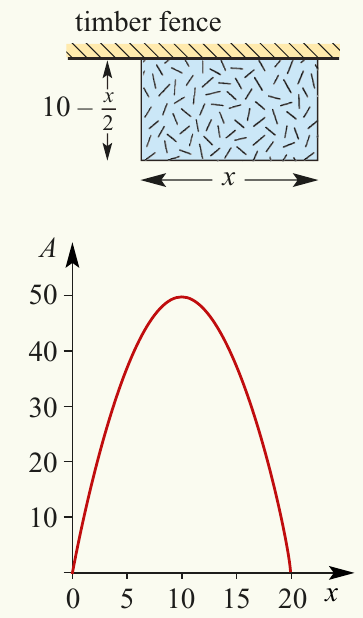
Interpretation: The optimal dimensions are a length of 10 metres (parallel to the existing fence) and a width of 5 metres, giving a total area of 50 square metres.
Important
Remember: When completing the square, the sign of the leading coefficient tells us whether we have a maximum or minimum:
- Negative coefficient → parabola opens downward → maximum value
- Positive coefficient → parabola opens upward → minimum value
Modelling projectile motion
Quadratic functions are ideal for modelling the path of objects moving through the air under gravity. The trajectory of a projectile follows a parabolic path, which can be described by a quadratic equation of the form .
Example
Worked Example: Cricket Ball Trajectory
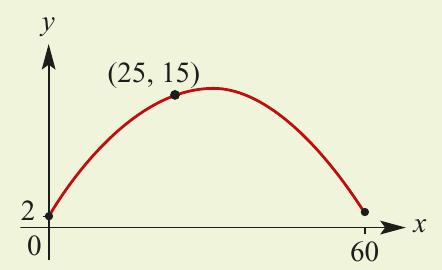
Problem: A fielder throws a cricket ball. It leaves his hand at a height of 2 metres above the ground. The wicketkeeper catches it 60 metres away, also at a height of 2 metres. After travelling 25 metres horizontally, the ball reaches a height of 15 metres. The path follows a parabola with equation .
Part a: Find the values of , , and
We have three points on the parabola: , , and .
Each point gives us an equation when we substitute into :
From point :
From point :
From point :
Now we have a system of three equations with three unknowns. We can substitute equation (1) into equations (2) and (3):
Substituting into equation (2):
Substituting into equation (3):
We can simplify equation (3') by dividing both sides by 60:
Rearranging:
Now multiply equation (3') by 25:
Subtract this from equation (2'):
Subtracting:
Therefore:
Substituting back:
Answer: The path of the ball has equation
Part b: Find the maximum height of the ball
For a quadratic in the form , the maximum occurs at .
Substituting into the equation:
Answer: The maximum height is (approximately 15.4 metres).
Part c: Find the height when the ball is 5 metres before the wicketkeeper
The wicketkeeper is at , so 5 metres before is at .
Substituting into the equation:
Answer: The height of the ball is metres (approximately 6.1 metres).
Note
When working with projectile motion, remember that three data points are needed to determine a unique quadratic equation. This is because we have three unknown coefficients (, , and ) in the general form .
Key techniques for quadratic models
Understanding these core techniques will help you tackle any quadratic modelling problem effectively.
Completing the square
This technique converts a quadratic from standard form to vertex form:
- Standard form:
- Vertex form:
The vertex gives us the maximum (if ) or minimum (if ) value directly. This is why completing the square is so powerful for optimization problems—it reveals the optimal value immediately.
Using simultaneous equations
When you have multiple data points, follow this systematic approach:
- Substitute each point into the general quadratic equation
- Create a system of equations
- Solve systematically by substitution or elimination
- Check your answer makes sense in the context
Important
Always work carefully through each step of solving simultaneous equations. Common mistakes include:
- Forgetting to substitute known values into all equations
- Sign errors when rearranging equations
- Arithmetic errors when simplifying fractions
Interpreting results
Always remember to:
- State what your variables represent
- Include appropriate units
- Explain what the mathematical answer means in the real-world context
- Check if your answer is reasonable
The mathematical solution is only valuable when you can interpret its meaning in the original problem context.
Summary
Key Points to Remember:
- Quadratic models are powerful tools for solving optimization and trajectory problems in real-world contexts
- Completing the square converts a quadratic to vertex form, making it easy to identify maximum or minimum values
- A negative leading coefficient indicates a maximum (parabola opens downward), while a positive leading coefficient indicates a minimum (parabola opens upward)
- Three points are needed to determine a unique quadratic equation—this creates three simultaneous equations to solve
- Always interpret your answer in the context of the problem, including appropriate units and explanations