The General Quadratic Formula (VCE SSCE Mathematical Methods): Revision Notes
📚Revision Notes
The General Quadratic Formula
Introduction
Some quadratic equations are difficult or impossible to solve using factorization by inspection. When this happens, we need an alternative method to find the solutions. The quadratic formula provides a reliable way to solve any quadratic equation in standard form, regardless of whether it can be factorized easily.
The quadratic formula is particularly useful for finding the -axis intercepts of a quadratic function when these values are not obvious through factorization.
Note
The quadratic formula is your go-to method when:
- A quadratic doesn't factor nicely by inspection
- You need exact values for the solutions
- You're working with quadratics involving parameters or surds
The quadratic formula
For any quadratic equation written in the form where , the solutions are given by the quadratic formula:
This formula works for all quadratic equations and will give you the exact solutions (if they exist).
Important
The quadratic formula provides an alternative to completing the square. However, completing the square is often more useful for curve sketching because it gives you the turning point coordinates directly. The quadratic formula is primarily used for finding solutions or -intercepts.
How the formula is derived
The quadratic formula comes from completing the square for the general quadratic equation. Here's a brief overview of the derivation:
Starting with the general quadratic in completed square form:
We set this equal to zero to solve for :
After rearranging:
Dividing both sides by :
Taking the square root of both sides:
Therefore:
Note
This derivation shows that the quadratic formula is really just a rearrangement of the completed square form. Understanding this connection helps you see why both methods work!
The axis of symmetry
An important relationship can be seen from the quadratic formula. The axis of symmetry of any quadratic is located exactly halfway between the two solutions (when they exist). This is given by:
Notice that this is the part of the quadratic formula before the symbol. This makes sense because the axis of symmetry is the average of the two solutions.
The discriminant and number of solutions
The expression under the square root sign in the quadratic formula, , is called the discriminant. It is often represented by the Greek letter delta: .
The discriminant tells us important information about the number of solutions to a quadratic equation:
Important
Understanding the Discriminant:
If : The discriminant is positive, meaning we can take its square root. This gives us two distinct real solutions. The parabola crosses the -axis at two points.
If : The discriminant equals zero, so the part of the formula becomes zero. This gives us exactly one solution (a repeated root). The parabola just touches the -axis at its vertex.
If : The discriminant is negative, meaning we cannot take its square root (in the real number system). There are no real solutions. The parabola does not intersect the -axis at all.
Understanding the discriminant helps you predict the nature of the solutions before calculating them.
Note
Exam tip: You can use a CAS calculator to solve quadratic equations quickly. On the TI-Nspire, use menu > Algebra > Solve. On the Casio ClassPad, select "solve" from the keyboard. However, you should still understand the quadratic formula for exam questions that require you to show working.
Worked example: solving simple quadratics
Example
Worked Example: Solving a Simple Quadratic
Solve using the quadratic formula.
First, identify the coefficients:
Substitute these values into the quadratic formula:
This gives us two solutions: or .
Worked example: quadratics with parameters
Example
Worked Example: Solving a Quadratic with Parameters
Solve where is a constant.
Here we have a parameter instead of a specific number. The method is the same.
Identify the coefficients:
Apply the quadratic formula:
We can simplify this further. Factor out 4 from under the square root:
Note that since for all values of , we know that . This means the discriminant is always positive, so this equation always has two distinct real solutions regardless of the value of .
Worked example: sketching using the quadratic formula
Example
Worked Example: Sketching a Graph Using the Quadratic Formula
Sketch the graph of , using the quadratic formula to find the -axis intercepts.
First, find the -intercept. When :
So the -intercept is .
Next, find the axis of symmetry:
Now find the turning point. When :
The turning point is at .
To find the -axis intercepts, solve using the quadratic formula.
Here: , ,
Simplify :
So the -intercepts are and .
As decimal approximations: or (to two decimal places).
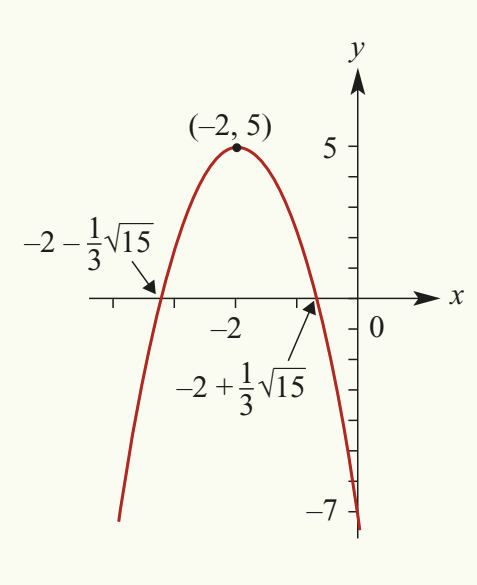
The graph shows a downward-opening parabola (since ) with vertex at and -intercepts at approximately and .
Remember!
Summary
Key Points to Remember:
- The quadratic formula can solve any quadratic equation in the form .
- The axis of symmetry is given by , which is the -coordinate of the turning point.
- The discriminant determines the number of solutions: if positive, two solutions; if zero, one solution; if negative, no real solutions.
- When using the quadratic formula, always identify , , and carefully, paying attention to negative signs.
- The quadratic formula is derived from completing the square, showing the deep connection between these two methods.