T-lymphocytes & Cell Mediated Immunity (AQA A-Level Biology): Revision Notes
📚Revision Notes
T-lymphocytes & Cell Mediated Immunity
Introduction to immunity
The human body has both non-specific and specific immune responses to protect against infection. Immunity refers to the body's ability to resist infection by defending against disease-causing microorganisms and their toxins. This protection involves recognising foreign material called antigens.
Note
The immune system's dual approach provides both immediate protection and long-term defence. The non-specific response acts as the body's first line of defence, while the specific response creates lasting immunity against particular threats.
The immune system operates through two main phases:
- Initial non-specific response (immediate but general)
- Primary specific immune response (slower but targeted, providing long-term immunity)
Antigens
An antigen is any part of an organism or substance recognised as non-self (foreign) by the immune system, which then stimulates an immune response.
Antigens are typically proteins found on:
- Cell-surface membranes of invading microorganisms
- Cell walls of pathogens
- Abnormal body cells (such as cancer cells)
- Transplanted cells from other individuals
When antigens are detected, they trigger antibody production as part of the body's defence mechanism.
Note
Think of antigens as molecular "name tags" that help the immune system distinguish between "self" and "non-self" materials. This recognition system is crucial for protecting the body while avoiding attacks on healthy tissue.
Lymphocytes
Lymphocytes are specialised white blood cells produced by stem cells in the bone marrow. The body has both non-specific responses (like phagocytosis) and specific responses that target particular antigens. These specific responses are slower initially but provide long-term immunity.
There are two main types of lymphocyte:
| Type | Maturation site | Associated immunity | Function |
|---|---|---|---|
| B lymphocytes (B cells) | Bone marrow | Humoral immunity | Produce antibodies in body fluids |
| T lymphocytes (T cells) | Thymus gland | Cell-mediated immunity | Target infected body cells directly |
Important
The key difference between B and T lymphocytes lies in their targets: B cells fight pathogens floating freely in body fluids, while T cells attack infected body cells directly. This division of labour provides comprehensive immune protection.
Cell-mediated immunity
Cell-mediated immunity involves T lymphocytes responding to the body's own cells that have become infected with foreign material from different species (such as viruses). T cells also respond to:
- Cells from other individuals of the same species (which have different antigens)
- Cancer cells (which present abnormal antigens)
T lymphocytes can distinguish these abnormal cells from healthy cells because antigen-presenting cells display foreign antigens on their cell-surface membranes. This occurs when:
- Phagocytes engulf and break down pathogens, then present pathogen antigens on their surface
- Body cells infected by viruses display viral antigens on their surface
- Transplanted cells carry different surface antigens
- Cancer cells develop abnormal surface antigens
Stages of T lymphocyte response
T lymphocytes only respond to antigens presented on body cells (not antigens in body fluids). This cellular response follows these key stages:
Example
Worked Example: The T Cell Response Process
Step 1: Pathogen invasion Pathogens invade body cells or are taken in by phagocytes
Step 2: Antigen presentation Phagocytes place antigens from the pathogen on their cell-surface membrane
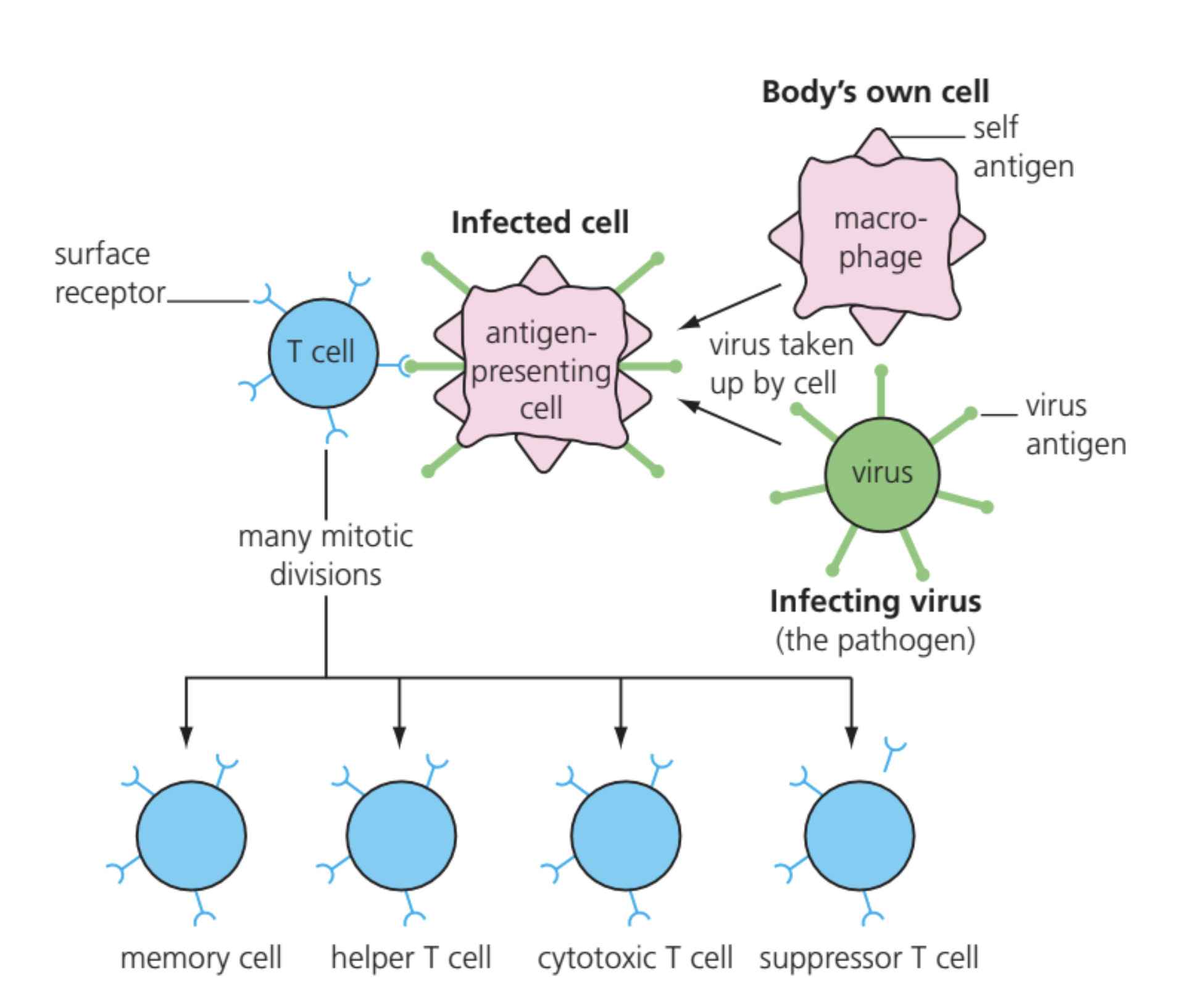
Step 3: Helper T cell activation Receptors on a specific helper T cell (TH cell) bind exactly to these presented antigens
Step 4: Clonal expansion This binding activates the T cell to divide rapidly by mitosis, forming a clone of genetically identical cells
Step 5: Differentiation The cloned T cells develop into different types:
- Memory cells - provide rapid response to future infections by the same pathogen
- Effector cells that:
- Stimulate phagocytes to increase phagocytosis
- Stimulate B cells to divide and produce antibodies
- Activate cytotoxic T cells (TC cells)
Each T cell responds to a single antigen type. Since there are many different antigens, the body produces numerous types of T cells, each responding to a different antigen.
Note
The specificity of T cells means that each cell is like a specialised key that fits only one particular antigen "lock." This precise matching system ensures targeted immune responses while minimising damage to healthy tissue.
Role of cytotoxic T cells
Cytotoxic T cells (TC cells) destroy abnormal cells and body cells infected by pathogens. They kill these cells by producing a protein called perforin, which creates holes in the target cell's membrane.
These holes make the cell membrane freely permeable to all substances, causing the cell to die. This mechanism is particularly effective against viruses because:
- Viruses replicate inside living cells
- By sacrificing infected body cells, the immune system prevents viruses from multiplying
- This stops the infection spreading to more cells
Important
The cytotoxic T cell mechanism demonstrates a crucial immune strategy: sacrificing infected cells to save the whole organism. While this may seem harsh, it prevents viruses from using the body's own cells as factories for replication, effectively stopping the infection in its tracks.
The action of cytotoxic T cells demonstrates the importance of cell-surface membranes in maintaining cell integrity and survival.
Remember!
Summary
Key Points to Remember:
-
Antigens are foreign substances that trigger specific immune responses, typically proteins on pathogen surfaces or abnormal cells
-
T lymphocytes mature in the thymus gland and are responsible for cell-mediated immunity, targeting infected body cells
-
Cell-mediated immunity works through antigen presentation on cell surfaces, followed by helper T cell activation and clonal expansion
-
Cytotoxic T cells kill infected cells using perforin to create holes in cell membranes, preventing pathogen replication
-
The immune response creates memory cells that enable faster responses to future infections by the same pathogen