Diffusion (AQA A-Level Biology): Revision Notes
📚Revision Notes
Diffusion
What is diffusion?
Diffusion represents a fundamental form of passive transport that enables substance exchange between cells and their surrounding environment. Unlike active transport, this process requires no metabolic energy input from sources like ATP.
Note
The term 'passive' can initially seem confusing since all particle movement involves energy. However, in biological contexts, passive means the energy comes from the natural, inherent motion of particles themselves rather than from external cellular energy sources.
Understanding simple diffusion
The kinetic theory basis
Simple diffusion operates on three key principles of particle behaviour:
- All particles possess kinetic energy that keeps them in constant motion
- This movement follows random patterns with no predetermined direction
- Particles continuously collide with each other and surrounding surfaces, including container walls
Note
These random collisions and movements create a natural tendency for particles to spread out from areas where they are densely packed to areas where they are less concentrated.
Definition and mechanism
Simple diffusion can be defined as the net movement of molecules or ions from regions of higher concentration to regions of lower concentration, continuing until particles become evenly distributed throughout the available space.
This movement occurs down a concentration gradient - the difference in concentration between two areas. The steeper this gradient, the faster diffusion occurs.
Membrane permeability limitations
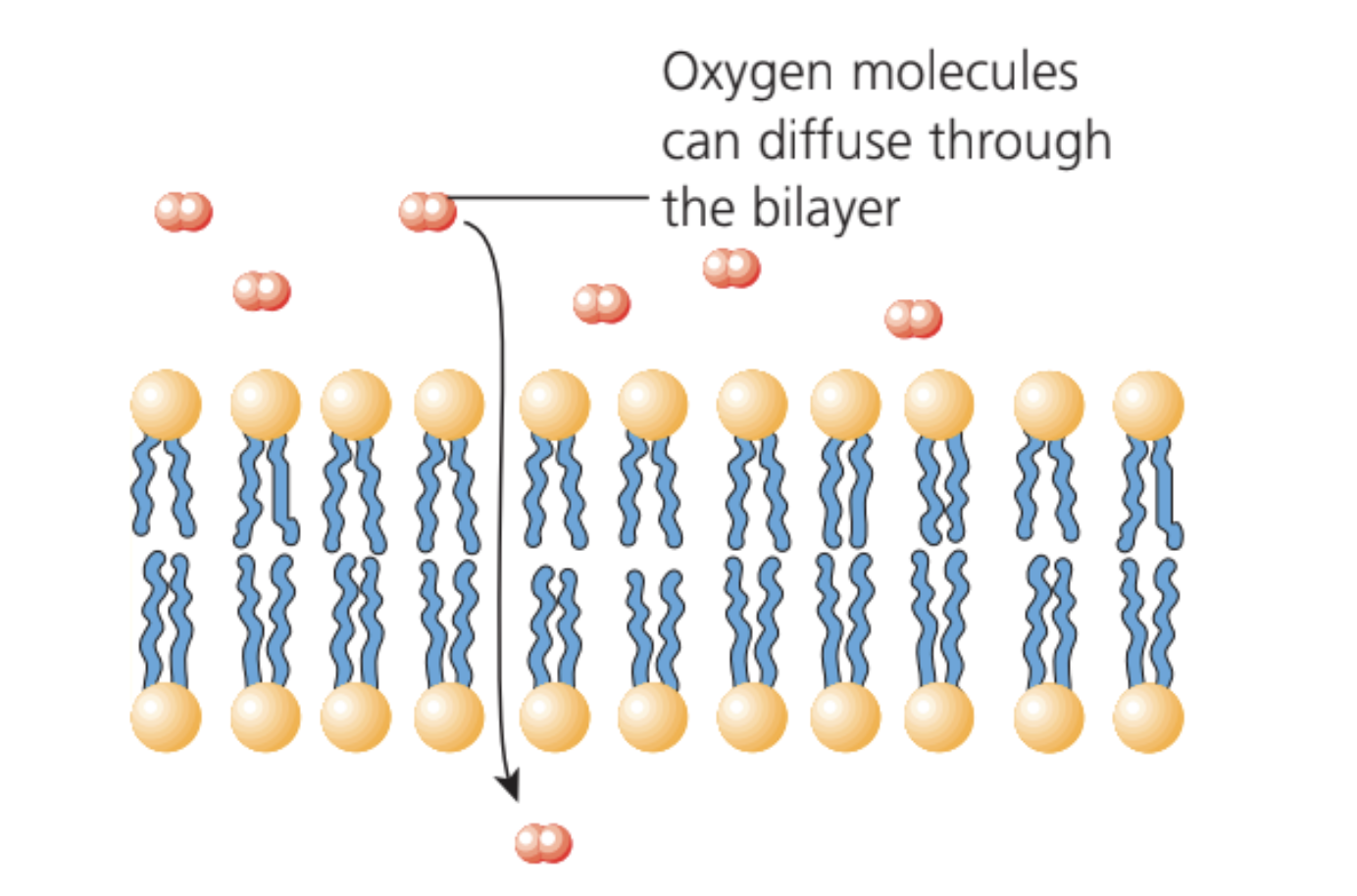
Most biological molecules cannot easily cross cell membranes through simple diffusion. The phospholipid bilayer structure of cell membranes presents a barrier to many substances due to its hydrophobic fatty acid tails.
Important
Only small, non-polar molecules such as oxygen and carbon dioxide can readily diffuse across membranes without assistance. These molecules can dissolve through the lipid portions of the membrane.
Facilitated diffusion
The need for assistance
Since plasma membranes restrict the passage of most molecules, cells have evolved mechanisms to transport essential substances that cannot pass through simple diffusion. Facilitated diffusion provides this transport while maintaining the passive nature of the process.
This process enables the movement of charged ions and polar molecules that would otherwise be blocked by the membrane's hydrophobic regions.
Protein channels
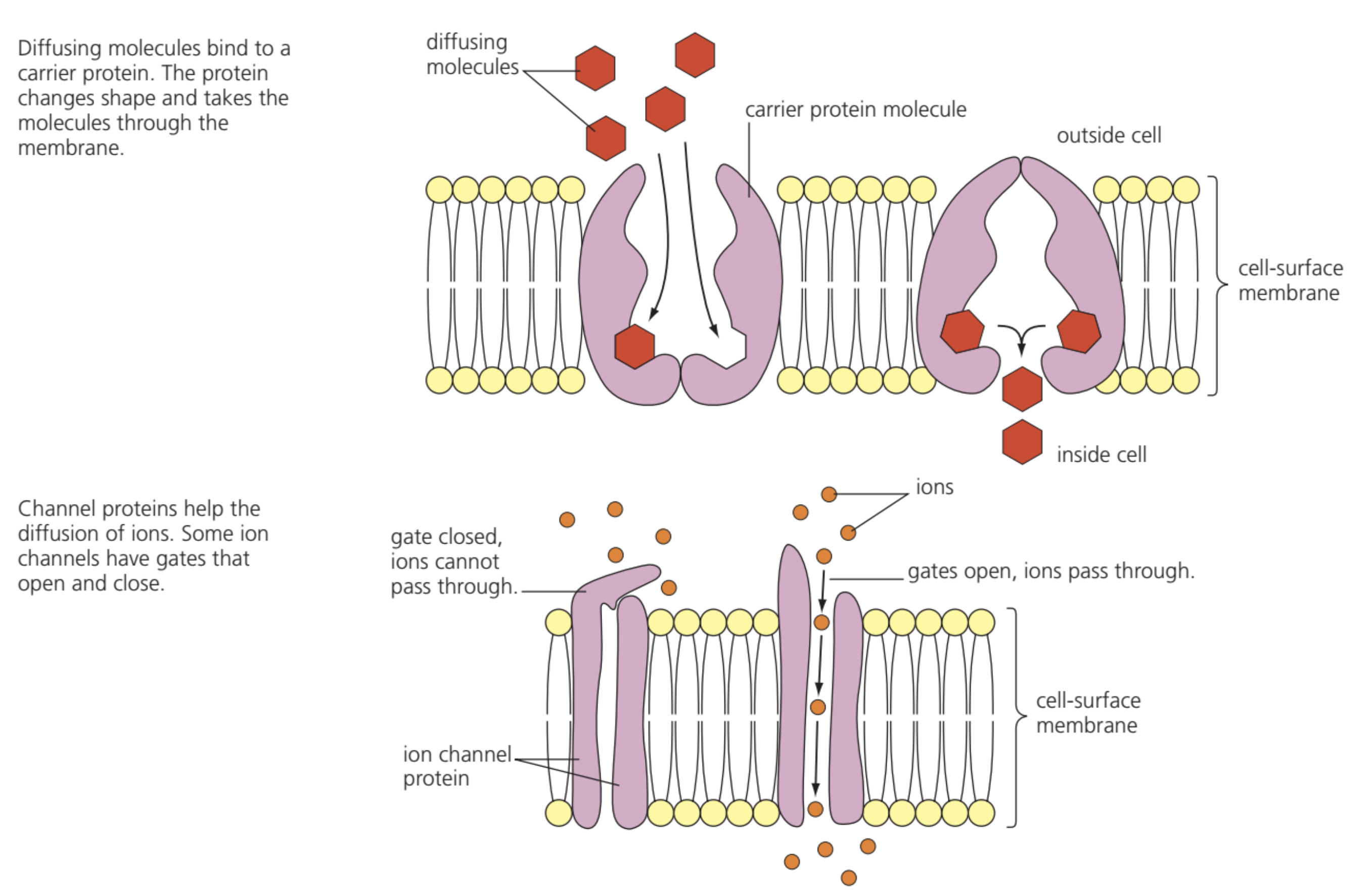
Protein channels create water-filled, hydrophilic pathways spanning the entire membrane. These channels exhibit selectivity, meaning each type opens only for specific ions.
Note
The channels operate through controlled mechanisms - they remain closed until the appropriate ion is present. When the correct ion binds to the channel protein, it triggers a conformational change that opens the channel on one side of the membrane while closing it on the other.
Carrier proteins
Carrier proteins offer an alternative facilitated diffusion mechanism. When a specific molecule (such as glucose) binds to its corresponding carrier protein, the protein undergoes a shape change that transports the molecule across the membrane.
Example
Transport Process Example: Glucose Transport
Step 1: Glucose molecule binds to specific carrier protein
Step 2: Protein undergoes conformational change
Step 3: Glucose is transported across membrane from high to low concentration
Step 4: Protein returns to original shape, ready for next transport cycle
This process requires no external energy input - the molecules move from high to low concentration areas using only their inherent kinetic energy. The carrier protein simply provides a pathway through the otherwise impermeable membrane.
Factors affecting diffusion rate
The rate of diffusion depends on several key factors:
- Concentration gradient - steeper gradients increase diffusion rate
- Temperature - higher temperatures increase particle kinetic energy
- Surface area - larger areas allow more diffusion to occur simultaneously
- Membrane thickness - thinner membranes reduce diffusion distance
- Molecular size - smaller molecules generally diffuse faster
Note
Understanding these factors helps explain why organisms have evolved specific adaptations like folded membranes in the small intestine (increased surface area) and thin alveolar walls (reduced diffusion distance).
Key differences between diffusion types
| Simple Diffusion | Facilitated Diffusion |
|---|---|
| No proteins required | Requires membrane proteins |
| Small, non-polar molecules only | Larger, polar molecules and ions |
| Direct through lipid bilayer | Through protein channels or carriers |
| Rate limited by membrane permeability | Rate can be limited by protein availability |
Important
Both types of diffusion are passive processes that move substances down their concentration gradients without requiring cellular energy input.
Links to other topics
Diffusion connects to several other A-Level biology concepts:
- Gas exchange in alveoli relies on simple diffusion of oxygen and carbon dioxide
- Root hair cells use facilitated diffusion for mineral ion uptake
- Photosynthesis depends on carbon dioxide diffusion into leaf cells
Remember!
Summary
Key Points to Remember:
- Diffusion is the net movement of particles down concentration gradients - individual particles still move randomly in all directions
- Both simple and facilitated diffusion are passive processes requiring no ATP input
- Facilitated diffusion uses specific membrane proteins but still moves substances down their concentration gradients
- Small, non-polar molecules like oxygen diffuse directly through membranes, while larger or charged molecules need protein assistance
- Diffusion rate increases with steeper concentration gradients and higher temperatures