Biodiversity within a Community (AQA A-Level Biology): Revision Notes
📚Revision Notes
Biodiversity within a Community
What is biodiversity?
Biodiversity describes the variety of life found in any given area. This concept encompasses three distinct but interconnected levels of biological variation that work together to create the complex web of life we observe in nature.
Note
Understanding biodiversity requires examining life at multiple scales - from the genes within individual organisms to the vast ecosystems they inhabit. Each level influences and depends upon the others.
The three components of biodiversity are:
- Species diversity - encompasses both the total number of different species present and the relative abundance of individuals within each species in a community
- Genetic diversity - represents the range of different genes and alleles found within the individuals that make up a population of a particular species
- Ecosystem diversity - covers the variety of different habitats and environments, ranging from small localised areas to entire global biomes
Species richness vs species diversity
Species richness provides a simple count of how many different species exist in a particular area at any given time. However, this measure alone can be misleading when comparing communities.
Example
Comparing Two Plant Communities
Consider two areas that both contain 25 different plant species:
Natural Meadow:
- 25 species in roughly equal proportions
- Each species contributes meaningfully to community structure
- Balanced distribution of individuals
Wheat Field:
- 25 species present technically
- Over 95% of plant biomass is a single wheat variety
- Remaining 24 species are rare weeds with minimal presence
This example illustrates why measuring species diversity (which accounts for both the number of species and their relative abundance) provides a more informative picture than species richness alone.
Measuring species diversity
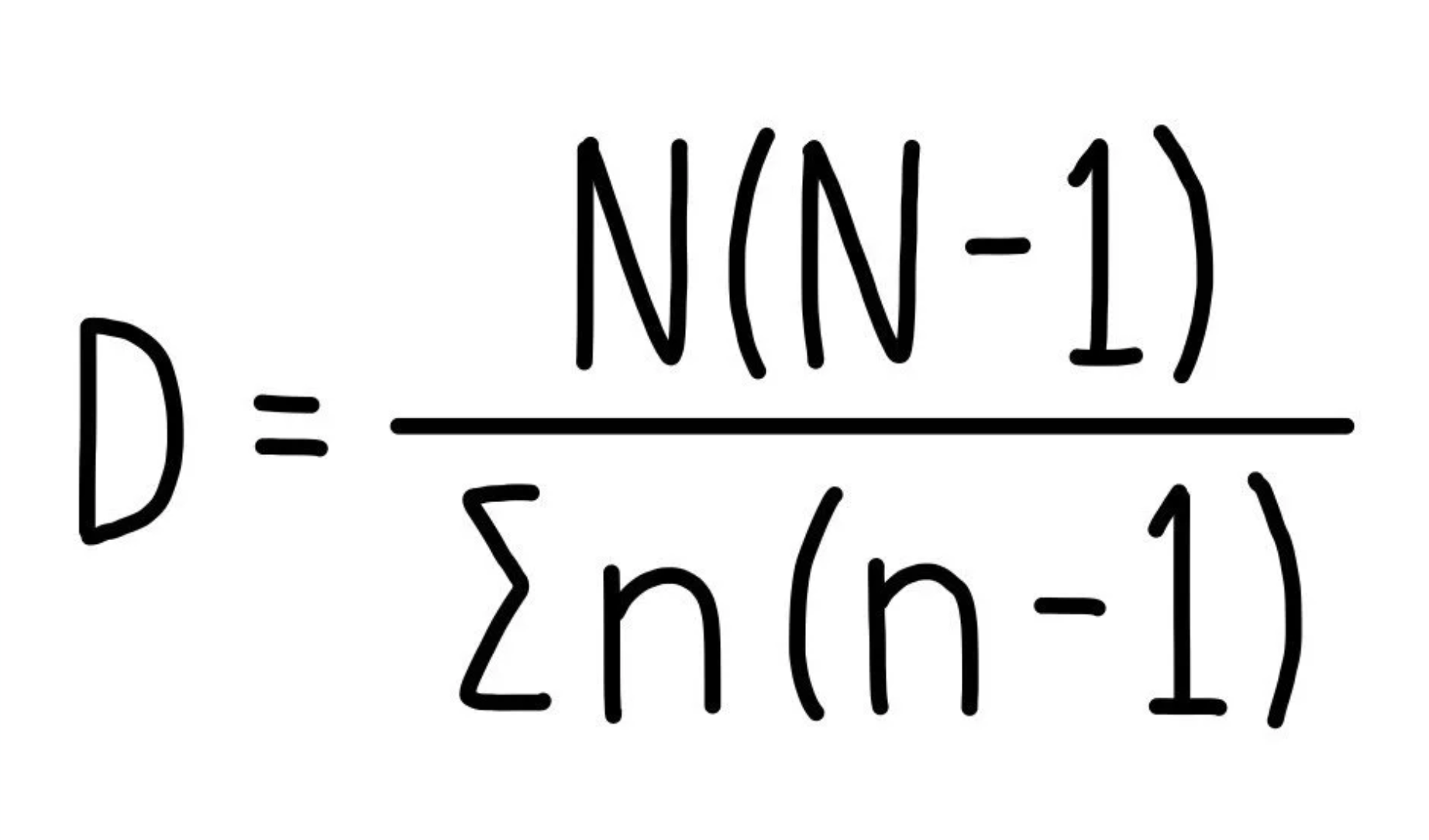
Scientists use mathematical indices to quantify and compare species diversity between different communities. The most commonly used formula is:
Where:
- d = index of diversity
- N = total number of organisms of all species combined
- n = total number of organisms of each individual species
- Σ = the sum of all calculations
Calculating the diversity index
Example
Step-by-Step Calculation Process
Step 1: For each species present, calculate where is the number of individuals of that species
Step 2: Add up all the values to get
Step 3: Calculate where is the total number of all organisms
Step 4: Divide by to get the diversity index
Interpreting diversity index values
The higher the calculated diversity index value, the greater the species diversity within that community. This quantitative approach allows for objective comparisons between different habitats or the same habitat over time.
Note
When two communities have identical numbers of species and total individuals, the community with more even distribution of individuals across species will have the higher diversity index. This reflects the biological reality that balanced communities tend to be more stable and resilient.
Species diversity and ecosystem stability
Ecosystem stability refers to how well an ecological community maintains its structure and function when faced with environmental pressures or changes.
The diversity-stability relationship
Communities with higher species diversity indices generally demonstrate greater ecological stability. This relationship exists because diverse ecosystems possess built-in resilience mechanisms.
Important
Why Diversity Enhances Stability:
- Diverse communities are more likely to contain species with varied environmental tolerances
- If environmental stress affects some species, others may compensate and maintain ecosystem function
- Multiple species can perform similar ecological roles, providing functional redundancy
Environmental extremes and diversity
In harsh environments such as hot deserts or arctic tundra, only species with specific adaptations can survive the extreme conditions. Consequently, these ecosystems typically show low species diversity indices.
Note
Characteristics of Unstable Ecosystems:
These environments are characterised by:
- Dominance by climatic factors rather than biological interactions
- Few species with highly specialised adaptations
- Vulnerability to further environmental change
In contrast, more temperate environments usually support higher species diversity, creating stable ecosystems where biological interactions between organisms drive community structure, environmental conditions are less extreme, and greater resilience to environmental fluctuations exists.
Community responses to environmental change
When environmental conditions change, communities with different diversity levels respond in markedly different ways:
- Low diversity communities show dramatic fluctuations in response to environmental change, with sharp increases and decreases in population sizes
- High diversity communities exhibit more gradual, buffered responses to the same environmental pressures
Important
This difference in response patterns explains why conservation efforts often focus on maintaining species diversity as a strategy for ecosystem preservation. Protecting biodiversity is essentially investing in ecosystem insurance.
Summary
Key Points to Remember:
- Biodiversity has three components: species diversity (number and abundance), genetic diversity (gene variety), and ecosystem diversity (habitat range)
- Species diversity considers both the number of different species and their relative abundance, making it more informative than simple species richness
- The diversity index formula provides a quantitative method for comparing biodiversity between communities
- Higher diversity index values indicate greater species diversity and typically correlate with increased ecosystem stability
- Environmental extremes limit species diversity, while moderate conditions generally support higher diversity and more stable ecosystems