Directional & Stabilising Selection (AQA A-Level Biology): Revision Notes
📚Revision Notes
Directional & Stabilising Selection
What is selection?
Selection is a process where organisms better suited to their environment are more likely to survive and reproduce, whilst those less well-adapted struggle to do so. Every organism faces selection pressures based on the environmental conditions present at the time. Different environmental factors favour different characteristics within populations, and the type of characteristics favoured determines the outcome of selection.
Most characteristics are controlled by multiple genes (polygenes) rather than single genes. These polygenic traits are heavily influenced by environmental factors, creating variation around a population mean. When this variation is plotted graphically, it produces a normal distribution curve.
Note
Environmental factors play a crucial role in shaping the expression of polygenic traits. This means that even organisms with similar genetic makeup can display different characteristics depending on the conditions they experience during development.
Selection can work in two main ways, each producing different effects on population characteristics.
Directional selection
Directional selection occurs when environmental conditions change, favouring individuals with characteristics at one extreme of the population distribution. These individuals possess phenotypes (observable physical and biochemical traits) that are better suited to the new conditions.
How directional selection works
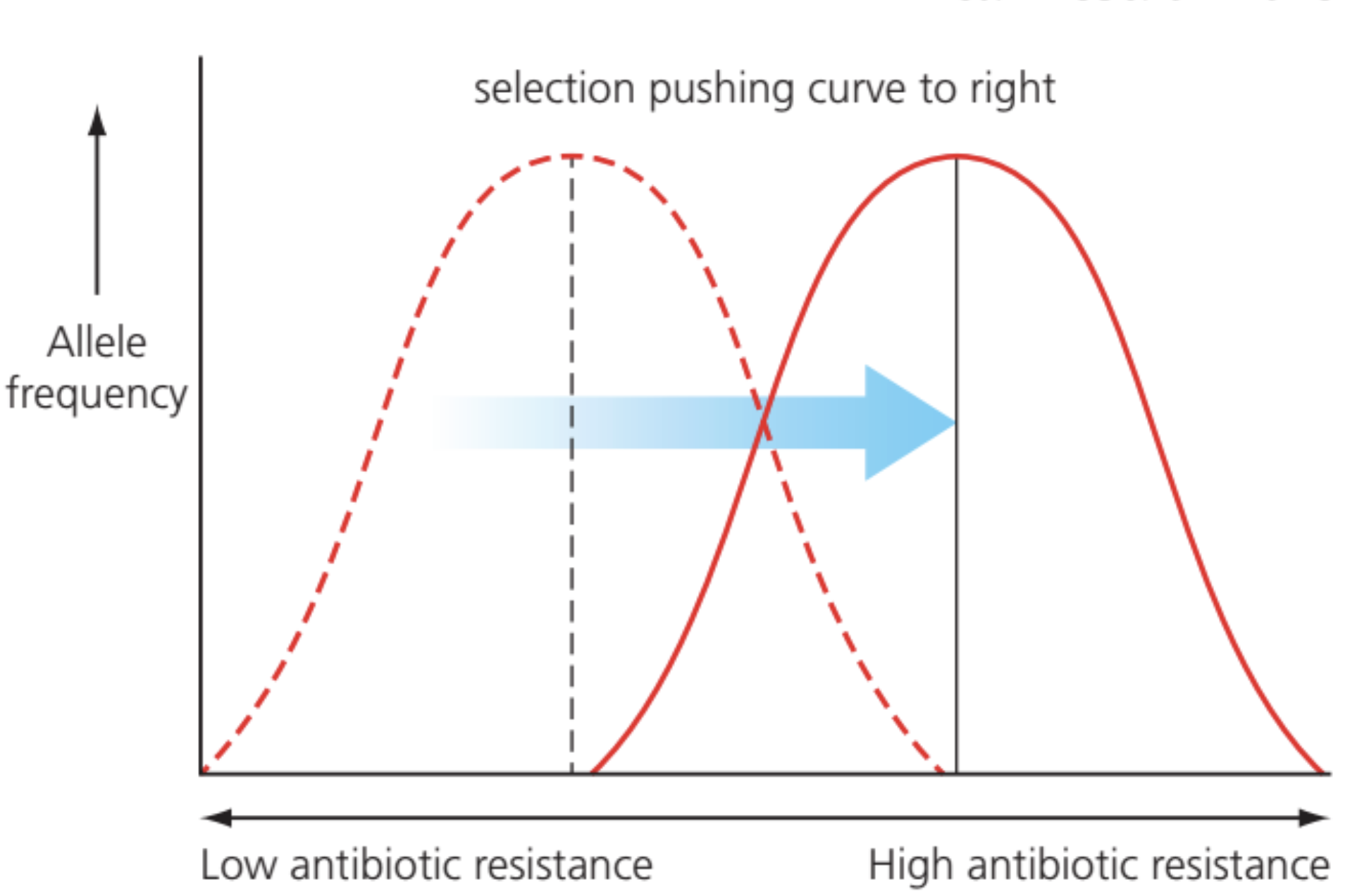
When environmental conditions shift, some individuals will have phenotypes that give them an advantage. These individuals are more likely to survive and breed successfully, passing their beneficial alleles to the next generation. Over time, this causes the population mean to move towards the favoured extreme.
Example
Worked Example: Antibiotic Resistance Development
The development of antibiotic resistance in bacteria demonstrates directional selection in action:
Step 1: Initial mutation - A spontaneous mutation occurs in bacterial DNA, creating an enzyme called penicillinase that can break down penicillin before it kills the bacterium.
Step 2: Selection pressure applied - When penicillin is used to treat infections, it creates a strong selection pressure against non-resistant bacteria.
Step 3: Survival advantage - Bacteria with the resistance mutation survive whilst others are killed by the antibiotic.
Step 4: Population shift - Resistant bacteria reproduce through binary fission, building up a population of penicillin-resistant organisms. Over time, the resistant population increases at the expense of the non-resistant population.
Step 5: Frequency change - The frequency of the resistance allele increases in the population, and the normal distribution curve shifts towards higher antibiotic resistance.
Important
It's crucial to understand that bacteria do not mutate because of antibiotic presence. Mutations occur randomly and are generally rare. However, when antibiotics are used frequently, any resistant mutants gain a significant survival advantage, allowing them to outcompete and replace the original population.
Stabilising selection
Stabilising selection operates when environmental conditions remain stable. In these situations, individuals with phenotypes closest to the population mean are favoured, whilst those at the extremes are selected against.
How stabilising selection works
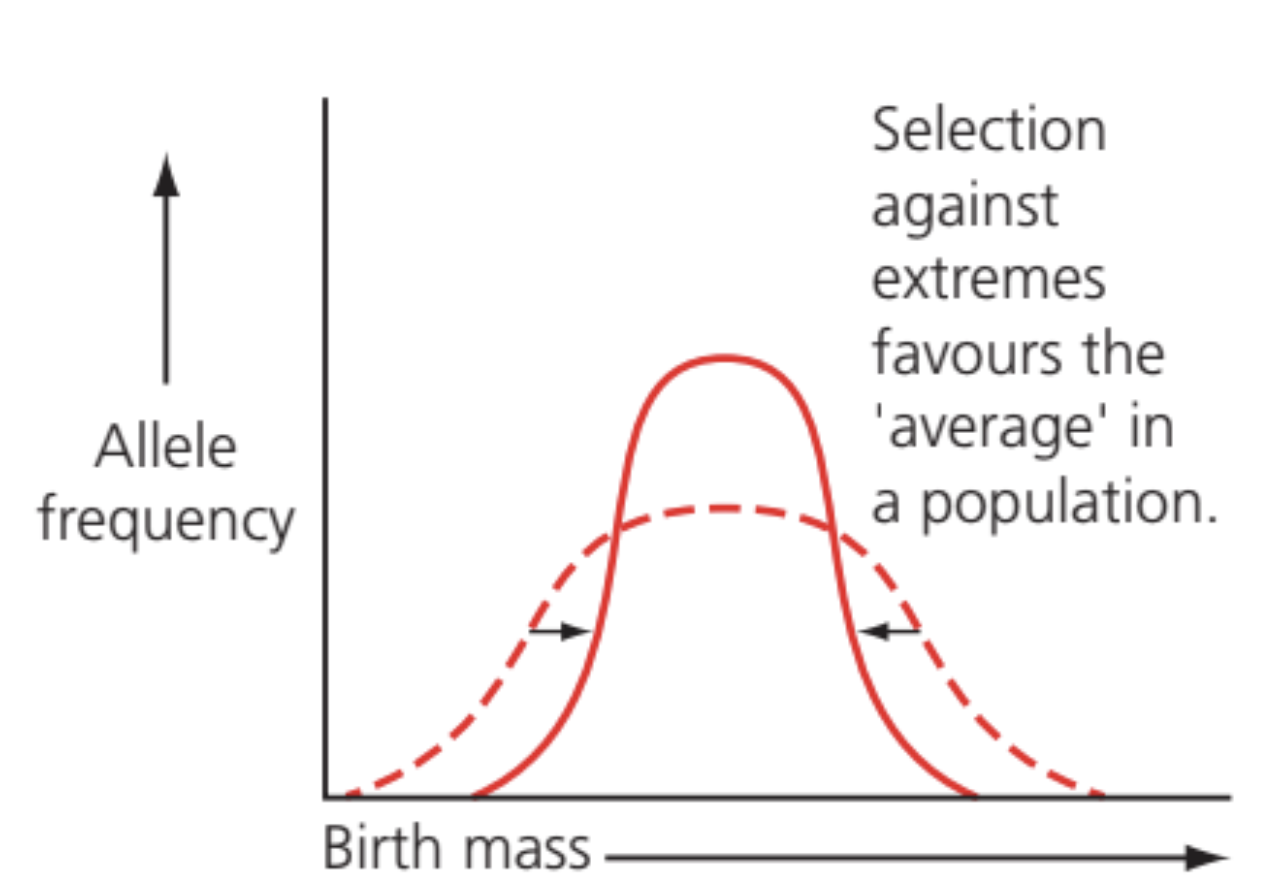
This type of selection tends to eliminate phenotypes at both extremes of the distribution. Individuals with average characteristics have the highest survival and reproduction rates, whilst those with extreme traits are less likely to pass on their alleles. This preserves the existing population characteristics rather than changing them.
Example
Worked Example: Human Birth Weight
Human birth weights provide a clear illustration of stabilising selection:
The pattern: Data collected over 12 years from hospital births shows that infant body mass follows a normal distribution, with most babies weighing between 2.5kg and 4.0kg at birth.
The selection pressure: Infant mortality rates are significantly higher at both extremes of birth weight. Babies weighing less than 2.5kg or more than 4.0kg face greater health risks and higher death rates during their first weeks of life.
The outcome: This creates selection pressure favouring babies with intermediate birth weights. The mortality data shows a clear U-shaped curve, with the lowest death rates occurring around the population mean birth weight.
The result: Stabilising selection maintains the narrow range of birth weights by selecting against both very low and very high birth weights. The peak of the distribution becomes higher and narrower, concentrating the population around the optimal birth weight.
Effects on population distribution
The two types of selection produce distinctly different changes to population characteristics:
Note
Key Differences in Selection Effects:
- Directional selection shifts the entire distribution curve towards one extreme, changing the population mean
- Stabilising selection makes the distribution curve taller and narrower, maintaining the same mean but reducing variation
Understanding these different patterns is essential for predicting how populations will respond to environmental changes.
Natural selection and adaptation
Natural selection through both directional and stabilising selection results in populations that are better adapted to their environment. These adaptations can be:
- Anatomical: Physical structural changes, such as shorter ears and thicker fur in Arctic foxes compared to foxes in warmer climates
- Physiological: Internal body function changes, like kangaroo rats producing concentrated urine to conserve water in desert environments
- Behavioural: Activity pattern changes, such as seasonal migration of swallows from the UK to Africa to avoid food shortages during winter
Summary
Key Points to Remember:
-
Selection favours organisms better adapted to their environment, whilst selecting against those that are poorly adapted
-
Directional selection shifts population characteristics towards one extreme when environmental conditions change - like antibiotic resistance development in bacteria
-
Stabilising selection preserves existing population characteristics by favouring average individuals when conditions remain stable - like optimal human birth weights
-
Both types of selection act on phenotypes but indirectly affect allele frequencies in subsequent generations
-
Selection results in populations becoming better adapted to their environment through anatomical, physiological, or behavioural changes