Structure of the Human Gas Exchange System (AQA A-Level Biology): Revision Notes
📚Revision Notes
Structure of the Human Gas Exchange System
Why mammals need specialised gas exchange systems
All aerobic organisms require a continuous oxygen supply to generate energy through ATP production during respiration. The carbon dioxide produced during this process must be efficiently removed to prevent harmful accumulation in the body.
Mammals face particular challenges with gas exchange due to two key factors:
Note
Key Challenges for Mammalian Gas Exchange:
- They are relatively large organisms containing a substantial volume of living cells that all require oxygen
- They maintain high body temperatures, which correlates with elevated metabolic rates and respiratory rates
The large volumes of oxygen needed and carbon dioxide that must be removed mean that simple diffusion across body surfaces would be inadequate. Therefore, mammals have evolved specialised gas exchange surfaces called lungs to ensure efficient gas exchange between the air and blood.
Gross structure of the human gas exchange system
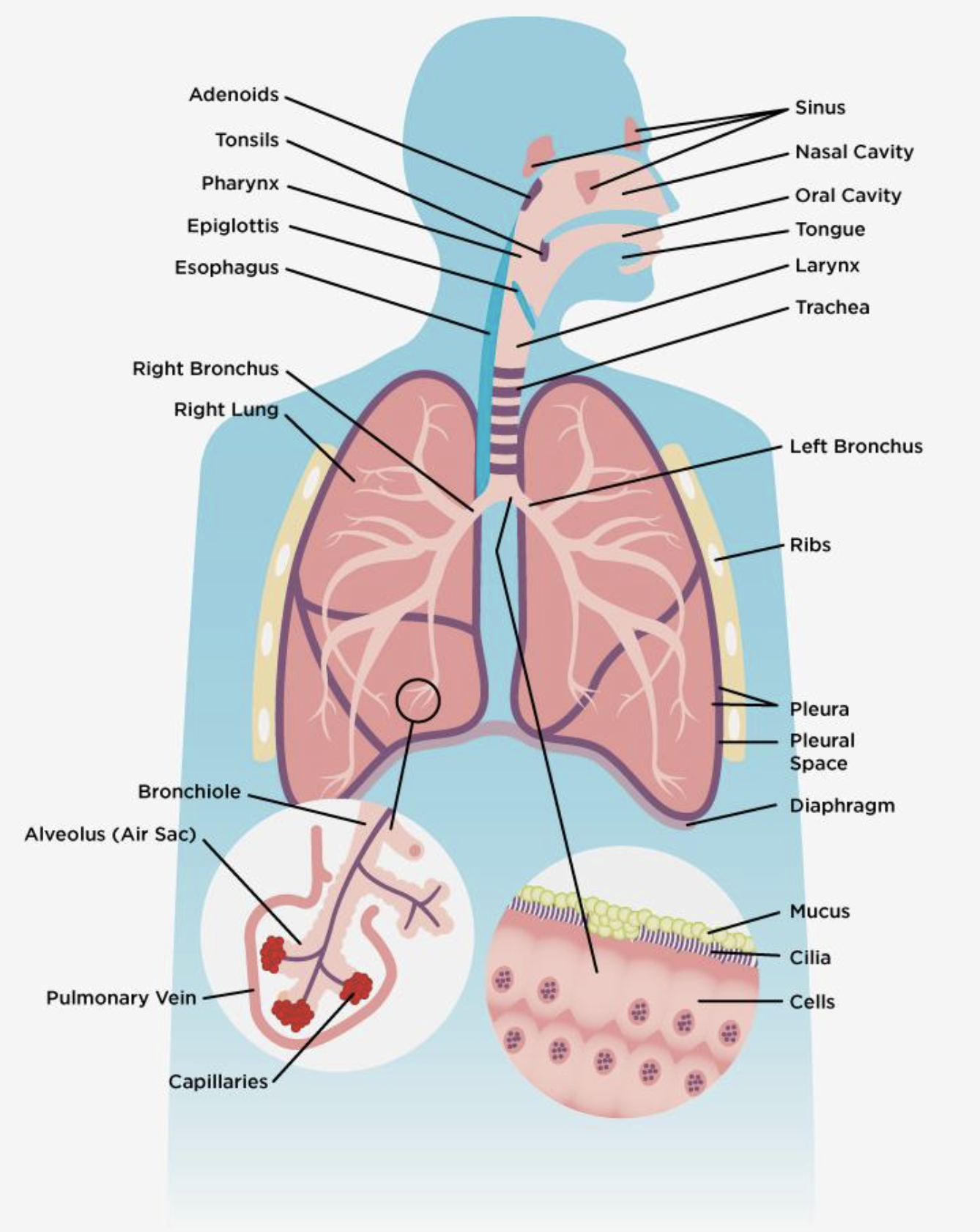
The human gas exchange system consists of a branching network of tubes that transport air from the external environment to microscopic gas exchange surfaces deep within the lungs.
The main pathway follows this sequence:
- Nasal cavity and nostril - where air enters and is warmed, filtered and moistened
- Trachea - the main airway leading from the throat towards the lungs
- Bronchi - left and right branches that divide from the trachea
- Bronchioles - smaller subdivisions that branch extensively throughout each lung
- Alveoli - tiny air sacs where gas exchange occurs
The entire system is supported and protected by the ribcage, a bony structure that can be moved by intercostal muscles to enable breathing movements.
Detailed structure of mammalian lungs
Note
Why are lungs positioned internally?
The lungs are positioned inside the body rather than externally because:
- Air is not sufficiently dense to support and protect these delicate structures
- Internal positioning prevents excessive water loss and desiccation of the gas exchange surfaces
The trachea
The trachea serves as the main airway connecting the throat to the lungs. Its key structural features include:
- Flexible construction that allows movement during breathing and swallowing
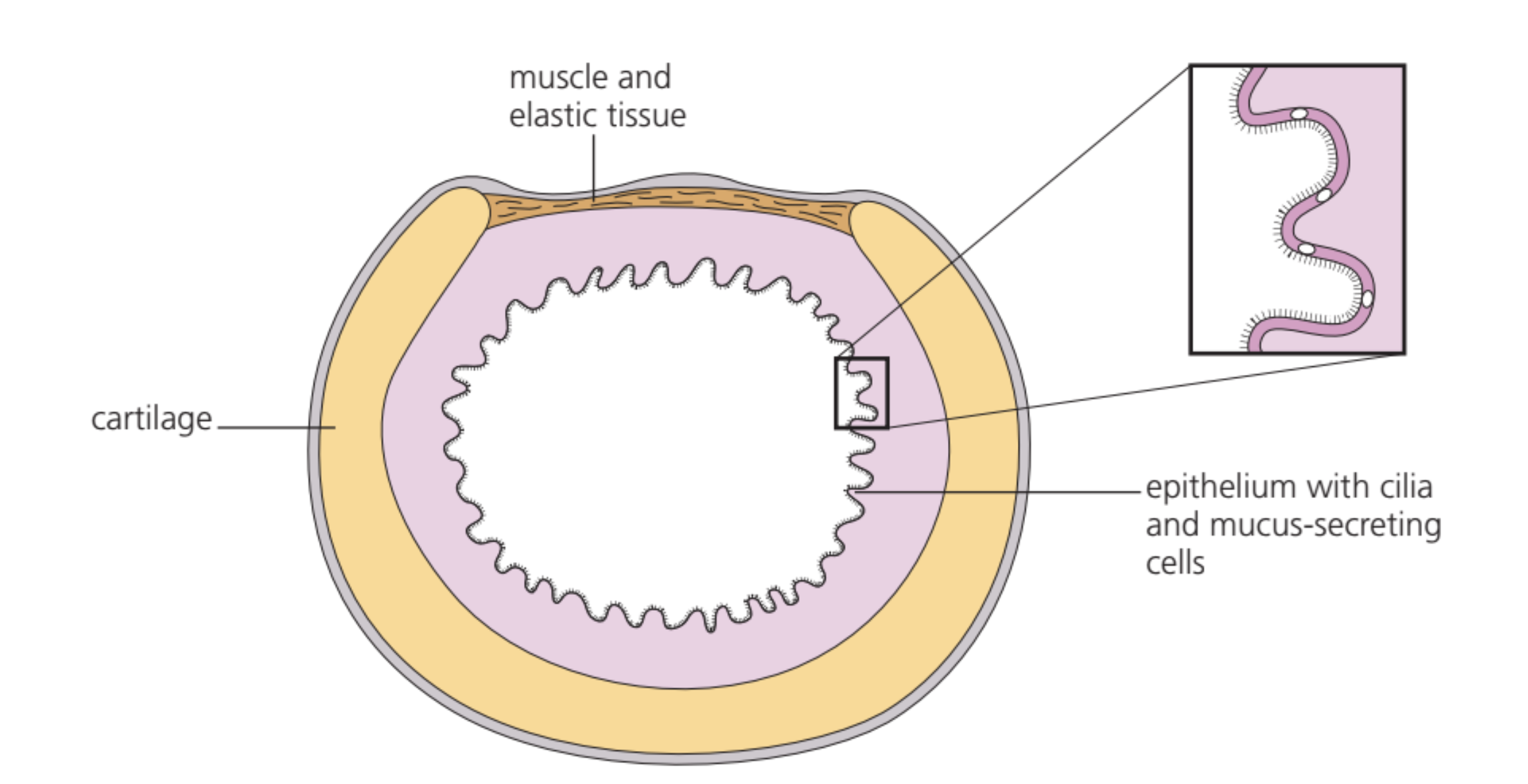
- Support provided by C-shaped rings of cartilage that prevent collapse when air pressure drops during inhalation
- Walls composed of muscle tissue lined with ciliated epithelium and goblet cells
- The ciliated cells have hair-like projections that sweep mucus upwards, while goblet cells produce the protective mucus that traps dust particles and pathogens
The bronchi
The trachea divides into left and right bronchi, each supplying one lung. The bronchi share similar structural features with the trachea:
- Cartilage support, though the amount of cartilage decreases as the bronchi become smaller
- Ciliated epithelium and mucus production for cleaning inspired air
- Muscle tissue in their walls
- Similar function in conducting air towards the gas exchange surfaces
The bronchioles
Bronchioles represent the extensive branching subdivisions of the bronchi within each lung. Their distinctive features include:
- Walls composed primarily of muscle lined with epithelial cells
- Ability to constrict and dilate, allowing control over airflow into and out of the alveoli
- Progressive reduction in diameter as they branch further
- No cartilage support in the smallest bronchioles
The alveoli
Alveoli are the primary gas exchange structures, appearing as minute air sacs at the terminal ends of the bronchiole network. Key characteristics include:
Important
Critical Features of Alveoli:
- Extremely small diameter between 100μm and 300μm
- The alveolar membrane forms the actual gas exchange surface where oxygen and carbon dioxide transfer occurs
- Extensive capillary networks surrounding each alveolus to transport gases to and from the bloodstream
- Walls containing collagen fibres for structural support and elastic fibres for flexibility
- Ability to stretch when filling with air during inspiration
- Elastic recoil during expiration that helps expel carbon dioxide-rich air
Key structural adaptations
The human gas exchange system demonstrates several important structural adaptations that ensure efficient gas exchange:
- Progressive branching creates an enormous total surface area for gas exchange
- Decreasing tube diameter ensures air reaches all regions of the lungs
- Cartilage support in larger airways prevents collapse while maintaining flexibility
- Muscular control in bronchioles allows regulation of airflow
- Cleaning mechanisms involving cilia and mucus protect the delicate alveolar surfaces
- Elastic properties of alveoli enable efficient ventilation through stretch and recoil
Summary
Key Points to Remember:
- Large mammals need specialised lungs because of their size and high metabolic rates
- Air travels through a branching system: trachea → bronchi → bronchioles → alveoli
- Cartilage rings support the trachea and bronchi but decrease in smaller airways
- Alveoli (100-300μm diameter) are the actual gas exchange surfaces
- The system combines structural support, cleaning mechanisms, and airflow control for efficient gas exchange