Principles of Homeostasis (AQA A-Level Biology): Revision Notes
📚Revision Notes
Principles of Homeostasis
What is homeostasis?
Homeostasis is the process by which organisms maintain a stable internal environment despite changes occurring in the external environment. This involves keeping the chemical composition, volume, and other characteristics of blood and tissue fluids within narrow, optimal ranges.
The internal environment consists of tissue fluids that surround each cell, providing nutrients and removing waste products. By maintaining these fluids at optimal levels, cells are protected from changes in the external environment, giving the organism greater independence.
Note
Homeostasis does not mean that conditions remain completely unchanged. Instead, small fluctuations occur around an optimum point due to variations in internal and external conditions such as temperature, pH, and water potential. The key ability is returning to that optimum point to maintain organisms in balanced equilibrium.
The importance of homeostasis
Homeostasis is essential for proper organism function for several reasons:
Enzyme and protein function: Enzymes that control biochemical reactions within cells, along with other proteins like channel proteins, are highly sensitive to changes in pH and temperature. Even small fluctuations can reduce enzyme activity rates or prevent them working entirely through denaturation. Maintaining a constant internal environment ensures reactions occur at suitable rates.
Important
Critical for Life: Changes to the water potential of blood and tissue fluids can cause cells to shrink or expand through osmosis. In extreme cases, cells may burst. Both situations prevent normal cellular function.
Maintaining constant blood glucose concentration is essential for ensuring stable water potential and providing a reliable glucose source for cellular respiration.
Environmental independence: Organisms capable of maintaining a constant internal environment are less dependent on external environmental changes. This allows them to occupy wider geographical ranges and increases their chances of finding food, shelter, and suitable habitats. For example, mammals can survive in environments ranging from hot deserts to frozen polar regions due to their ability to maintain constant body temperature.
Control mechanisms
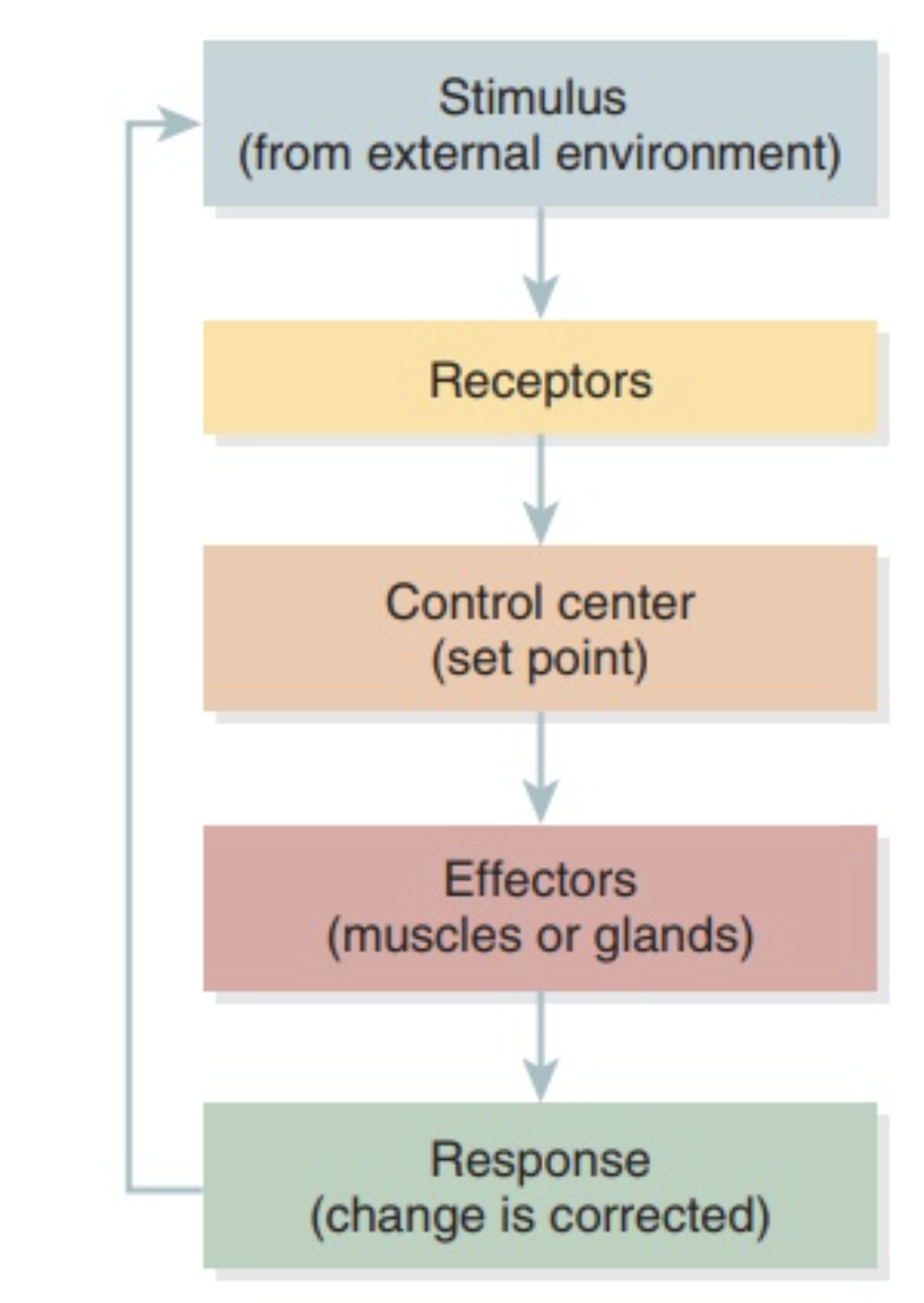
Homeostatic control systems operate through a series of components that work together:
- Optimum point: The ideal condition at which the system functions best. This is continuously monitored.
- Receptor: Detects any deviation from the optimum point by responding to stimuli and gathering information about changes.
- Coordinator: Processes information received from receptors and sends appropriate instructions to effectors. This coordination ensures the correct response occurs.
- Effector: Usually a muscle or gland that brings about the necessary changes to return the system to its optimum point. The response creates normality.
- Feedback mechanism: A process by which receptors respond to changes brought about by the effector's actions.
Example
Worked Example: Central Heating System Analogy
These components can be illustrated using a central heating system:
Step 1: Temperature drops below the set point (deviation from optimum)
Step 2: Thermostat (receptor) detects this change
Step 3: Programmer (coordinator) processes this information
Step 4: Boiler (effector) is activated, heating the radiators
Step 5: Room temperature rises until desired temperature is restored (feedback)
Coordination of control mechanisms
Most biological systems use negative feedback to maintain homeostasis. In negative feedback, changes produced by the control system lead to alterations in the stimulus detected by the receptor, which then turns the system off. This creates a self-regulating loop that maintains stability around the optimum point.
Note
Positive feedback occurs when a deviation from an optimum causes changes that result in an even greater deviation from normal conditions. While less common in homeostasis, positive feedback can be seen in neurone function, where a stimulus causes increased sodium ion permeability, allowing more ions to enter and causing further increases in permeability.
Control systems typically have multiple receptors and effectors, allowing separate mechanisms to produce positive movements towards an optimum. This provides greater control precision, with different factors being regulated simultaneously. Having separate mechanisms that control departures in different directions from the original state is a general feature of homeostasis.
The coordination of information is essential before action is taken. For example, temperature receptors in the skin may signal that the body is cold and temperature should be raised. However, information from the hypothalamus may indicate that body temperature is already above normal. The brain must analyse information from all receptors to decide the best course of action. Similarly, effectors must work together harmoniously - sweating would be ineffective for cooling the body if not accompanied by vasodilation (widening of blood vessels).
Summary
Key Points to Remember:
- Homeostasis maintains a stable internal environment within restricted limits, not completely constant conditions
- Enzyme function depends on stable pH and temperature - small changes can significantly reduce reaction rates
- Control systems have five key components: optimum point, receptor, coordinator, effector, and feedback mechanism
- Negative feedback is self-regulating - it turns the system off when the optimum is reached
- Multiple receptors and effectors work together to provide precise control and coordinate responses effectively