All-or-nothing Principle & the Refractory Period (AQA A-Level Biology): Revision Notes
📚Revision Notes
All-or-nothing Principle & the Refractory Period
All-or-nothing principle
The all-or-nothing principle describes how nerve impulses behave as complete responses rather than variable ones. This principle operates through a critical concept called the threshold value.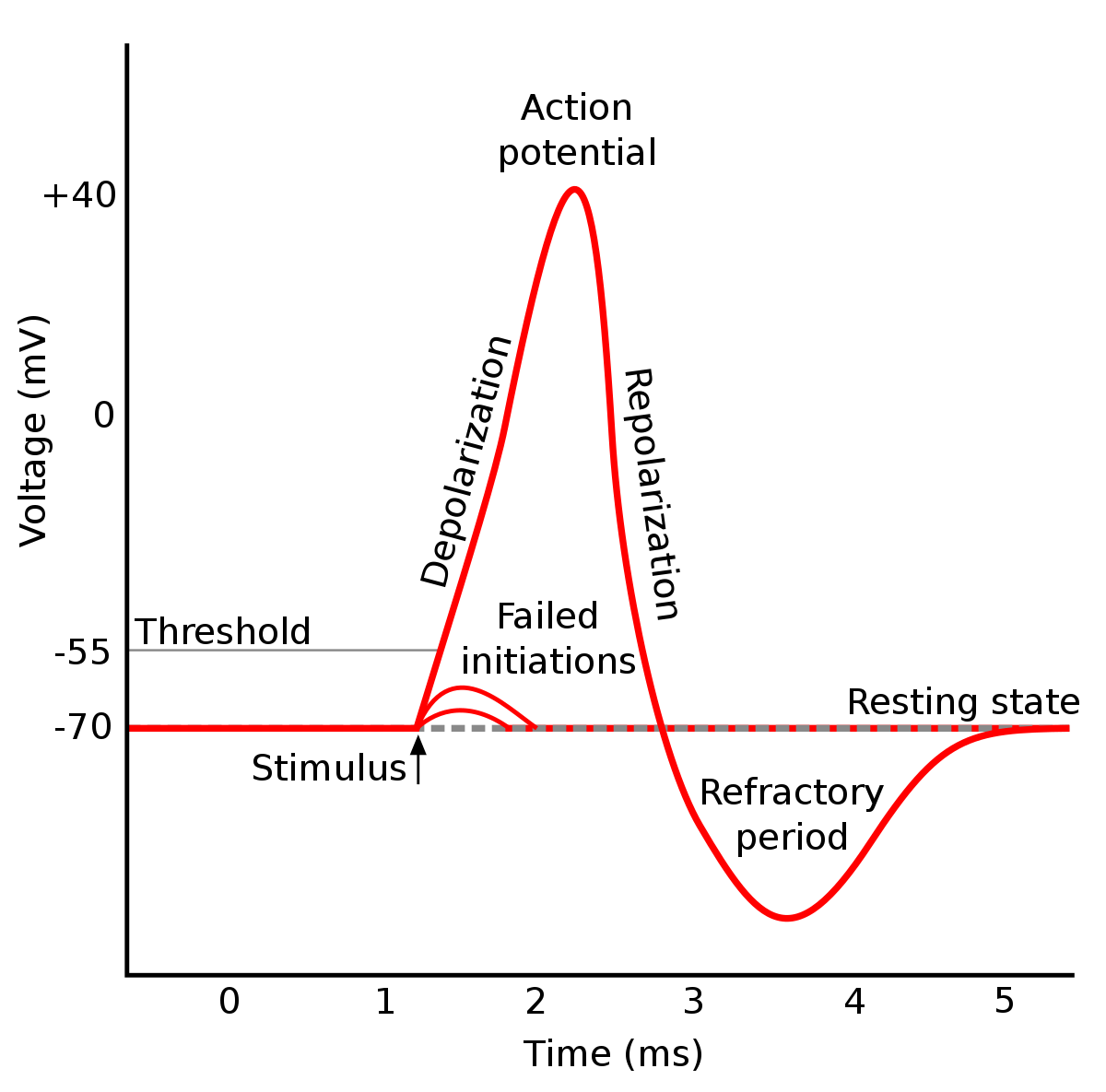
Important
When a stimulus reaches a neurone, it must achieve a specific minimum level of intensity called the threshold value to trigger an action potential. If the stimulus falls below this threshold, no action potential occurs and therefore no nerve impulse travels along the axon. However, once the threshold is exceeded, a full action potential is generated regardless of how much stronger the stimulus becomes.
This means that all action potentials produced by a neurone are essentially identical in size and strength. The stimulus strength cannot be determined by examining the size of individual action potentials since they are always the same magnitude.
Note
This is similar to a light switch - it's either completely on or completely off. There's no "halfway" setting for action potentials, just like you can't have a light bulb that's "sort of" illuminated.
How organisms detect stimulus intensity
Since all action potentials are identical, organisms have developed two methods to perceive different stimulus intensities:
Frequency coding: Stronger stimuli generate more action potentials within a given time period. A gentle touch might produce a few impulses per second, while a painful stimulus could generate many impulses in rapid succession.
Recruitment: Different neurones have varying threshold values. Weak stimuli may only activate neurones with low thresholds, while stronger stimuli recruit additional neurones with higher thresholds. The brain interprets the total number and types of active neurones to determine stimulus intensity.
Example
Practical Example: Detecting Pain Intensity
When you accidentally touch a hot surface:
- Light contact: Only a few neurones with low thresholds fire at a low frequency
- Firm contact: More neurones are recruited AND they fire at higher frequencies
- Your brain interprets both the number of active neurones and their firing rates to determine "this is very painful!"
The refractory period
After an action potential has been generated, the neurone enters a recovery phase called the refractory period. During this time, the voltage-gated sodium channels remain closed, making it impossible for another action potential to be triggered, regardless of stimulus strength.
Important
The refractory period occurs because the sodium channels that opened during depolarisation must reset before they can respond to another stimulus. This creates a brief window where the neurone is unresponsive to any incoming signals.
Functions of the refractory period
The refractory period serves three essential functions in nerve conduction:
Note
Ensures unidirectional propagation: Action potentials can only move forwards along the axon because the region behind each impulse is temporarily unresponsive. This prevents the impulse from travelling backwards and ensures signals reach their intended destination.
Note
Produces discrete impulses: By separating consecutive action potentials, the refractory period ensures that nerve signals remain distinct rather than merging together. This maintains the clarity of neural communication.
Note
Limits maximum frequency: The refractory period establishes an upper limit on how frequently action potentials can be generated. This limiting factor helps prevent the nervous system from becoming overwhelmed with excessive signals and maintains controlled neural communication.
Relationship between stimulus strength and impulse frequency
While individual action potentials cannot vary in size, the refractory period allows stimulus intensity to be encoded through timing. Stronger stimuli can overcome the refractory period more quickly in some neurones, leading to higher frequencies of impulses. This frequency modulation provides the nervous system with a method to convey information about stimulus strength while maintaining the reliability of the all-or-nothing response.
Summary
Key Points to Remember:
- The all-or-nothing principle means action potentials are either fully generated or not produced at all - there is no middle ground
- A threshold value must be reached before any nerve impulse can occur
- The refractory period is the recovery time when no new action potential can be generated
- Stimulus intensity is detected through impulse frequency and neurone recruitment, not impulse size
- The refractory period ensures impulses travel in one direction only and remain separate from each other