Neurones (AQA A-Level Biology): Revision Notes
📚Revision Notes
Neurones
Neurones (nerve cells) are specialised cells that have adapted to rapidly transmit electrochemical changes known as nerve impulses throughout the body. These cells form the basic functional units of the nervous system, enabling communication between different parts of an organism.
Structure of a motor neurone
A mammalian motor neurone consists of several distinct components, each serving a specific function in nerve impulse transmission.
Cell body
The cell body contains all the standard cellular organelles, including a nucleus and abundant rough endoplasmic reticulum. The high concentration of rough ER reflects the cell's active role in protein synthesis, particularly for producing neurotransmitters - the chemical messengers used in nerve signalling.
Dendrites and dendrons
Dendrons are extensions that branch out from the cell body, subdividing into smaller fibres called dendrites. These structures act as receiving stations, carrying incoming nerve impulses towards the cell body from other neurones or sensory receptors.
Note
The distinction between dendrons and dendrites is based on size: dendrons are the larger main branches extending from the cell body, while dendrites are the smaller, more numerous subdivisions that provide an increased surface area for receiving signals.
Axon
The axon is a single, elongated fibre that extends away from the cell body. This structure serves as the main transmission pathway, carrying nerve impulses away from the cell body towards target cells or other neurones.
Schwann cells and myelination
Schwann cells surround the axon, providing both protection and electrical insulation. These cells perform phagocytosis (removal of cellular debris) and contribute to nerve regeneration when damage occurs.
Many Schwann cells wrap around the axon multiple times, creating layers of membrane that form the myelin sheath. This covering is rich in myelin, a lipid that provides excellent electrical insulation. Neurones with this covering are called myelinated neurones.
Important
The myelin sheath is crucial for rapid nerve impulse transmission. Without proper myelination, nerve signals travel much slower and can become weakened, leading to various neurological disorders such as multiple sclerosis.
Nodes of Ranvier
Nodes of Ranvier are small gaps ( long) between adjacent Schwann cells where the myelin sheath is absent. These constrictions occur approximately every along the axon in humans and play a role in accelerating nerve impulse transmission.
Note
The regular spacing of nodes of Ranvier allows for a special type of conduction called "saltatory conduction," where the nerve impulse appears to "jump" from node to node, significantly increasing transmission speed.

Types of neurones
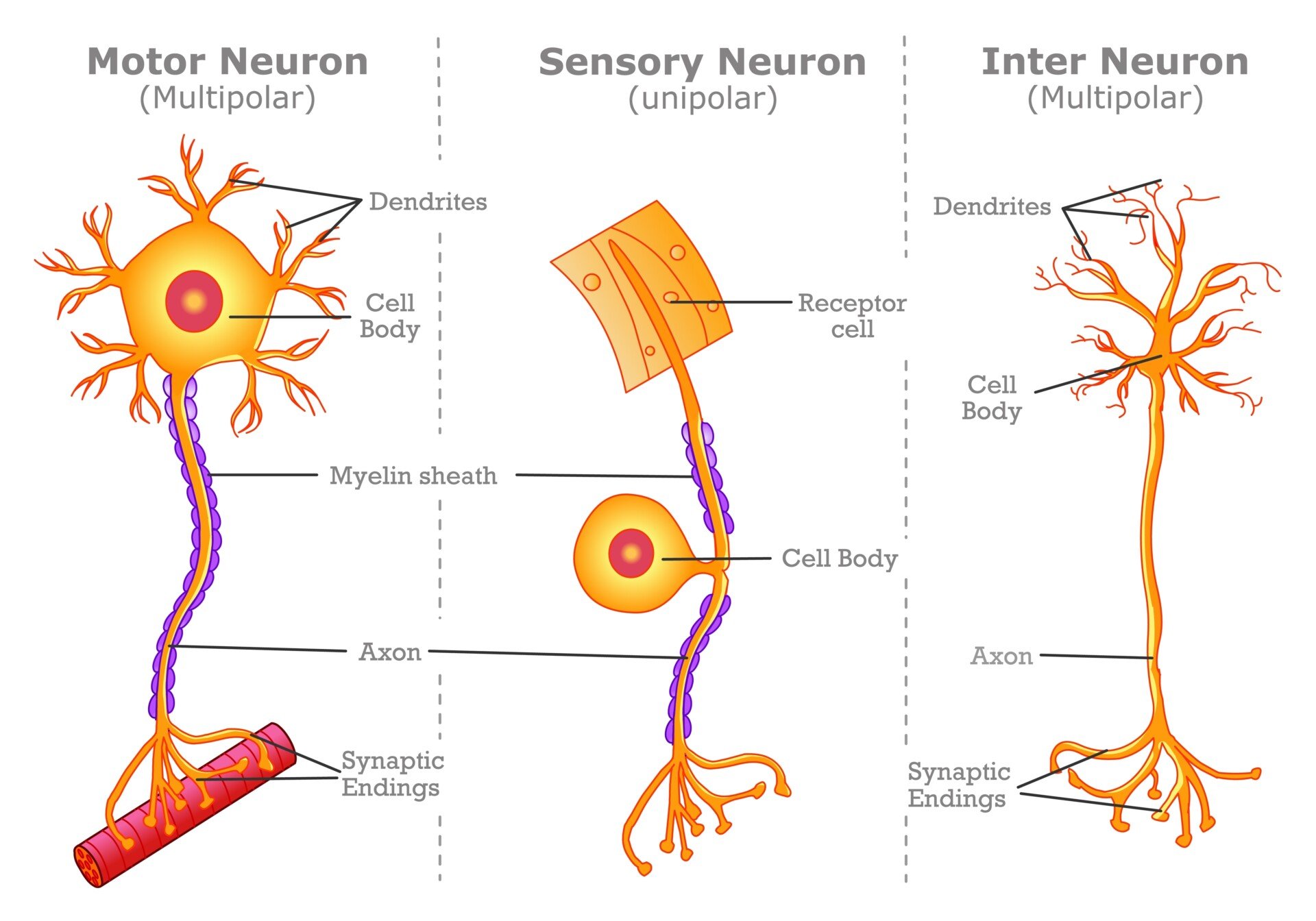
Neurones can be classified into three main functional categories based on their role in the nervous system.
Sensory neurones
Sensory neurones transmit nerve impulses from a receptor (such as those in sense organs) to either an intermediate neurone or directly to a motor neurone. These neurones typically have one very long dendron that carries impulses towards the cell body, and a shorter axon that carries impulses away from the cell body.
Motor neurones
Motor neurones carry nerve impulses from an intermediate or relay neurone to an effector (such as a muscle or gland). These neurones are characterised by having a long axon and multiple short dendrites, allowing them to receive signals from many other neurones whilst transmitting to distant target organs.
Intermediate neurones
Intermediate neurones (also called relay neurones) function as connectors within the nervous system, transmitting impulses between other neurones. For example, they link sensory neurones to motor neurones in reflex pathways. These neurones have numerous short processes, reflecting their role in integrating information from multiple sources.
Important
The direction of impulse transmission always flows from dendrites towards the axon, ensuring organised and coordinated nervous system function. This unidirectional flow is essential for proper nervous system operation.
Example
Worked Example: Reflex Arc Pathway
Step 1: Stimulus detection - A sensory receptor detects a stimulus (e.g., touching a hot object)
Step 2: Sensory transmission - The sensory neurone carries the impulse from the receptor to the spinal cord
Step 3: Integration - An intermediate neurone in the spinal cord processes the signal
Step 4: Motor response - A motor neurone carries the impulse to an effector muscle
Step 5: Response - The muscle contracts to withdraw from the stimulus
Summary
Summary
Key Points to Remember:
-
Neurones are specialised cells adapted for rapid transmission of electrochemical nerve impulses throughout the body
-
The myelin sheath formed by Schwann cells provides electrical insulation, with nodes of Ranvier acting as gaps that enhance transmission speed
-
Sensory neurones carry impulses from receptors, motor neurones transmit to effectors, and intermediate neurones connect different parts of the nervous system
-
The cell body contains abundant rough ER for neurotransmitter production, while dendrites receive signals and the axon transmits them away
-
All neurones follow the same directional flow: impulses travel from dendrites through the cell body to the axon terminal