Reflex Arc (AQA A-Level Biology): Revision Notes
📚Revision Notes
Reflex Arc
What is a reflex arc?
A reflex arc represents the simplest type of nervous response to a stimulus. It describes the pathway that nerve impulses follow to produce an involuntary response to a sensory stimulus.
When you immediately withdraw your hand after touching something hot or sharp, you demonstrate a reflex response. This reaction happens without conscious thought - by the time your brain processes the danger, your muscles have already moved your hand away from harm. This type of automatic response to a sensory stimulus is called a reflex.
Example
Real-Life Example: The Hot Stove Reflex
Imagine you accidentally touch a hot stove burner:
- Your temperature receptors instantly detect the heat
- Nerve impulses race through your sensory neurone to your spinal cord
- An intermediate neurone in your spinal cord immediately connects to a motor neurone
- The motor neurone sends impulses to your arm muscles
- Your hand jerks away from the stove - all before you even consciously realise what happened!
This entire process takes just milliseconds, protecting you from serious burns.
Structure of a reflex arc
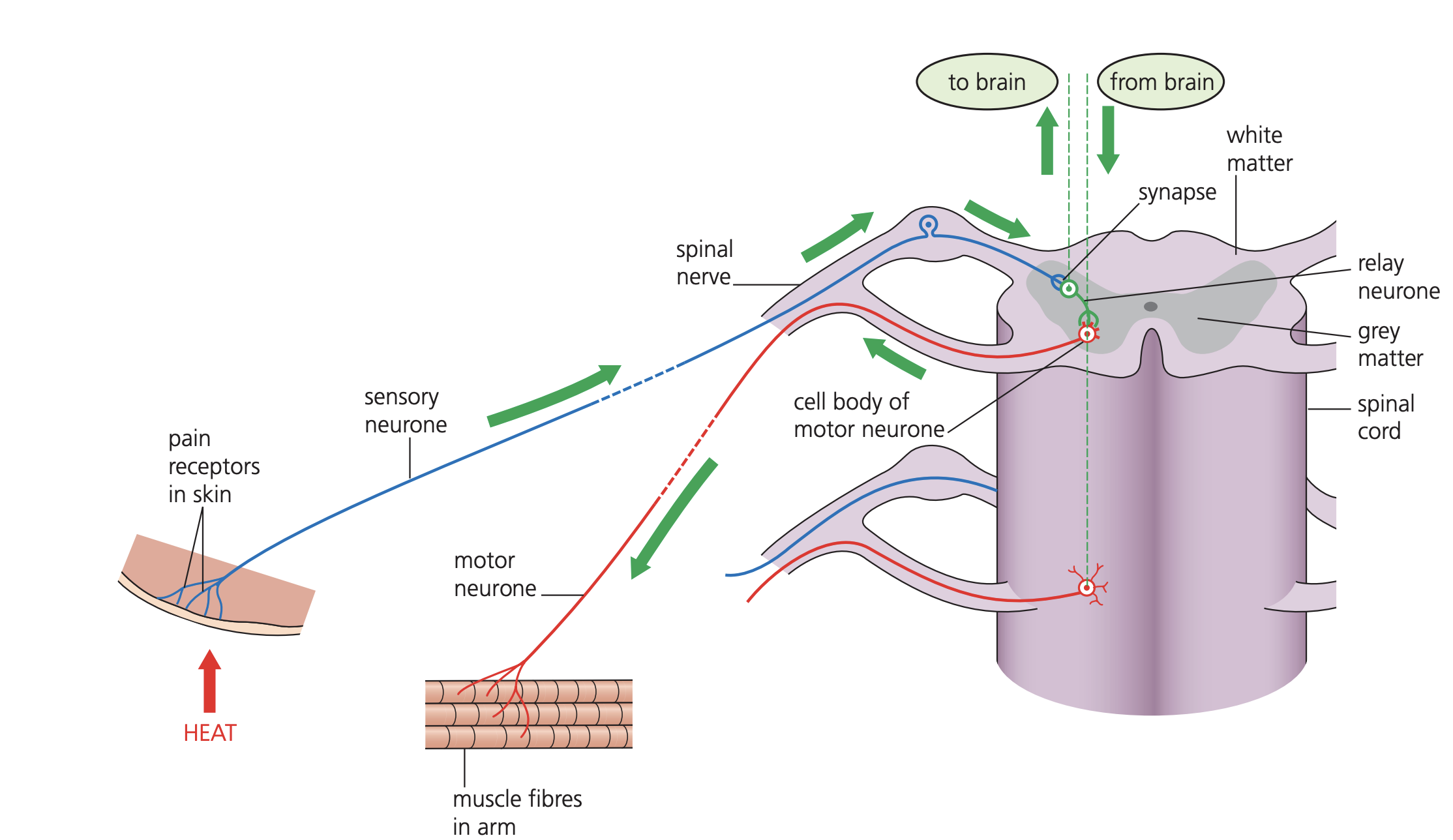
Most reflex arcs involve just three neurones and occur entirely within the spinal cord, making them spinal reflexes. The spinal cord is a column of nervous tissue running along the back, protected inside the vertebral column. Pairs of nerves emerge at intervals along the spinal cord.
Important
The simplicity of reflex arcs - using only three neurones - is what makes them so incredibly fast and reliable. This minimal pathway reduces delays and ensures consistent protective responses.
The seven stages of a reflex arc
The reflex arc follows a precise sequence of events that can be broken down into seven distinct stages. Each stage plays a crucial role in ensuring the fastest possible response to potentially harmful stimuli.
Example
Worked Example: The Withdrawal Reflex from a Hot Object
Let's trace each stage using the withdrawal reflex:
Stage 1: Stimulus - heat from the hot object
Stage 2: Receptor - temperature receptors in the skin detect the heat and generate nerve impulses
Stage 3: Sensory neurone - carries nerve impulses from the receptor to the spinal cord
Stage 4: Coordinator (intermediate neurone) - located in the spinal cord, this neurone links the sensory neurone to the motor neurone
Stage 5: Motor neurone - carries nerve impulses from the spinal cord to the effector muscle
Stage 6: Effector - the muscle in the upper arm contracts in response to the nerve impulses
Stage 7: Response - the hand moves quickly away from the hot object
Complete pathway: Stimulus → Receptor → Sensory neurone → Intermediate neurone → Motor neurone → Effector → Response
Why reflex arcs are important
Reflex arcs provide several crucial survival advantages that have been refined through millions of years of evolution. These automatic responses form an essential protective mechanism that operates independently of conscious thought.
Speed of response
Reflex pathways are extremely fast because they involve very few synapses (typically one or two). Synapses are the slowest part of any nerve pathway, so minimising them increases response speed dramatically. No decision-making process occurs, making the response immediate and consistent.
Note
A typical reflex response takes only 50-100 milliseconds from stimulus to response - faster than the blink of an eye!
Protection from harm
Reflexes protect the body from damage and work effectively from birth. They don't require learning or conscious control, making them reliable protective mechanisms. Examples include withdrawal from pain, blinking when objects approach the eye, and the knee-jerk response when tendons are tapped.
Brain efficiency
Reflexes are involuntary and don't require the brain's decision-making processes. This leaves the brain free to handle more complex responses and thoughts without being overwhelmed by routine protective responses.
Important
While reflexes operate automatically, some impulses are still sent to the brain for awareness. This allows the brain to override reflexes if necessary - for example, a doctor might suppress the withdrawal reflex when giving an injection.
The brain isn't overloaded with situations requiring the same obvious response, allowing it to focus computational power on complex problem-solving and decision-making tasks.
Automatic protection
Reflexes ensure consistent protective responses even when tired, distracted, or unconscious. They provide a reliable first line of defence against harmful stimuli, operating 24/7 without conscious effort or attention.
Summary
Key Points to Remember:
- Reflex arcs are the simplest nervous pathways that produce involuntary responses to stimuli
- The pathway involves seven stages: stimulus, receptor, sensory neurone, intermediate neurone, motor neurone, effector, and response
- Most reflex arcs use only three neurones and occur in the spinal cord as spinal reflexes
- Reflexes are fast because they involve minimal synapses and no conscious decision-making
- They provide essential protection from harm while allowing the brain to focus on complex tasks
- Reflexes work automatically and don't require learning or conscious control
- The brain can still override reflexes when necessary for more complex situations