Abstract Algebra (AQA A-Level Further Maths): Revision Notes
📚Revision Notes
Binary Operations
Introduction to sets and elements
In abstract algebra, one of the most important concepts is that of a set. A set consists of distinct objects, which we call elements. Sets can be finite (containing a specific number of elements) or infinite (containing unlimited elements).
For example, the set {1, 2, 3, 4, 5} is finite with five elements, while the set of natural numbers, ℕ, contains infinitely many elements: {1, 2, 3, 4, ...}.
Important number sets
You'll frequently work with these standard sets:
Note
Standard Number Sets:
- ℕ represents the set of natural numbers (the counting numbers): {1, 2, 3, 4, ...}
- ℤ represents the set of integers (positive or negative whole numbers, including zero): {0, ±1, ±2, ±3, ...}
- ℤ⁺ is the set of positive integers: {1, 2, 3, 4, ...}
- ℤ⁻ is the set of negative integers: {-1, -2, -3, -4, ...}
- ℚ is the set of rational numbers: numbers that can be written as for some integers and (where )
- ℝ is the set of real numbers
Note that irrational numbers (such as ) cannot be expressed as and are therefore not in ℚ, but they are in ℝ.
What is a binary operation?
A binary operation is a function that takes two inputs from a set and produces a single output. Common examples include addition () and multiplication () on the set ℕ.
However, not every function with two inputs qualifies as a binary operation on a particular set. For a function to be a binary operation on a set, it must satisfy a crucial property called closure.
Important
Definition: A function is a binary operation on a set if it can be applied to any two elements of the set so that the result is also a member of the set.
This means that when you combine any two elements from the set using the operation, you must always get another element that belongs to the same set.
Worked example 1: Determining if operations are binary operations
Example
Worked Example: Checking for Binary Operations
Question: Which of these functions are binary operations on the set ℤ?
a)
b)
Solution:
Part a: For subtraction on ℤ
Any two integers can be subtracted to give another integer. For example:
- (which is in ℤ)
- (which is in ℤ)
Since the result always stays within ℤ, subtraction is a binary operation on ℤ.
Part b: For division on ℤ
Division does not, in general, produce a member of ℤ. Consider the example:
- and
Since is not an integer, it's not a member of ℤ. Additionally, division by zero is undefined, which further prevents this from being a binary operation.
Therefore, is not a binary operation on ℤ.
Exam tip: When checking if something is a binary operation, you only need one counter-example to prove it isn't. However, to prove it is a binary operation, you must show it works for all possible pairs of elements.
Properties of binary operations
Binary operations can have special properties that make them particularly useful in mathematics. The two most important properties are commutativity and associativity.
Commutativity
A binary operation is commutative if the order in which you apply the operation doesn't matter.
Important
Definition: A binary operation is commutative if for all and in the set.
Addition on ℕ is commutative because . However, subtraction is not commutative because but , and these are different.
Worked example 2: Testing for commutativity
Example
Worked Example: Testing Commutativity
Question: Which of these binary operations on the set ℕ are commutative?
a)
b)
Solution:
Part a: Testing
To test commutativity, we need to check if for all values of and in ℕ.
Let's try a counter-example: and
Since , we have in general.
Therefore, is not commutative.
Part b: Testing
Addition of natural numbers is commutative because the sum doesn't depend on the order. For any :
Therefore, is commutative.
Exam tip: To prove an operation is NOT commutative, give a single counter-example. To prove it IS commutative, you must show it works for all possible pairs (often using algebraic reasoning).
Associativity
A binary operation is associative if the way you group elements doesn't affect the result.
Important
Definition: A binary operation is associative if for all , , and in the set.
Addition is associative because . The grouping doesn't matter.
Worked example 3: Testing for associativity
Example
Worked Example: Testing Associativity
Question: Which of these binary operations on ℝ is associative?
a)
b)
Solution:
Part a: Testing
We need to check if .
Left side:
- First, calculate
- Then,
Right side:
- First, calculate
- Then,
Comparing: in general.
Therefore, is not associative.
Part b: Testing
Multiplication of real numbers is associative:
Since these are equal, is associative.
Special elements in binary operations
Certain elements within a set can have special relationships with a binary operation. The most important are identity elements and inverse elements.
Identity elements
An identity element is a special element that leaves all other elements unchanged when combined with them.
Important
Definition: The identity element, , of a set under an operation is such that for all values of in the set.
For example:
- Under addition, the identity element is 0 because
- Under multiplication, the identity element is 1 because
Note
Important property: The identity element for a binary operation is always unique. This can be proven as follows:
Suppose a binary operation has two identity elements, and , on set .
Since is an identity element:
Since is an identity element:
Therefore:
This proves that the identity element must be unique.
Inverse elements
An inverse element combines with another element to produce the identity element.
Important
Definition: The inverse, , of an element under an operation is such that , where is the identity element.
For example, under multiplication on the real numbers (excluding 0):
- The identity element is 1
- The inverse of 4 is because
Note
Not every element necessarily has an inverse. For instance, under multiplication on ℝ, the number 0 has no inverse because you cannot multiply any number by 0 to get 1.
Self-inverse elements
An element is self-inverse if it is its own inverse.
Important
Definition: An element is a self-inverse if .
This means that (the identity element).
For example, under multiplication:
- The number 1 is self-inverse because
- The number -1 is self-inverse because
Worked example 4: Finding identity and inverse elements
Example
Worked Example: Finding Identity and Self-Inverse Elements
Question: The binary operation is defined by on the set ℚ.
a) Find the identity element of the set ℚ under .
b) Which element of ℚ is self-inverse under ?
Solution:
Part a: Finding the identity element
The identity element must satisfy for all in ℚ.
Using our operation:
This means:
Therefore:
We can verify: ✓
The identity element is 0.
Part b: Finding the self-inverse element
For an element to be self-inverse, we need .
Since , we need:
Using our operation:
Therefore:
So:
The only self-inverse element is 0.
Exam tip: When finding identity or inverse elements, always start with the defining equation and work algebraically. Remember that the identity element must work for all elements in the set.
Cayley tables
For finite sets, we can represent a binary operation visually using a Cayley table (named after the 19th-century mathematician Arthur Cayley). This table shows the result of applying the operation to all possible pairs of elements.
Important
Definition: A Cayley table is a grid displaying the result of a binary operation applied to all possible pairs of elements from a finite set.
How to read a Cayley table
The convention for reading a Cayley table is:
- Take the first element from the left-hand column
- Take the second element from the top row
- Find where the row and column intersect to see the result
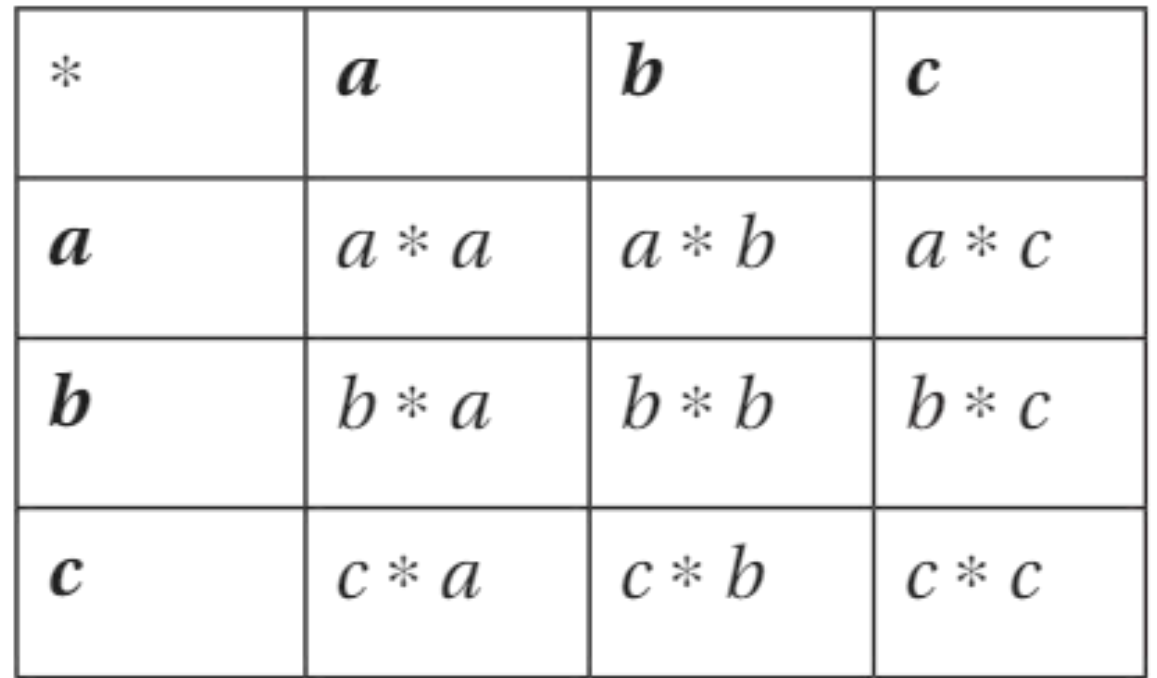
In this Cayley table for operation on the set , to find , you:
- Look at the row starting with
- Look at the column headed by
- Find where they intersect:
Example: Multiplication table
Here's the Cayley table for the set under multiplication:
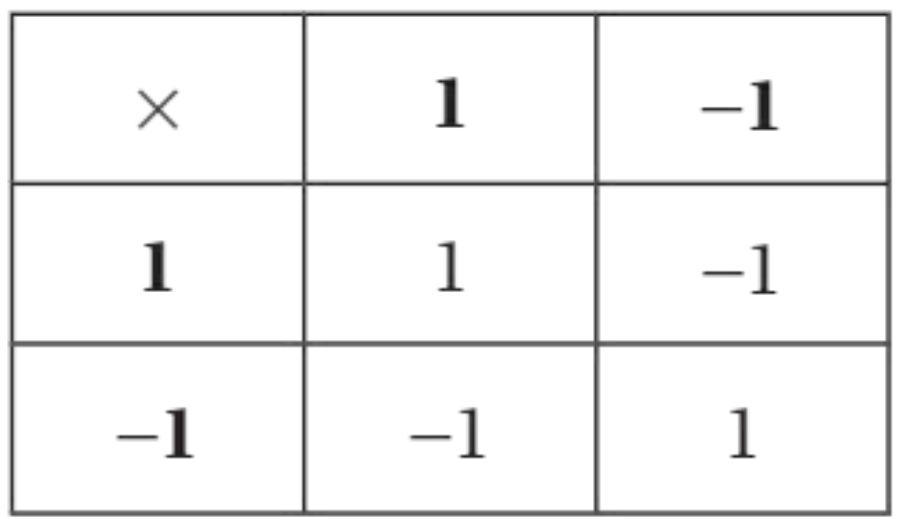
This table shows, for example, that and .
Finding the identity element from a Cayley table
To find the identity element from a Cayley table:
Note
Steps to Find the Identity Element:
- Look for a column that is identical to the initial column of elements (the leftmost column)
- The element at the top of this column is the identity element
- Also check the corresponding row - it should be identical to the initial row
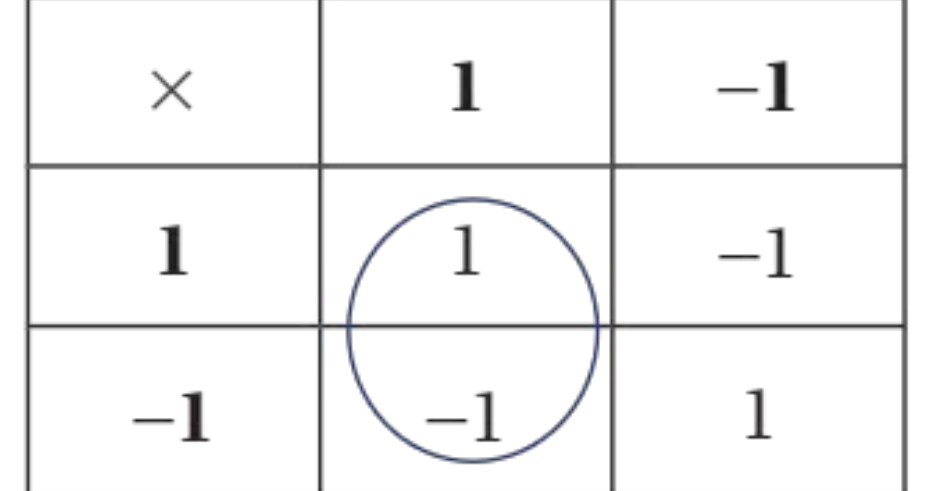
In this table, the column headed by 1 matches the initial column of elements {1, -1}, and the row for 1 also matches the initial row. Therefore, 1 is the identity element.
Finding inverse elements from a Cayley table
Once you've identified the identity element, you can find inverses:
Note
Steps to Find Inverse Elements:
- Locate all instances of the identity element within the table
- For each element in a row, find where the identity element appears in that row
- The element at the top of that column is the inverse of
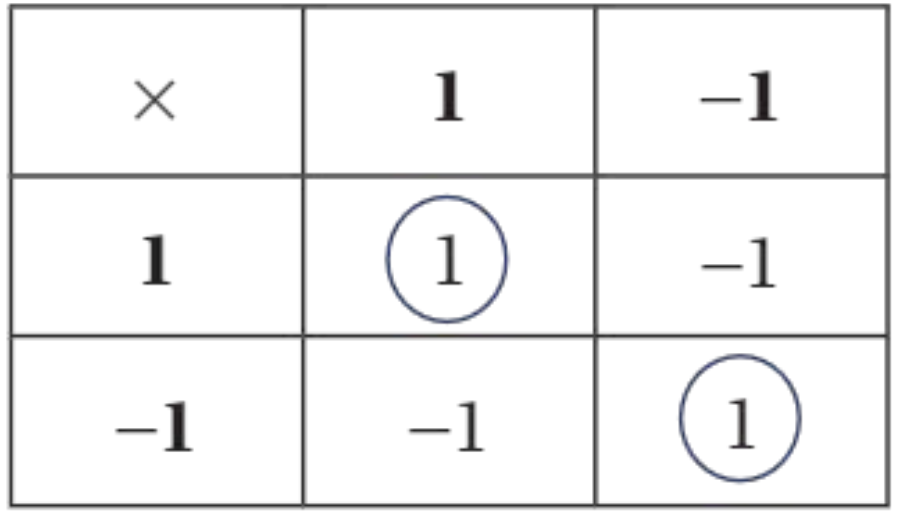
In this table, both 1 and -1 are self-inverse because:
- (the identity)
- (the identity)
Worked example 5: Using a Cayley table
Example
Worked Example: Analyzing a Cayley Table
Question: For the Cayley table given:
a) Find the identity element.
b) Work out which of the elements are self-inverses.
Solution:
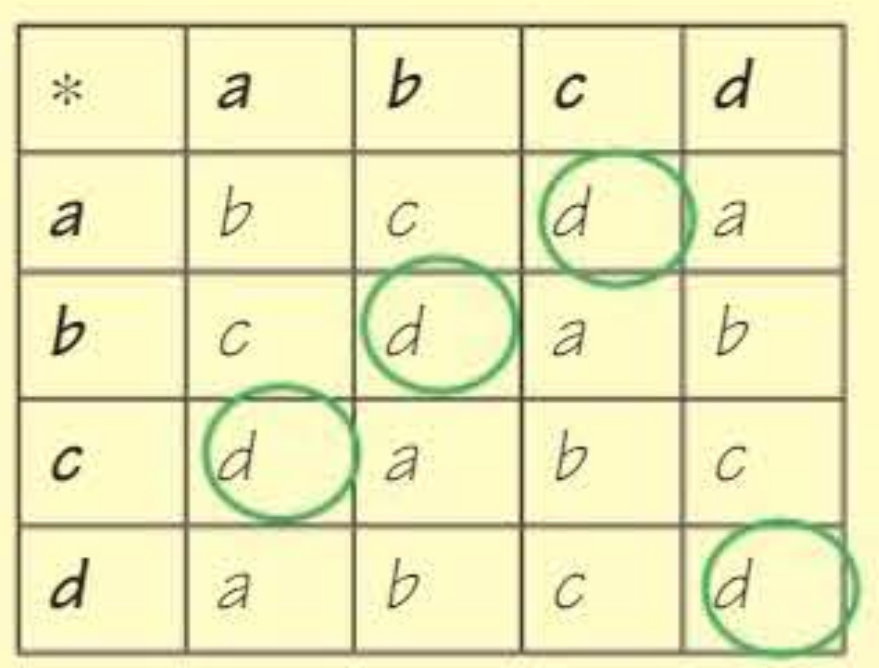
Part a: Finding the identity element
Looking at the fourth column (headed by ): , , ,
This column is identical to the initial column of elements. We can verify by checking the fourth row, which also matches the initial row.
Therefore, is the identity element.
Part b: Finding self-inverse elements
We need to find all instances of (the identity) in the table, then check each row:
- In row : appears in the column headed by , so , meaning is self-inverse
- In row : appears in the column headed by , so , meaning is self-inverse
Also, examining the table:
- For element : the inverse is (because and )
- For element : the inverse is (because and )
Therefore, and are self-inverses, while and are inverses of each other.
Symmetry in Cayley tables
Note
Exam tip: If a Cayley table is symmetrical along its leading diagonal (the diagonal from top-left to bottom-right), this indicates that the operation is commutative. This is because symmetry means that for all pairs of elements.
Summary of key properties
When analysing a binary operation, check for these properties:
Summary
Key Properties to Check:
- Closure: Does the operation always produce an element in the set?
- Commutativity: Does for all elements?
- Associativity: Does for all elements?
- Identity: Is there an element such that for all ?
- Inverses: For each element , is there an element such that ?
Remember!
Summary
Key Points to Remember:
- A binary operation on a set must be closed - combining any two elements must give another element in the same set
- An operation is commutative if the order doesn't matter:
- An operation is associative if the grouping doesn't matter:
- The identity element leaves all elements unchanged and is unique:
- An inverse element combines with an element to give the identity:
- Cayley tables provide a visual way to display all results of a binary operation on a finite set, and you can read them to find identity elements and inverses
- When using a Cayley table, take the first element from the left column and the second from the top row