Planar Graphs and Isomorphisms (AQA A-Level Further Maths): Revision Notes
📚Revision Notes
Planar Graphs and Isomorphisms
Introduction to graph representation
Before exploring planar graphs and isomorphisms, it's important to understand how graphs can be described and represented mathematically.
A graph consists of points called vertices connected by lines called edges. When describing a specific graph, you can use two methods: listing the vertex set and edge set, or constructing an adjacency matrix.
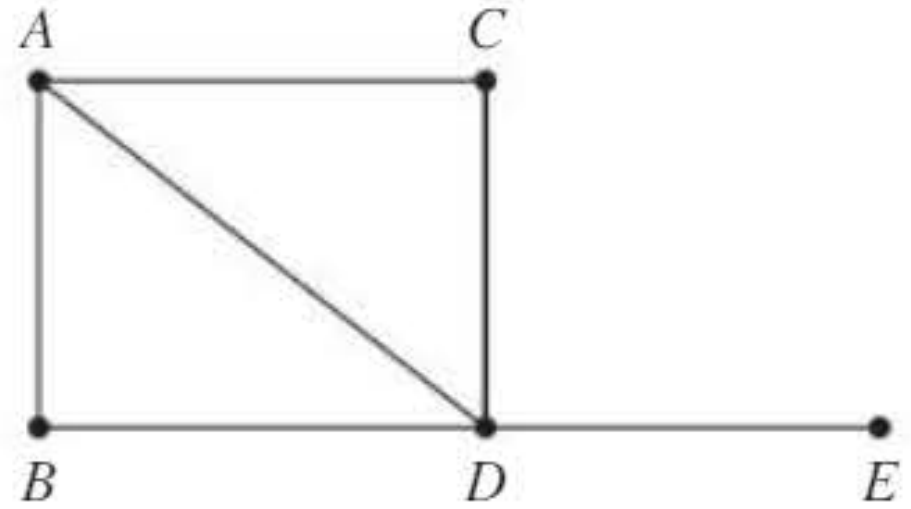
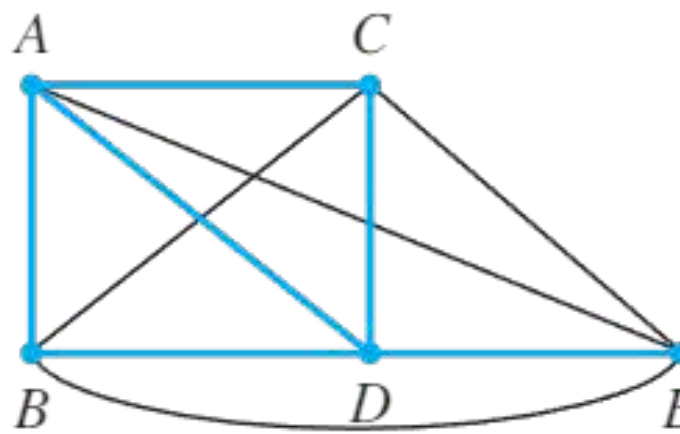
For the graph shown above, you can describe it by stating the vertex set {A, B, C, D, E} together with the edge set {AB, AC, AD, BD, CD, DE} of the graph.
Adjacency matrices
An adjacency matrix provides a numerical way to represent a graph. This shows the number of connections between each pair of vertices in the graph. An undirected loop at a vertex would be recorded as 2 in the matrix.
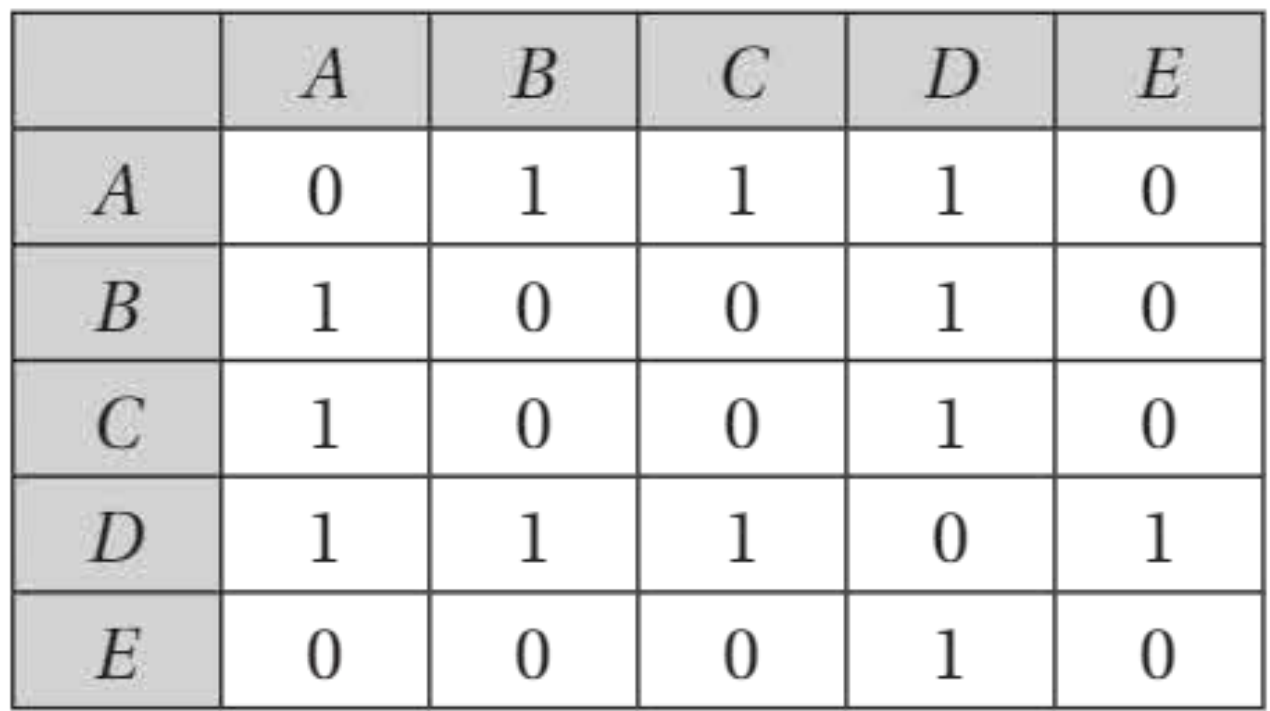
To construct an adjacency matrix, create a table where both rows and columns are labelled with the vertex names. Each cell contains the number of edges connecting the corresponding pair of vertices. For simple graphs (those without loops or multiple edges), the adjacency matrix contains only 0s and 1s.
Note
Key Properties of Adjacency Matrices:
- The matrix is symmetric for undirected graphs (the value at row i, column j equals the value at row j, column i)
- The diagonal elements represent loops at vertices
- The sum of each row (or column) gives the degree of that vertex
The complement of a graph
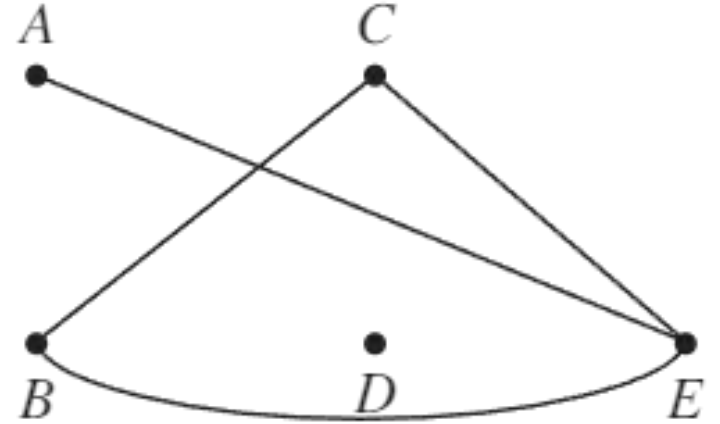
The complement of a simple graph G is denoted by G' and contains the same vertices as G but includes only the edges that are NOT in the original graph G.
To understand this concept, consider that if graph G has certain edges connecting its vertices, then G' has all the OTHER possible edges between those same vertices.
Finding the complement using adjacency matrices
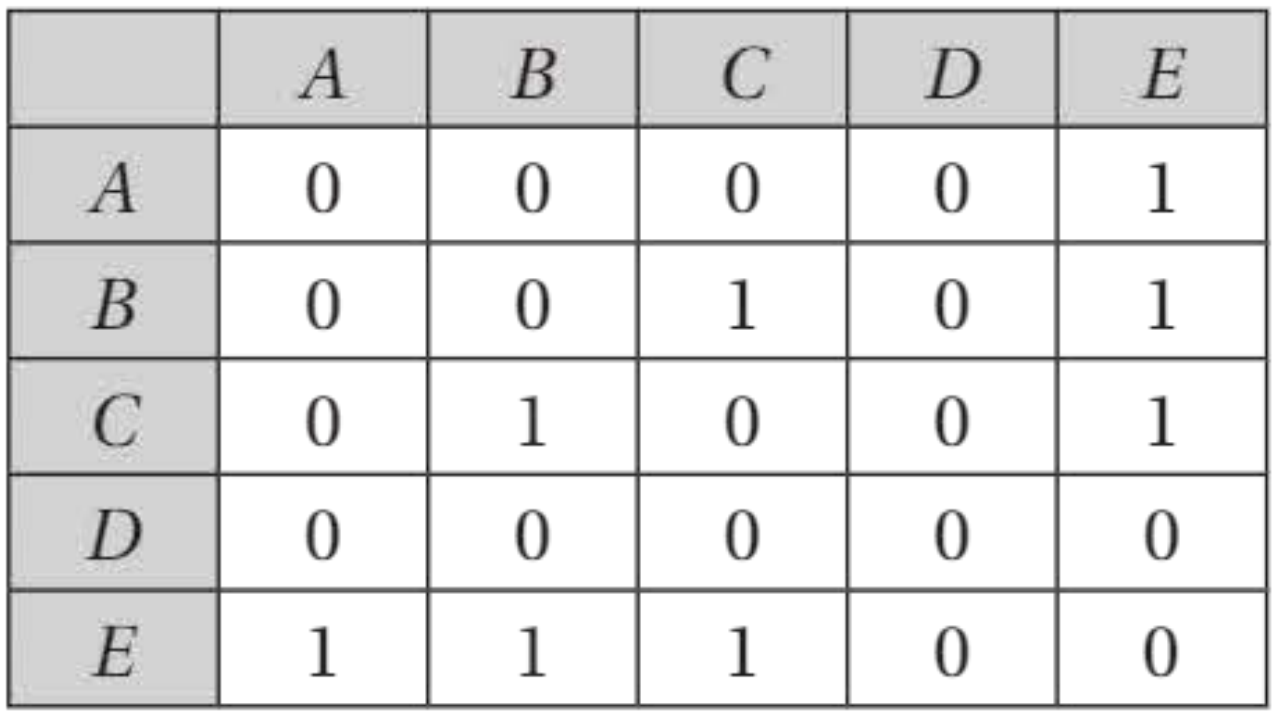
There's a straightforward method to find the adjacency matrix for G' from the adjacency matrix of G:
Important
Finding the Complement Matrix:
Change all 1s to 0s and all 0s to 1s, except on the leading diagonal (which remains unchanged because we don't want to create loops).
The leading diagonal stays as 0s because the complement shouldn't introduce loops where the original graph didn't have them.
Relationship with complete graphs
An important property of complements is their relationship with complete graphs. When you combine a simple graph G with its complement G', you obtain the complete graph , where n is the number of vertices.
A complete graph with n vertices is one where every possible pair of vertices is connected by an edge. The complete graph has edges.
For example, if a simple graph has 5 vertices, then G combined with G' gives . This makes sense because together, G and G' include every possible edge between the 5 vertices exactly once.
Isomorphic graphs
Two graphs and are isomorphic if they have the same structure. This means that even though the graphs may look different when drawn, they are essentially the same graph with vertices potentially relabelled or repositioned.
More formally, graphs are isomorphic if there's a one-to-one correspondence between their vertices such that if an edge joins two vertices in , then there's an edge between the corresponding vertices in , and vice versa.
Testing for isomorphism
To determine whether two graphs are isomorphic, you need to establish a vertex correspondence and verify that the edge patterns match. Here are several approaches:
Method 1: Compare adjacency matrices
If you list corresponding vertices in the same order, the adjacency matrices will be identical for isomorphic graphs.
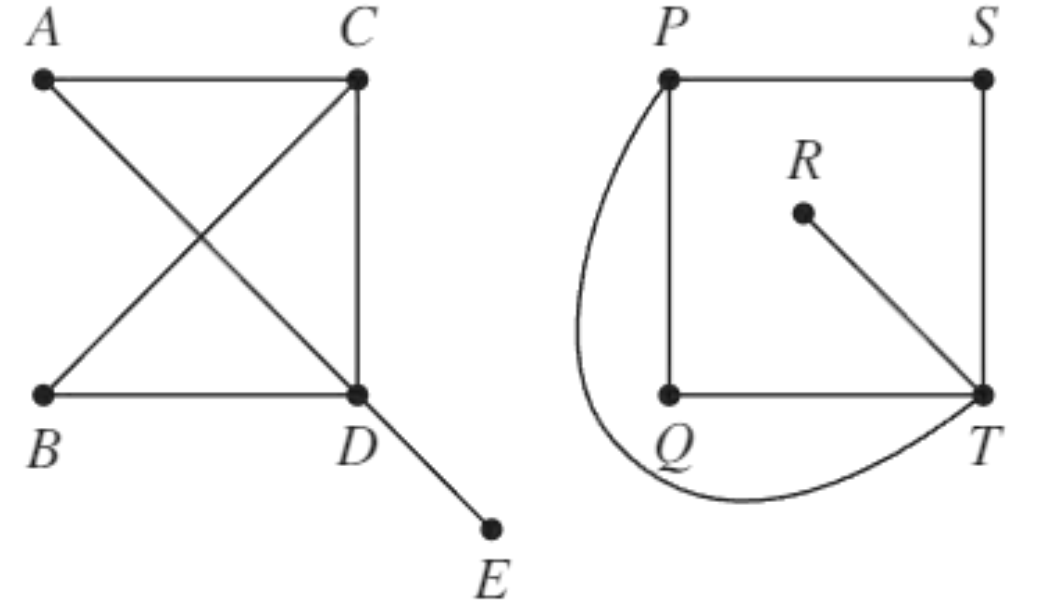
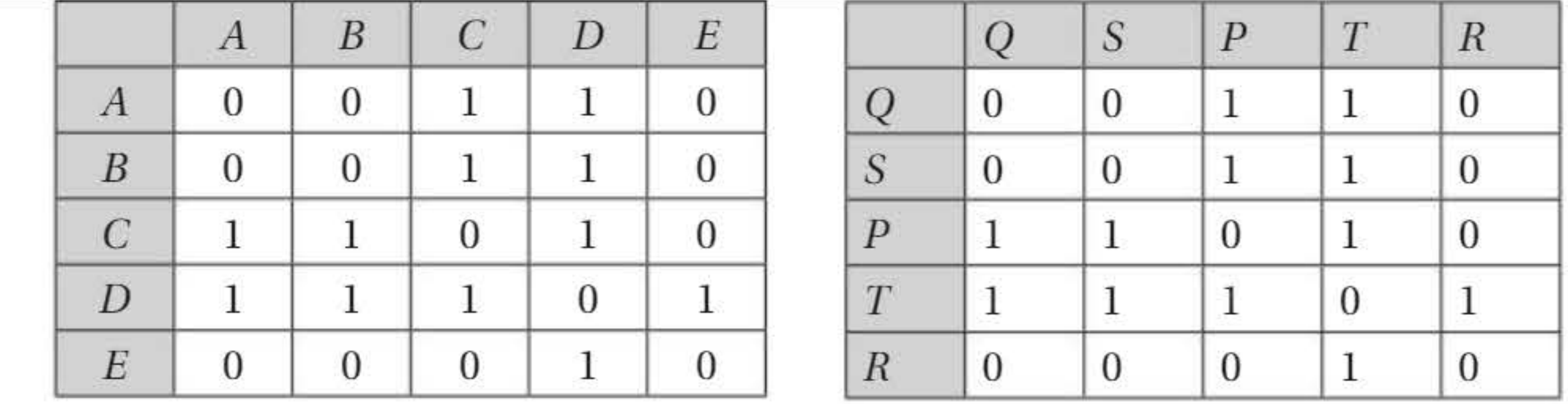
In this example, if you pair vertices {A, B, C, D} with vertices {Q, S, P, T} in that specific order, then the edges {AC, AD, BC, BD, CD, DE} from the first graph correspond to {QP, QT, SP, ST, PT, TR} in the second graph. The adjacency matrices, when arranged with corresponding vertices in the same positions, are identical.
Method 2: Use degree sequences
The degree sequence lists the degrees of all vertices in the graph. For two graphs to be isomorphic, they must have the same degree sequence. However, having the same degree sequence does NOT guarantee isomorphism – it's a necessary but not sufficient condition.
Important
Testing with Degree Sequences:
When looking for corresponding vertices in isomorphism problems, start by matching vertices with the same degree. However, remember that two graphs with identical degree sequences might still not be isomorphic, so you need to verify the edge connections as well.
Planar graphs
A graph is planar if it can be drawn in a plane without any edges crossing, except at vertices. This is a fundamental concept in graph theory with important applications in circuit design, map drawing, and network planning.

When a planar graph is drawn without edge crossings, it divides the plane into regions called faces. A face is a region bounded by edges in the plane drawing. Remember to count the "infinite face" – the unbounded region surrounding the entire graph.
Note
Working with Planar Graphs:
Edges that lead to degree 1 vertices, multiple edges, and loops can all be temporarily removed from a graph when testing for planarity, then added back once the remaining graph has been drawn in the plane.
Euler's formula
For any simple, connected planar graph drawn in the plane with V vertices, E edges, and F faces (including the infinite face):
This is Euler's formula and is a key tool for determining whether a graph is planar.
Example
Worked Example: Applying Euler's Formula
If a planar graph has 6 vertices and 9 edges, how many faces does it have?
Using Euler's formula:
Therefore, the graph has 5 faces.
Corollaries of Euler's formula
Several useful inequalities follow from Euler's formula for graphs with no degree 1 vertices, loops, or multiple edges:
For simple connected planar graphs:
If every edge borders exactly two faces, and every face has at least three edges, then:
Substituting this into Euler's formula gives:
For a graph with and edges, we'd need , which is false. Therefore, K₅ is non-planar.
For bipartite graphs:
In a bipartite graph, every face must have at least four edges (because bipartite graphs have no triangles), giving:
This leads to:
For with and : we'd need , which is false. Therefore, K₃,₃ is non-planar.
Important
Key Results for Non-Planarity:
- is non-planar if
- is non-planar if and
Critical Warning: If , this does NOT guarantee the graph is planar. The inequality being satisfied is necessary but not sufficient for planarity. However, if , then the graph is definitely non-planar.
Kuratowski's theorem
While Euler's formula provides necessary conditions for planarity, Kuratowski's theorem gives a complete characterization:
Important
Kuratowski's Theorem:
A graph is non-planar if and only if it contains a subgraph that is a subdivision of or .
Recall that a subdivision of a graph is formed by adding vertices of degree 2 along existing edges. This theorem provides a definitive test for non-planarity.
Worked example: Using Kuratowski's theorem
Example
Worked Example: Testing for Planarity
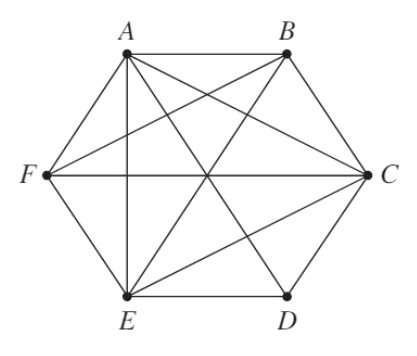
Consider a hexagon with internal subdivisions as shown. To determine if this graph is non-planar:
Step 1: Check using Euler's formula inequality. Count vertices and edges.
For planarity, we need :
Since , the graph is non-planar.
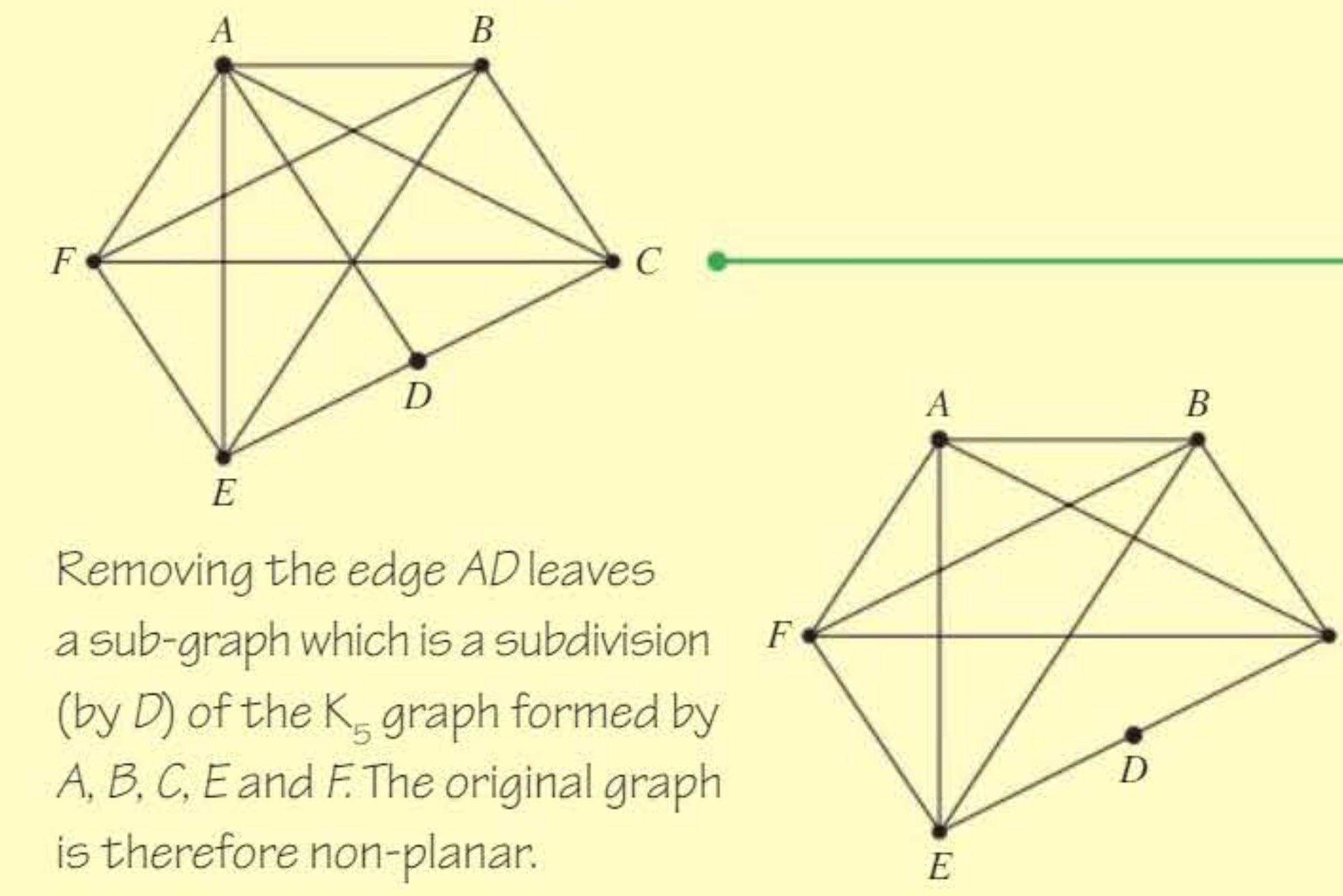
Step 2: To confirm using Kuratowski's theorem, we can identify a subdivision of . If we remove edge AD from the graph, we can redraw it to show it contains vertices A, B, C, E, F, and G arranged as with vertex D subdividing an edge.
Conclusion: This proves the original graph has a subgraph that is a subdivision of , confirming it's non-planar by Kuratowski's theorem.
Worked example: Complete solution with complement and isomorphism
Example
Worked Example: Complete Analysis
Problem: The diagram shows graph G:
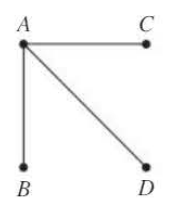
Part a: Construct the adjacency matrix for G
Create a table with rows and columns labelled A, B, C, D. Enter 1 if vertices are connected, 0 otherwise.
Part b: Find the adjacency matrix for G' and sketch G'
Change 1s to 0s and 0s to 1s (except the leading diagonal). Then draw the graph showing edges corresponding to the 1s in the new matrix.
Part c: Show that G and G' are not isomorphic
Calculate degree sequences:
- G has degrees (3, 1, 1, 1)
- G' has degrees (0, 2, 2, 2)
Since the degree sequences differ, the graphs cannot be isomorphic.
Part d: Find a graph H with 4 vertices such that H and H' are isomorphic
has edges, so the sum of vertex degrees equals 12.
If H has 4 vertices and H and H' are isomorphic, they must have the same number of edges. Since H and H' together form , each must have 3 edges.
For 3 edges, the degree sum is 6. The degrees must be (2, 2, 1, 1) because the complement would then have degrees (1, 1, 2, 2).
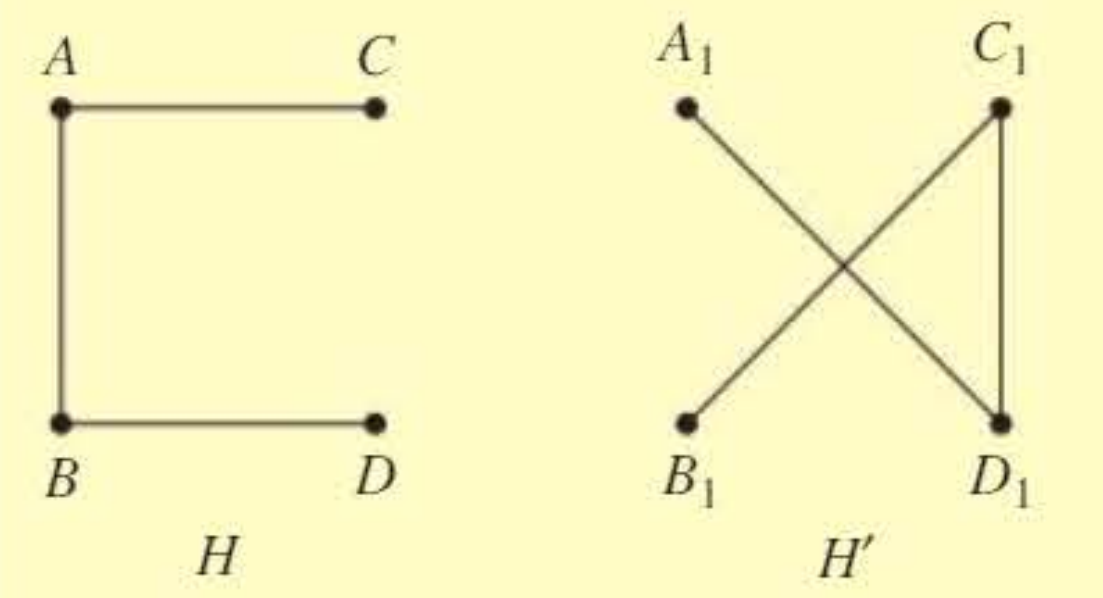
Graph H (a rectangle) and H' (rectangle with both diagonals) are isomorphic with correspondence showing edges match between the two structures.
Summary
Key Points to Remember:
- A graph is planar if it can be drawn without edge crossings except at vertices; the drawing divides the plane into faces
- Euler's formula: For a simple, connected planar graph, where V is vertices, E is edges, and F is faces
- For simple planar graphs with no degree 1 vertices: ; if this fails, the graph is non-planar
- Kuratowski's theorem: A graph is non-planar if and only if it contains a subgraph that is a subdivision of or
- Two graphs are isomorphic if they have the same structure; test by comparing degree sequences and adjacency matrices with corresponding vertices in the same order
- The complement G' of graph G has the same vertices but only the edges NOT in G; find it by swapping 0s and 1s in the adjacency matrix (except the diagonal)
- Combining a simple graph G with its complement G' gives the complete graph