Groups (AQA A-Level Further Maths): Revision Notes
📚Revision Notes
Groups
Introduction to groups
A group is a set of mathematical elements that can be combined using a specific operation, following certain rules called axioms. Groups are fundamental structures in abstract algebra and appear throughout mathematics.
Note
Groups are one of the most important concepts in modern mathematics. They provide a framework for studying symmetry and appear in fields ranging from physics and chemistry to cryptography and computer science.
The simplest way to understand groups is through examples. Consider the set of permutations of the numbers 1, 2 and 3. A permutation rearranges these numbers in different orders.
Elements and the identity element
The individual items within a group are called elements.
For the permutations of 1, 2 and 3, there are six possible arrangements. These can be written using notation that shows how each number maps to a new position:
Definition: The identity element (denoted ) is the element that leaves every other element unchanged when combined with it.
In the permutations example, element maps each number to itself: 1→1, 2→2, 3→3. This means the order remains unchanged, making the identity element.
Important
Every group must contain exactly one identity element. This is a fundamental requirement for any set to be classified as a group.
Closure property
Definition: A set has the closure property under a given operation if combining any two elements from the set always produces another element that is also in the original set.
For the permutations example, if you apply permutation followed by permutation , the result is permutation , which is already in our set. This property must hold for all possible combinations.
Note
Closure ensures that you can never "escape" the group by combining elements. No matter which two elements you combine, the result will always be another element from the same group.
Cayley tables
A Cayley table is a grid showing the result of combining every possible pair of elements in a group. It provides a complete picture of the group's structure.
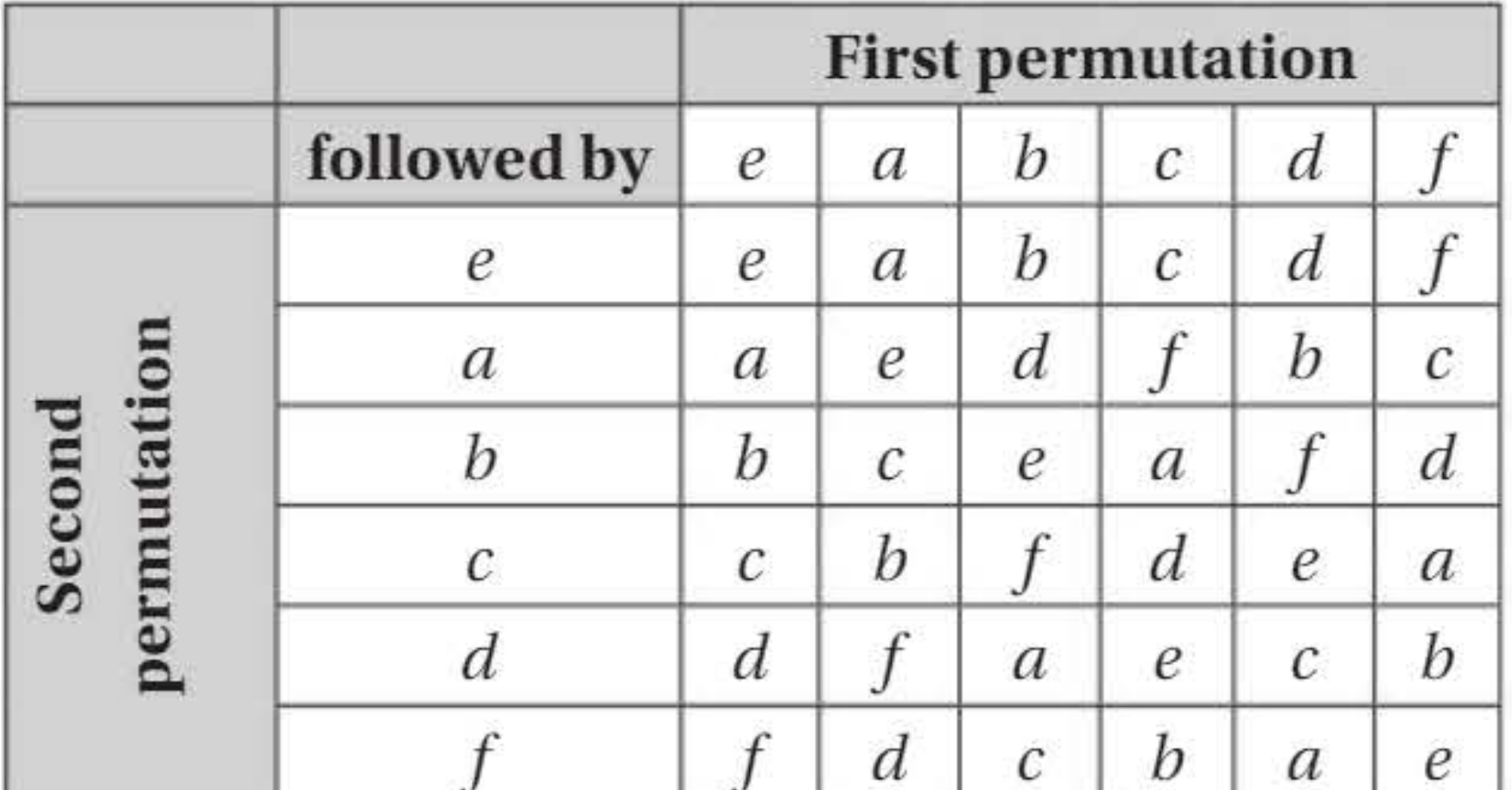
The table above shows all combinations for the permutation group. The first permutation (from the top row) is applied first, followed by the second permutation (from the left column). The result appears in the corresponding cell.
From this Cayley table, you can verify that every combination produces an element already in the set, confirming the closure property.
Inverse elements
Definition: An inverse element of element is another element that, when combined with , produces the identity element .
For example, in the permutation group:
- (so is its own inverse)
- (so and are inverses of each other)
Definition: A self-inverse is an element that acts as its own inverse, meaning when combined with itself it produces the identity element.
In the permutations example, elements , , and are self-inverses, while is the inverse of and vice versa.
Important
Every element in a group must have an inverse. This is non-negotiable - without inverses for all elements, you don't have a group.
Associativity
Definition: An operation is associative if the grouping of operations doesn't affect the result. Mathematically, three elements , , are associative if:
This means that followed by gives the same result as followed by .
For the permutations example, consider elements , and :
- (since combining and first gives , then with gives )
- (since combining and first gives , then with gives )
Both expressions equal , confirming associativity for these elements. This property holds for all combinations in a group.
Note
Certain operations are known to be associative without needing proof, including:
- Modular multiplication and addition
- Matrix multiplication
- Composition of mappings
When working with these operations, you can simply state that associativity holds.
Formal definition and group axioms
Definition: A group is a non-empty set with a binary operation satisfying four axioms:
Important
The Four Group Axioms:
-
Closure: is closed in (combining any two elements produces another element in )
-
Associativity: is associative
-
Identity: There exists an identity element such that for all in
-
Inverses: Each element has an inverse such that
Remember these four conditions with the mnemonic CAII: Closure, Associativity, Identity, Inverses.
Note: A binary operation combines two elements of a set according to a specific rule.
These four conditions (collectively called the group axioms) must all be satisfied for a set to qualify as a group.
Example
Worked Example 1: Addition modulo 4
Question: Show that the set forms a group under addition modulo 4 ().
Solution:
First, construct the Cayley table:
| 0 | 1 | 2 | 3 | |
|---|---|---|---|---|
| 0 | 0 | 1 | 2 | 3 |
| 1 | 1 | 2 | 3 | 0 |
| 2 | 2 | 3 | 0 | 1 |
| 3 | 3 | 0 | 1 | 2 |
Now verify the four axioms:
Closure: Every combination in the table produces an element from . ✓
Associativity: Addition is associative (this is a known property). ✓
Identity: The element 0 is the identity because combining 0 with any other element leaves that element unchanged. For example: and . ✓
Inverses: Each element has an inverse:
- 0 is self-inverse:
- 1 and 3 are inverses:
- 2 is self-inverse:
All four axioms are satisfied, so forms a group.
Order of a group
Definition: The order of a group equals the number of elements in the group.
For the permutations example at the start, the group has 6 elements , so the order is 6.
For the addition modulo 4 example, the group has 4 elements , so the order is 4.
Period of an element
Definition: The period (or order) of a particular element is the smallest positive integer such that , where is the identity.
In other words, the period tells you how many times you must combine an element with itself to return to the identity.
For the permutations example:
- Element has period 2 because
- Element has period 3 because (since and )
Note
The identity element always has period 1, since by definition.
Abelian groups
Definition: An abelian group is a group with the additional property of commutativity, meaning the order in which elements are combined doesn't matter.
Mathematically, for all elements and in the group:
Not all groups are abelian. In the permutations example, , so this group is not abelian.
However, the addition modulo 4 group is abelian because (and this holds for all pairs).
Note
Exam tip: Abelian groups can be identified in Cayley tables by checking for symmetry along the leading diagonal. If the table is symmetric about the diagonal from top-left to bottom-right, the group is abelian.
This visual check is often faster than testing commutativity for every pair of elements!
Dihedral groups
Definition: Dihedral groups (denoted , where is the number of sides) represent all symmetries of a regular polygon with sides.
These symmetries include:
- Rotations about the centre
- Reflections in lines of symmetry
The order of a dihedral group is (there are rotations and reflections).
Cyclic groups and generators
Definition: A cyclic group contains only rotational symmetries and can be generated by repeatedly applying a single element.
Definition: A generator is an element that, through repeated application, produces all other elements in the group.
Example
Worked Example 2: Symmetries of an equilateral triangle
Question: Show that the symmetries of an equilateral triangle form a group, and identify a generator for the cyclic group of rotations.
Solution:
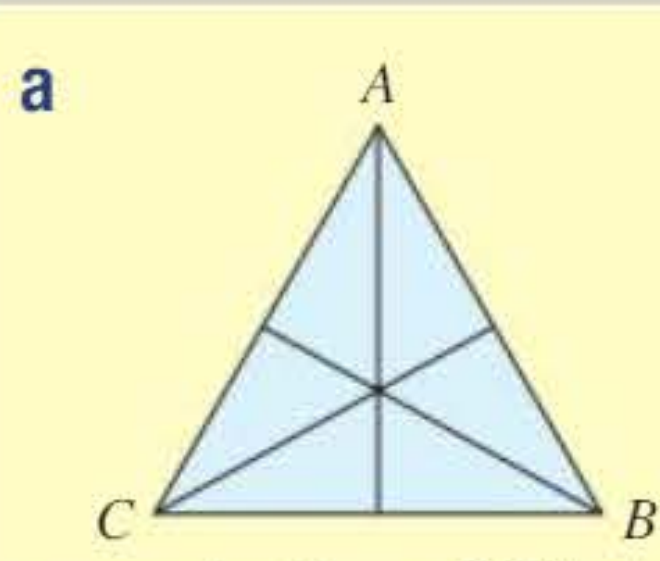
Label the vertices , , . Define the symmetries as:
- = rotation of (identity)
- = rotation of anticlockwise about the centre
- = rotation of anticlockwise about the centre
- = reflection in the mirror line through
- = reflection in the mirror line through
- = reflection in the mirror line through
The complete Cayley table shows all 6 symmetries:
Verifying the axioms:
Identity: is the identity element (leaves all symmetries unchanged). ✓
Inverses: From the table, , , and are self-inverses; is the inverse of and vice versa. ✓
Closure: Every combination produces a symmetry in the original set. ✓
Associativity: Since the binary operation is composition of mappings, it is associative. ✓
Therefore, the set of symmetries forms a group (this is the dihedral group ).
Finding the generator for the cyclic group:
The cyclic group consists of rotational symmetries only:
The Cayley table for rotations only:
By repeatedly applying :
Therefore, is a generator of the group, denoted .
Note that is also a generator since and .
Example
Worked Example 3: Checking group properties
Question: The set forms a group under the binary operation defined as . Show that the identity element is 2.
Solution:
For to be the identity, we need for all .
Using the definition:
For this to equal :
Verify: ✓
Also check the other direction: ✓
Therefore, 2 is the identity element.
Summary
Key Points to Remember:
- A group must satisfy four axioms: closure, associativity, identity, and inverses (remember: CAII)
- Every group contains exactly one identity element that leaves all other elements unchanged
- A Cayley table displays all possible combinations of group elements and helps verify the group axioms
- An abelian group is commutative (order doesn't matter) and has a symmetric Cayley table
- The order of a group is the number of elements it contains, while the period of an element is how many times it must be combined with itself to reach the identity
- Dihedral groups () represent symmetries of regular polygons and have order
- A generator is a single element that, through repeated application, produces all elements in a cyclic group