Summing Series and the Method of Differences (AQA A-Level Further Maths): Revision Notes
📚Revision Notes
Summing Series and the Method of Differences
Introduction to sigma notation
Sigma notation provides a concise way to write the sum of a sequence of terms. The Greek letter Σ (sigma) represents summation.
When writing the sum of a series containing n terms such as , we use the notation:
This means "find the sum of all the terms from to ."
Note
The expression is called the general term, where r is the variable. If all terms are defined algebraically, is a function of r.
For example, if , then:
Key notation:
- means "the sum of these n terms"
- The lower number (1) indicates where to start
- The upper number (n) indicates where to finish
- The expression after Σ tells you what to sum
Standard summation formulae
For A-Level Further Mathematics, you must memorise three essential formulae. These will not be provided in the exam and you must be able to quote them without proof.
Important
Memorization Required: These three formulae are NOT provided in the exam formula booklet. You must be able to recall and apply them accurately under exam conditions.
Sum of first n integers
The sum of the first n positive integers is given by:
In words: the sum equals n multiplied by (n+1), divided by 2.
Note
Memory aid: Think of this as "n lots of (n+1), then halve it"
Sum of first n squares
The sum of the squares of the first n positive integers is:
This formula can be derived using the method of differences, which we will explore later in this note.
Sum of first n cubes
The sum of the cubes of the first n positive integers is:
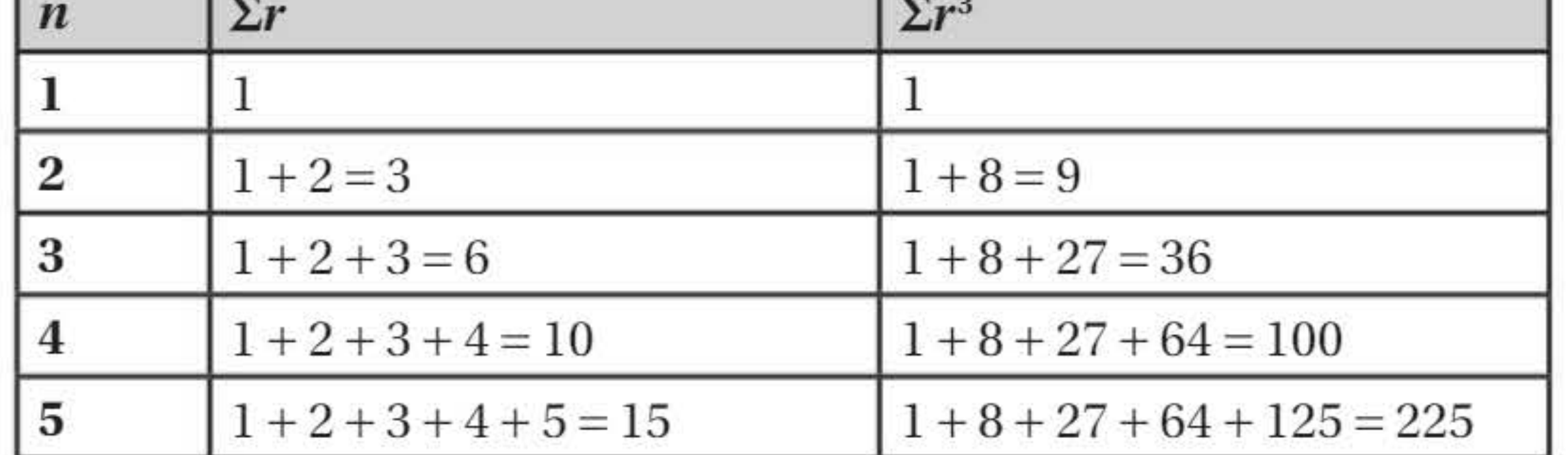
Notice that this can also be written as:
This shows an elegant relationship: the sum of the cubes equals the square of the sum of the integers.
Deriving the sum of integers formula
Understanding how to derive the formula for helps build intuition for series manipulation. This elegant method demonstrates the power of algebraic symmetry.
Example
Derivation: Sum of First n Integers
Step 1: Write out the sum from 1 to n:
Step 2: Write the same sequence in reverse order:
Step 3: Add the two expressions together term by term:
Step 4: Notice that every term equals (n+1). Since there are n terms in total:
Step 5: Divide both sides by 2:
This elegant proof demonstrates why the formula works and should help you remember it.
The method of differences
The method of differences is a technique used to sum certain types of series where the general term can be expressed as the difference of two consecutive function values.
When to use the method of differences
Note
There is no single universal method for summing all series. Some series cannot be expressed as simple algebraic expressions.
However, when the general term of a series can be written in the form:
we can find the sum using the method of differences, also known as the telescoping series method.
How the method works
The key insight is that when we write out successive differences vertically, most terms cancel out, leaving only the first and last terms.
Important
Step-by-step procedure for Method of Differences:
-
Express the general term as a difference:
-
Write differences vertically for successive values of r:
- For :
- For :
- For :
- ...
- For :
-
Eliminate terms wherever possible. Notice that appears as +f(2) and -f(2), so cancels out. Similarly, all cancel.
-
Collect remaining terms: Only and remain.
Therefore:
Worked examples
Example
Example 1: Sum of Even Numbers
Find the value of
Solution:
First, rewrite as a sum of integers by factoring out 2:
This can be written using sigma notation:
Now substitute into the standard formula :
Example
Example 2: Sum Involving Products
Evaluate
Solution:
Write out the first few terms to understand the pattern:
Expand the general term:
Split into two separate sums:
To use standard formulae, we need sums starting from 1. Subtract the missing terms:
Calculate the sums from 1 to 4:
Substitute the standard formulae:
Combine over a common denominator:
Example
Example 3: Basic Telescoping Series
Find the sum to n terms of the series
Solution:
The general term is already in the form where .
Write the differences vertically:
Eliminate terms wherever possible. Notice that cancels with , cancels with , and so on.
Collect up the remaining terms:
Therefore: The sum equals
Example
Example 4: Partial Fractions with Method of Differences
The expression can be written as
Find the sum to n terms of the series
Solution:
Using the given partial fraction decomposition:
Write out the terms vertically to see the telescoping pattern:
- For :
- For :
- For :
- For :
Continue this pattern and observe the cancellations. After eliminating middle terms:
Simplify:
Therefore:
Example
Example 5: Proving Standard Formulae Using Method of Differences
Use the method of differences to show that
Solution:
Consider the identity . Expanding both cubes:
Subtracting:
Therefore:
Now sum from to and write differences vertically:
- For :
- For :
- For :
- ...
- For :
The middle cubic terms cancel telescopically, leaving:
Expanding :
This proves the formula.
Exam tips and common pitfalls
Note
Memory requirement: You must memorise all three standard formulae. They will not be given in the formula booklet. Practice writing them out regularly until they become automatic.
Important
Common mistakes to avoid:
- Forgetting to adjust limits when splitting sums (e.g., vs )
- Not writing differences vertically in method of differences questions
- Algebraic errors when combining fractions over common denominators
- Missing the telescoping pattern in series
Exam strategy:
- For questions involving sums, first try to express in terms of standard formulae
- If the term looks like a difference, consider the method of differences
- Always write differences vertically to clearly see cancellations
- Check your final answer by substituting small values of n (e.g., n=1, n=2)
When using method of differences:
- Rearrange the expression to identify the difference form
- Use partial fractions if necessary to create differences
- Write at least 4-5 terms vertically to see the pattern clearly
- Circle or cross out terms that cancel
- Collect only the remaining terms
Summary
Key Points to Remember:
- Sigma notation () provides a compact way to write sums of sequences
- Three essential formulae must be memorised:
- The method of differences applies when the general term can be written as
- Always write differences vertically to identify which terms cancel in telescoping series
- The sum of cubes equals the square of the sum of integers: