Eigenvalues, Eigenvectors, and Matrix Diagonalization
Sample Answer
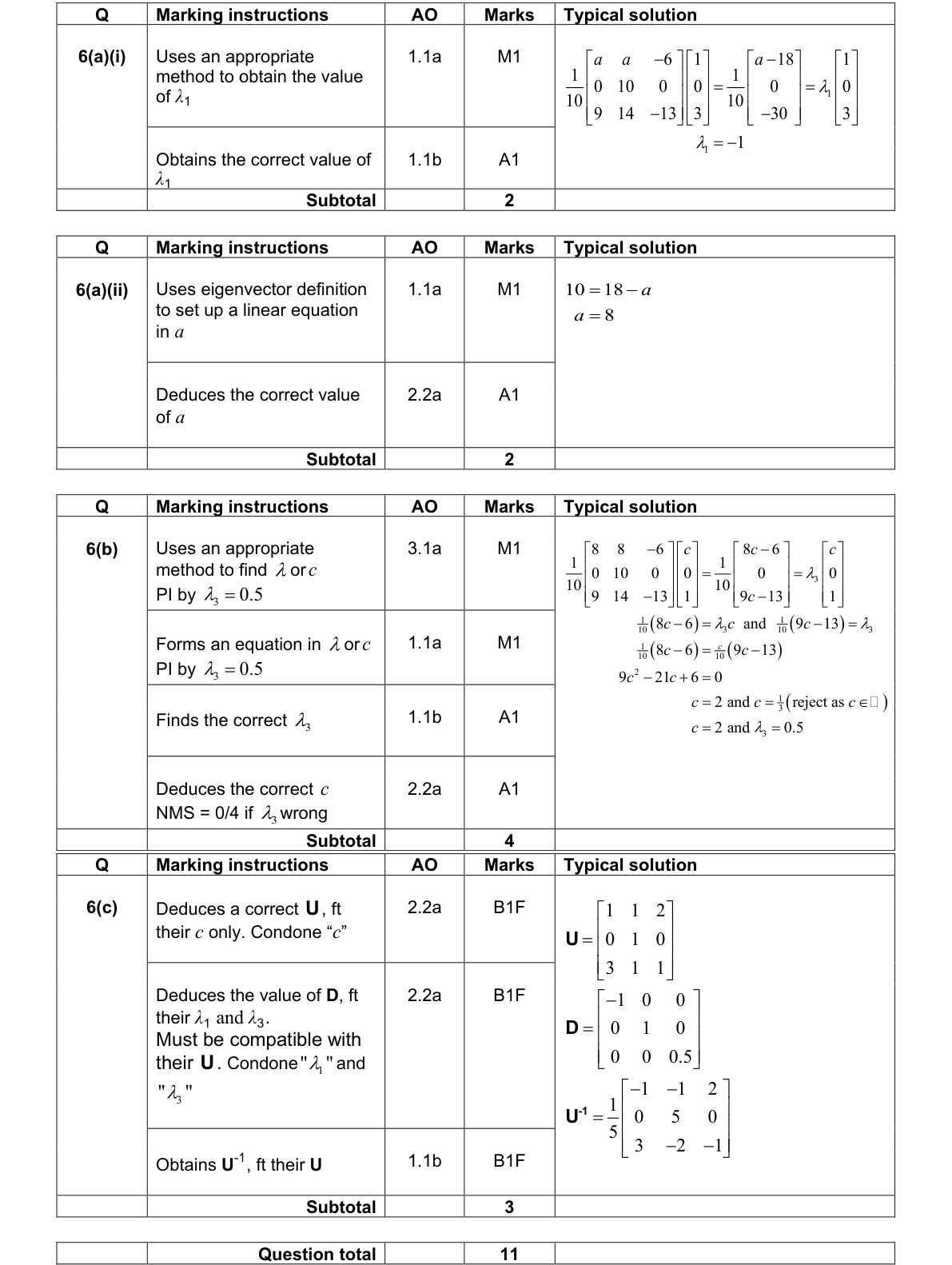
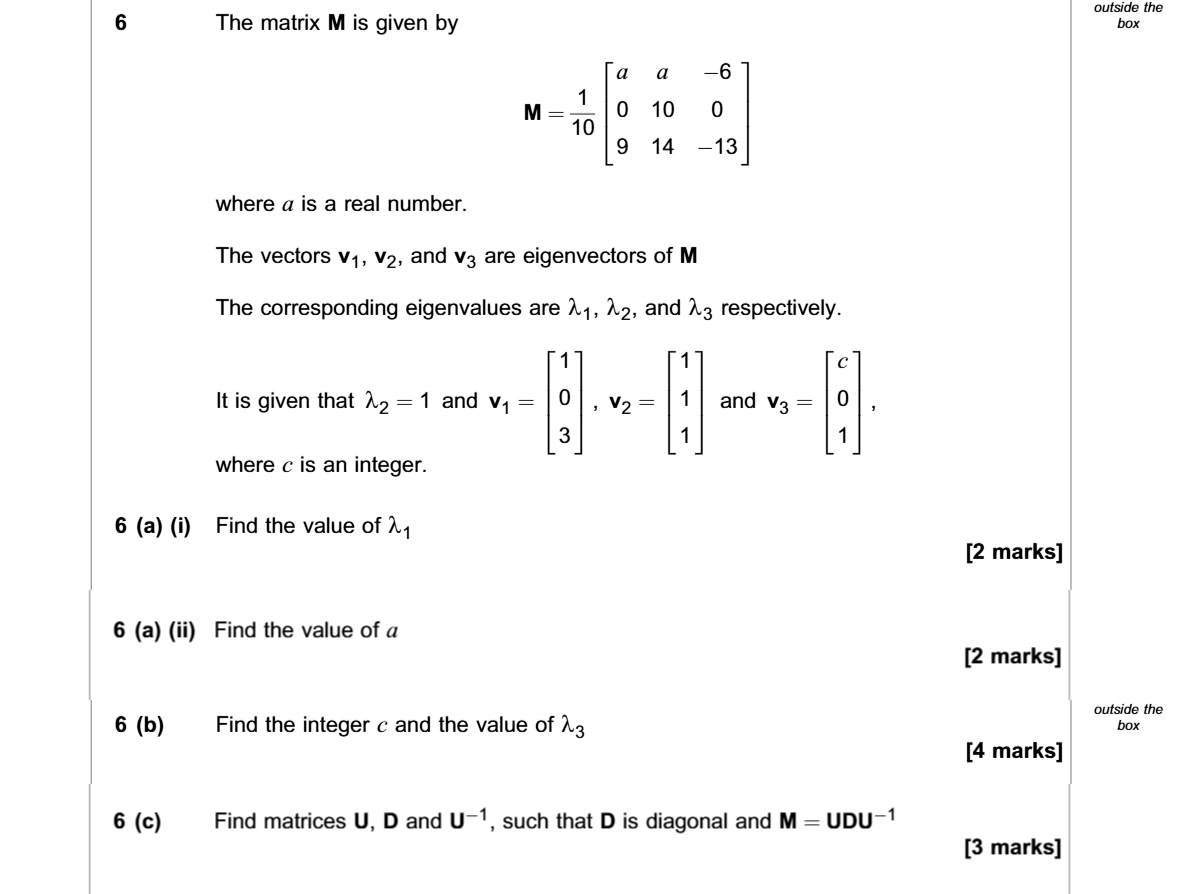
Part 6(a)(i): Find the value of λ1
Working
Since v1 is an eigenvector with eigenvalue λ1, we have:
Mv1=λ1v1
Substituting the given values:
101a09a1014−60−13103=λ1103
Computing the left-hand side:
101a+0−180+0+09+0−39=101a−180−30
From the third row:
10−30=3λ1
−3=3λ1
λ1=−1
Final Answer: λ1=−1
Part 6 (a)(ii): Find the value of a
Working
From part (i), we established that λ1=−1 and:
101a−180−30=λ1103
From the first row:
10a−18=λ1=−1
Solving for a:
a−18=−10
a=8
Final Answer: a=8
Part 6 (b): Find the integer c and the value of λ3
Working
Now that we know a=8, the matrix is:
M=10180981014−60−13
Since v3 is an eigenvector with eigenvalue λ3:
Mv3=λ3v3
10180981014−60−13c01=λ3c01
1018c−609c−13=cλ30λ3
From the third row:
λ3=109c−13
From the first row:
108c−6=cλ3
Substituting the expression for λ3:
108c−6=c⋅109c−13
8c−6=c(9c−13)
8c−6=9c2−13c
0=9c2−21c+6
0=3c2−7c+2
0=(3c−1)(c−2)
This gives c=31 or c=2
Since c is an integer: c=2
Therefore:
λ3=109(2)−13=1018−13=105=0.5
Final Answer: c=2 and λ3=0.5
Part 6(c): Find matrices U, D and U−1
Working
The matrix U is formed using the eigenvectors as columns:
U=(v1v2v3)=103111201
The diagonal matrix D contains the corresponding eigenvalues:
D=λ1000λ2000λ3=−100010000.5
To find U−1, we calculate:
det(U)=1(1⋅1−0⋅1)−1(0⋅1−0⋅3)+2(0⋅1−1⋅3)
=1−0−6=−5
The adjugate matrix is:
adj(U)=10−31−52−201
Therefore:
U−1=det(U)1adj(U)=−5110−31−52−20amp;1
U−1=51−103−15−220−1
Final Answer:
U=103111201,D=−100010000.5,U−1=51−103−15−220−1
Marking Scheme