Argand Diagrams (AQA A-Level Further Maths): Revision Notes
📚Revision Notes
Argand Diagrams
What is an Argand diagram?
Real numbers can be shown on a number line, but imaginary numbers cannot fit on this same line. To represent both real and imaginary numbers together, we need a different approach. By combining two number lines at right angles, we create a plane where complex numbers can be displayed visually.
This plane is called an Argand diagram, and it provides a powerful way to represent complex numbers graphically.
Important
Definition: An Argand diagram is a coordinate plane used to represent complex numbers visually, where the horizontal axis shows real numbers and the vertical axis shows imaginary numbers.
Structure of an Argand diagram
An Argand diagram has two perpendicular axes that work together to create a complete representation of complex numbers:
- The real axis (Re) is the horizontal axis
- The imaginary axis (Im) is the vertical axis
The complex number is represented as the point on an Argand diagram.
Note
For any complex number :
- The real part determines the horizontal position
- The imaginary part determines the vertical position
This creates a one-to-one correspondence between complex numbers and points on the plane.
Complex conjugates on Argand diagrams
The complex conjugate of is written as .
On an Argand diagram, the complex conjugate is the reflection of across the real axis. This geometric relationship is fundamental to understanding complex conjugates visually.
Note
When finding complex conjugates:
- The real part stays the same
- The imaginary part changes sign
- The distance from the origin remains unchanged
Example
Worked Example: Plotting a Complex Number and Its Conjugate
Given , show and on an Argand diagram.
Solution:
First, identify the real and imaginary parts:
- has real part and imaginary part
- Plot at the point
For the complex conjugate:
- has real part and imaginary part
- Plot at the point
Notice that is the reflection of in the real axis.
Complex numbers as vectors
Complex numbers can also be represented as position vectors on an Argand diagram. This vector interpretation opens up powerful geometric techniques for working with complex numbers. We can draw an arrow from the origin to the point representing the complex number, treating it as a displacement from the origin.
Vector addition on Argand diagrams
When adding two complex numbers, we can use vector addition. The sum can be found by:
- Drawing vectors for and from the origin
- Completing the parallelogram (or using the triangle method)
- The diagonal represents
This geometric approach provides visual insight into complex number addition and helps verify algebraic calculations.
Example
Worked Example: Vector Addition
Given and , show , and on an Argand diagram.
Solution:
Plot each complex number as a position vector:
- is plotted at
- is plotted at
To find :
Plot at
The sum can be visualised using vector addition. Draw vectors from the origin to and to , then complete the parallelogram. The diagonal from the origin represents .
Important
Exam tip: Always label each vector clearly on your diagram to avoid confusion.
Scalar multiples and collinearity
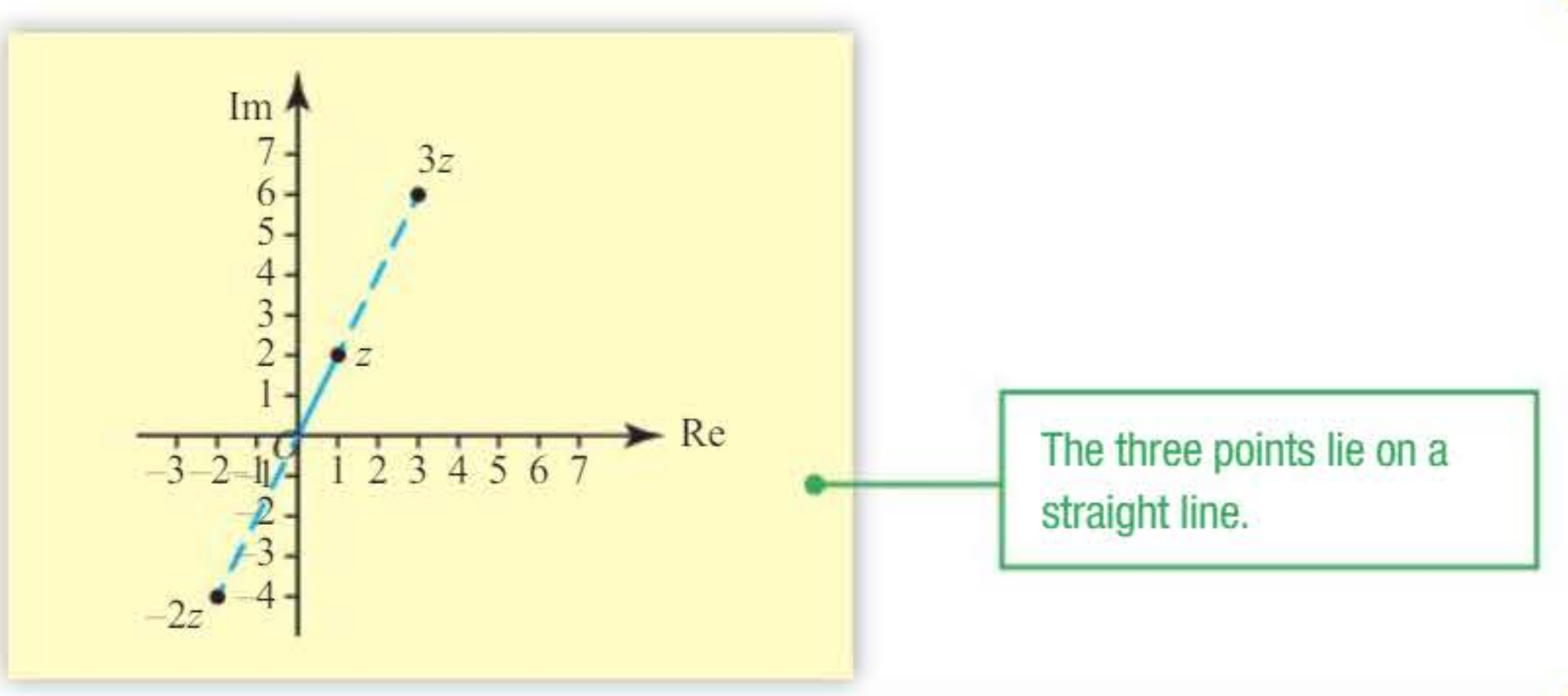
When a complex number is multiplied by a real number (scalar) , the resulting point lies on the straight line through the origin and .
This means that , , , etc. are all collinear with the origin. This property is essential for understanding geometric transformations and scaling of complex numbers.
Example
Worked Example: Scalar Multiples
Given , show , and on an Argand diagram.
Solution:
First, plot at the point .
Calculate the scalar multiples:
- , plot at
- , plot at
All three points lie on a straight line through the origin. This is because scalar multiplication stretches or shrinks the position vector but keeps it along the same line.
Problem-solving strategies for geometric problems
When working with complex numbers in geometric contexts, it's essential to combine algebraic techniques with geometric visualization. The Argand diagram serves as a bridge between these two approaches.
Note
Problem-Solving Strategies:
When solving geometric problems involving complex numbers on Argand diagrams:
- Draw an Argand diagram to visualise the problem
- Use rules for calculating area, lengths and angles from coordinate geometry
- Use the fact that the product of gradients of perpendicular lines is
- Fully define transformations by specifying the type, scale factor, centre, and any translations
Example
Worked Example: Polynomial Roots and Geometry
Given:
a) Find all the roots of given that is a factor.
Solution:
Using factor theorem or long division:
Factorising further:
Using a calculator or further factorisation:
The four roots are: , , ,
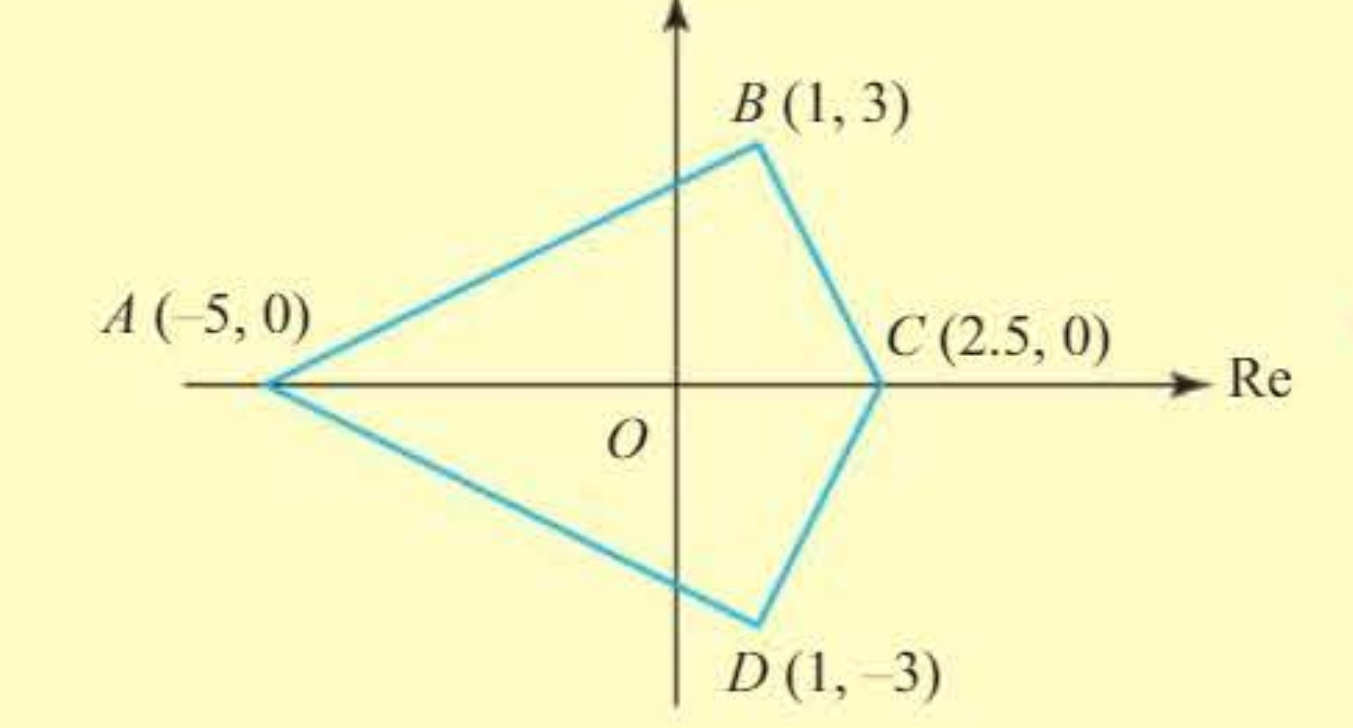
b) Find the area of the quadrilateral formed by the points representing the four roots.
Solution:
Plot the roots on an Argand diagram:
The quadrilateral is a kite, which can be split into two triangles.
Using the formula for area:
c) Prove that the quadrilateral contains two right angles.
Solution:
Calculate the gradient of line :
Calculate the gradient of line :
Check if lines are perpendicular:
Since the product of gradients equals , angle is a right angle. Similarly, we can prove that angle is also a right angle.
Important
Exam tip: When finding roots of polynomials, some calculators have an equation solver which can find all roots including complex ones.
Transformations involving complex numbers
Argand diagrams are useful for describing geometric transformations. Understanding how complex number operations relate to geometric transformations provides deep insights into both algebra and geometry.
Important
When describing a transformation, always include:
- The type of transformation (enlargement, rotation, translation, etc.)
- The scale factor (for enlargements)
- The centre (for enlargements and rotations)
- The vector (for translations)
Example
Worked Example: Describing Transformations
Given . The points , and are represented by , and respectively.
a) Find in the form .
Solution:
First calculate :
Now find :
b) Describe the transformation that maps line segment to .
Solution:
We have:
- at representing
- at representing
- at representing
Find the vector :
This shows that .
Since and are parallel and is four times the length of , the transformation is:
An enlargement with scale factor 4, centre the origin, followed by a translation by the vector
Alternatively: An enlargement with scale factor 4, centre
Note
Exam tip: You can use either algebraic methods or the Argand diagram to answer transformation questions. Choose the method that works best for you.
Summary
Key Points to Remember:
- An Argand diagram represents complex numbers on a plane with the real axis horizontal and the imaginary axis vertical.
- The complex number is plotted at the point .
- The complex conjugate is the reflection of across the real axis.
- Complex numbers can be treated as position vectors and added using vector addition rules.
- Scalar multiples of a complex number are collinear with the origin.
- For geometric problems, use the product of gradients () to prove lines are perpendicular, and standard area formulas from coordinate geometry.