Rational Functions with Oblique Asymptotes (AQA A-Level Further Maths): Revision Notes
📚Revision Notes
Rational Functions with Oblique Asymptotes
Introduction
When sketching graphs of rational functions, you've already learned about vertical and horizontal asymptotes. This note extends that knowledge to include oblique asymptotes (also called slant asymptotes), which are diagonal lines that a curve approaches as tends to infinity.
Oblique asymptotes occur when a rational function is improper, meaning the degree of the numerator is greater than or equal to the degree of the denominator.
Note
Understanding oblique asymptotes builds directly on your knowledge of horizontal asymptotes. The key difference is that while horizontal asymptotes are flat lines that functions approach, oblique asymptotes are diagonal lines that appear when the function's behavior is dominated by a linear relationship at extreme values of .
Understanding proper and improper rational functions
Proper rational functions
A proper rational function has a numerator with a lower degree than the denominator. For these functions, the horizontal asymptote is at because as becomes very large, the denominator dominates and "pulls" the function value towards zero.
Example
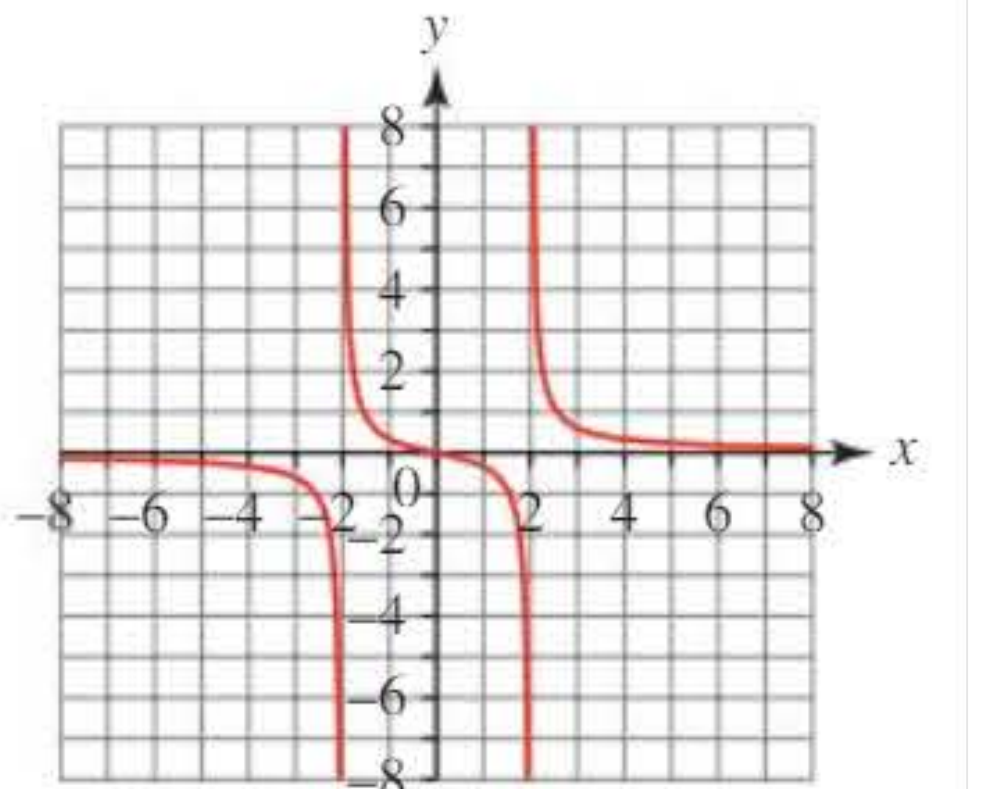
Example: Proper Rational Function
Consider the function
This function has:
- Vertical asymptotes at and (where the denominator equals zero)
- Horizontal asymptote at (because the denominator degree is greater)
As gets very large, the term in the denominator grows much faster than the in the numerator, causing the function to approach zero.
Improper rational functions
An improper rational function has a numerator with a degree greater than or equal to the denominator's degree. For these functions, the logic changes. The numerator starts to dominate for large values of , so the function no longer tends to zero. Instead, it approaches a slant line.
Example
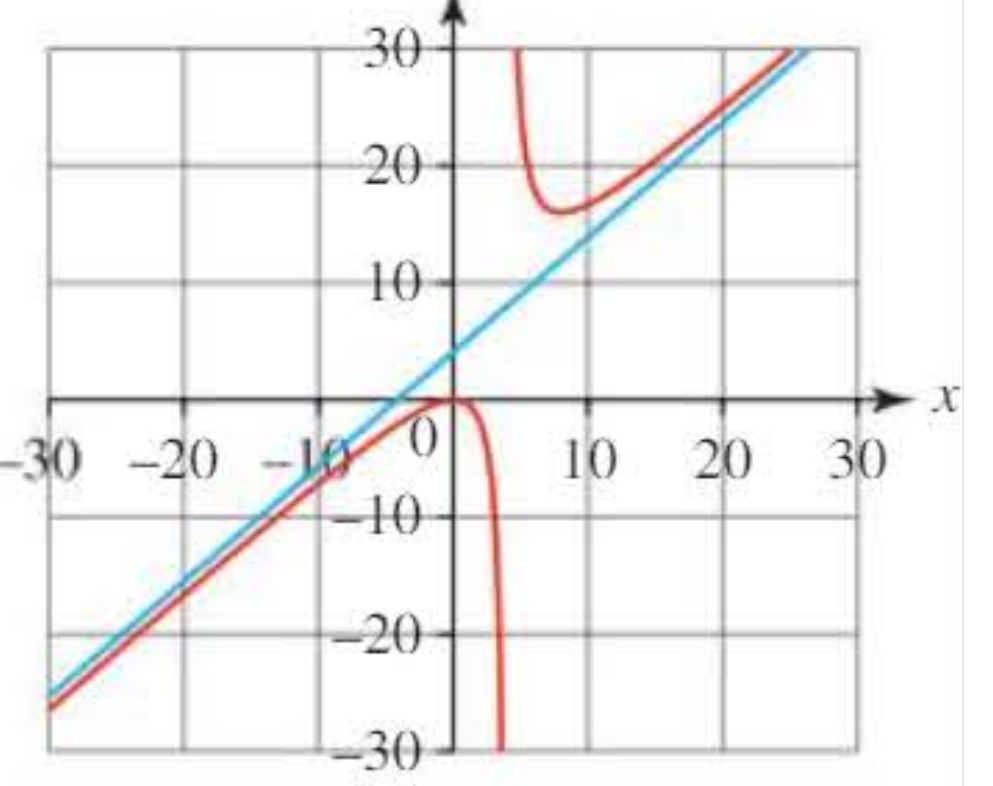
Example: Improper Rational Function
Consider the function
This function has:
- Vertical asymptote at (where the denominator equals zero)
- Oblique asymptote (shown in the graph below)
Important
Key Distinction:
- Proper functions (numerator degree < denominator degree) → horizontal asymptote at
- Improper functions (numerator degree ≥ denominator degree) → oblique asymptote (diagonal line)
The degree comparison is crucial for determining which type of asymptote to look for!
Finding oblique asymptotes using algebraic long division
To find the equation of an oblique asymptote, you must use algebraic long division to rewrite the improper rational function.
The method
- Divide the numerator by the denominator using long division
- Express the function in the form:
- is the quotient (this gives the oblique asymptote equation)
- is the remainder fraction
- As , the remainder fraction
- Therefore, , and the oblique asymptote has equation
Why this works
When becomes very large, the fractional remainder part becomes negligible (approaches zero), leaving only the "whole" part . The function approaches this line but never quite reaches it.
Note
Understanding the Process:
Think of long division as separating the rational function into two parts:
- A polynomial part that dominates for large
- A remainder fraction that becomes insignificant as
This is why the oblique asymptote is simply the quotient - it's what remains when the negligible part disappears!
Important
Key Point: You find the equation of an oblique asymptote by dividing the function out to find the 'whole' part and setting equal to this. The remainder is ignored because it approaches zero for large .
Worked example 1: Finding asymptotes
Example
Worked Example: Finding Asymptotes
Question: Find the equations of the asymptotes of the curve
Solution:
Step 1: Find the vertical asymptote.
There is a vertical asymptote at because the function is undefined when (the denominator would be zero).
Step 2: Use algebraic long division to divide out the function.
Dividing by :
Performing the division:
- Multiply:
- Subtract:
- Bring down:
- Multiply:
- Subtract:
Therefore:
Step 3: Identify the oblique asymptote.
As , the term
Hence
There is an oblique asymptote with equation
Worked example 2: Finding unknowns given an asymptote
Example
Worked Example: Finding Unknowns Given an Asymptote
Question: A curve with equation has an asymptote
a) Find the values of and
b) Write down the equation of the other asymptote
c) Without using calculus, find the coordinates of the turning points
d) Sketch the curve
Solution:
Part a) Find the values of and
The oblique asymptote is found by dividing the numerator by the denominator. If the asymptote is , then when we multiply this by the denominator, we should get the numerator (plus a remainder).
Multiply the asymptote by the denominator:
Comparing with :
The coefficient of gives:
The coefficient of gives:
The rational function is
Part b) Write down the equation of the other asymptote
The vertical asymptote occurs where the denominator equals zero:
Therefore:
Part c) Find the coordinates of the turning points
The range of allowable values of can be found by setting and solving for :
For real solutions, the discriminant must be non-negative:
Using the quadratic formula to find when :
Therefore: or
The curve exists for and
There will be a minimum point at and a maximum point at
To find the -values for these turning points, substitute the -values into the original function:
For the minimum:
Solving:
For the maximum:
Solving:
Turning points:
- Minimum at
- Maximum at
Part d) Sketch the curve
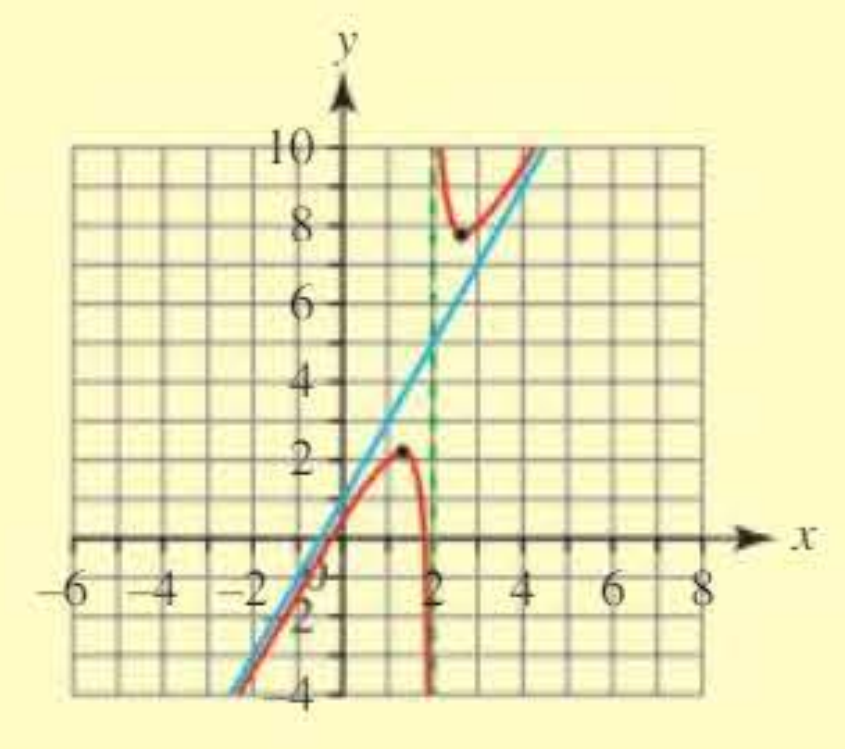
Draw both asymptotes (the vertical line and the oblique line ). Mark the turning points and sketch the curve approaching the asymptotes.
Note
Understanding Part c):
The method used here exploits the fact that turning points occur where the function reaches its extreme values. By setting and finding when the resulting quadratic in has a discriminant of zero, we identify the boundary values of - these are precisely where the turning points occur.
Strategy for finding unknowns in rational functions
When you are given the equation of an oblique asymptote and need to find unknown coefficients in the rational function:
Important
Reverse Engineering Method:
Step 1: Multiply the asymptote equation by the denominator of the rational function to form a quadratic expression in the form
Step 2: Read off the values of and/or from this quadratic. These will correspond to the coefficients in the numerator of the rational function.
This method works because the oblique asymptote represents the quotient when you divide the numerator by the denominator - so multiplying back reverses the division!
Key facts to remember
Types of asymptotes for rational functions
| Type | When it occurs | How to find it |
|---|---|---|
| Vertical | Denominator equals zero | Solve denominator = 0 |
| Horizontal | Proper function (numerator degree < denominator degree) | typically |
| Oblique | Improper function (numerator degree ≥ denominator degree) | Use algebraic long division |
Essential points for exam success
Summary
Key Points to Remember:
- Always check if a rational function is proper or improper before looking for asymptotes
- Improper rational functions have oblique asymptotes, not horizontal ones
- Use long division systematically - write out each step clearly
- The oblique asymptote equation is the quotient (ignore the remainder)
- Vertical asymptotes occur where the denominator is zero (function undefined)
- When sketching, draw asymptotes first as dashed lines, then sketch the curve approaching them
Important
Common Mistakes to Avoid:
- Don't confuse proper and improper functions - the degree comparison determines the asymptote type
- Don't forget to check for vertical asymptotes even when focusing on oblique asymptotes
- Don't include the remainder when stating the oblique asymptote equation
- Always show your long division working clearly in exams
Remember!
Summary
Summary: Oblique Asymptotes
- Oblique asymptotes occur when a rational function is improper (numerator degree ≥ denominator degree)
- Use algebraic long division to rewrite the function as , where is the oblique asymptote equation
- As , the remainder term approaches zero, leaving only the oblique asymptote line
- To find unknown coefficients when given an asymptote equation, multiply the asymptote by the denominator and compare with the numerator
- Always identify both vertical and oblique asymptotes before sketching the curve