First Order Equations (AQA A-Level Further Maths): Revision Notes
📚Revision Notes
First Order Equations
What is a first order differential equation?
A first order differential equation is an equation that contains only a first derivative, such as , along with the variables and . These equations describe how one quantity changes in relation to another, and they appear frequently in physics, engineering, and other sciences.
Note
First order differential equations are used to model real-world phenomena such as population growth, radioactive decay, cooling processes, and motion under varying forces. Understanding how to solve these equations is essential for analyzing dynamic systems.
There are several methods available for solving first order differential equations. The choice of method depends on the structure of the equation you're working with.
Methods for solving first order differential equations
Separating the variables
One approach is called separating the variables. This method works when you can rearrange the equation so that all terms involving appear on one side and all terms involving appear on the other side. You can then integrate both sides separately to find the solution.
Using an integrating factor
Another powerful method involves using an integrating factor. This technique is particularly useful when the equation cannot be easily separated into distinct and terms. The integrating factor transforms the equation into a form that can be integrated directly.
Note
Choosing the right method:
- If you can easily separate all terms from all terms, use separation of variables
- If the equation cannot be separated, try using an integrating factor
- Look for patterns that match the derivative of a product to identify exact equations
Exact equations
An exact equation is a special type of differential equation where the left-hand side can be recognised as the derivative of a product. When you can identify this pattern, you can integrate both sides immediately without additional manipulation.
For example, if you notice that the left side matches , you can write the equation in this form and integrate directly. This is the product rule working in reverse.
The integrating factor method
Standard form
To use the integrating factor method, you first need to arrange your differential equation into the standard form:
In this form, and are functions that depend only on the variable . The coefficient of must be 1, and the term containing must be on the same side as the derivative.
Important
Key requirements for standard form:
- The coefficient of must equal 1 (divide through by the coefficient if necessary)
- The term must be on the left side with the derivative
- Both and must be functions of only, with no terms on the right side
Finding the integrating factor
The integrating factor is defined as:
To understand why this works, consider differentiating a product of the form . Using the product rule:
This matches exactly the left side of the equation after multiplying through by the integrating factor.
Note
The integrating factor formula may look complicated, but it systematically transforms any equation in standard form into an exact equation. You don't need to include the constant of integration when finding the integrating factor itself.
Solving the equation
Once you have found the integrating factor, follow these steps:
- Multiply every term in the equation by the integrating factor
- Recognise that the left side is now an exact equation (the derivative of a product)
- Integrate both sides with respect to
- Rearrange to make the subject
General and particular solutions
When you solve a differential equation, the result typically includes a constant of integration, . This is called the general solution because it represents a family of curves, one for each value of .
If you are given initial conditions (specific values of and ), you can substitute these values into the general solution to find the exact value of . This gives you the particular solution, which is the specific curve that passes through the given point.
Important
General vs Particular Solutions:
- A general solution contains an arbitrary constant and represents infinitely many possible solutions
- A particular solution has a specific value for determined by initial conditions
- Always check whether the question asks for general or particular solution
Using substitutions
Sometimes a differential equation appears too complex to solve directly using an integrating factor. In these cases, you can use a substitution to transform it into a simpler equation that can be solved using standard methods.
Note
Substitution strategy: When using substitutions, remember to:
- Use the chain rule to find in terms of the new variable
- Substitute both and into the original equation
- Solve the transformed equation (often simpler)
- Substitute back to express your answer in terms of the original variables
The key steps are:
- Identify an appropriate substitution (often given in the question)
- Find an expression for using the chain rule
- Substitute into the original equation
- Solve the transformed equation using an integrating factor
- Substitute back to find in terms of
Worked examples
Example
Worked Example 1: Solving using exact equations
Question: Solve the differential equation , giving your answer in the form .
Solution:
The left-hand side can be recognised as the derivative of a product. Specifically, it matches the pattern for .
Step 1: Recognise the left side as a product derivative:
Step 2: Integrate both sides:
Step 3: Rearrange to express in terms of :
This example shows how recognizing the product rule pattern allows immediate integration without needing an integrating factor.
Example
Worked Example 2: Using an integrating factor
Question: Solve the differential equation , for .
Solution:
This equation is already in standard form with and .
Step 1: Find the integrating factor:
Step 2: Multiply through by the integrating factor:
Since :
Step 3: Recognise this is now an exact equation:
Step 4: Integrate both sides:
You can leave the solution in implicit form: .
Example
Worked Example 3: Finding particular solutions
Question: a) Find the general solution to the equation
b) Given that when , find the particular solution.
Solution:
Part a: First, rearrange into standard form:
So and the integrating factor is:
Multiply throughout by :
Recognise the exact equation:
Integrate both sides:
Therefore, the general solution is:
Part b: Substitute and :
Therefore, the particular solution is:
This example demonstrates how initial conditions allow you to find a specific value for the constant of integration.
Example
Worked Example 4: Using substitutions
Question: a) Use the substitution to transform the differential equation into the differential equation
b) Hence use an integrating factor to find the general solution to the differential equation in the form .
Solution:
Part a: Find an expression for using the chain rule:
Now substitute into the original equation. Since and :
Divide through by :
Part b: This is now in standard form with .
Find the integrating factor:
Multiply through by the integrating factor:
The left side is the derivative of :
Therefore:
Substitute back for and make the subject:
Notice how the substitution transformed a complex equation into one solvable by standard methods.
Example
Worked Example 5: Application to population growth
Question: A population of bacteria has an initial size of 100. After hours, the size of the population is . The connection between and can be modelled by the equation .
a) Solve this equation to show that
b) Find the size of the population after 24 hours.
c) Prove that the number of bacteria never falls below 40.
Solution:
Part a: Rearrange into standard form:
The integrating factor is:
Multiply through by :
The left side becomes:
Integrate using integration by parts:
Use initial conditions: when , :
Therefore:
Part b: Substitute :
The population after 24 hours is approximately 1175 bacteria.
Part c: To find the minimum value, set :
From the solution:
Setting equal:
At this time:
By inspection, this is a minimum (as increases before and after this point), so the value of never falls below approximately 40.
Example
Worked Example 6: Raindrop velocity
Question: A raindrop falls vertically through a cloud. Initially the raindrop is at rest. At time seconds, the velocity m s⁻¹ of the raindrop satisfies the equation .
a) Solve this equation to find an expression for in terms of
b) Find the time at which the velocity of the raindrop is 21 m s⁻¹
c) Criticise the model.
Solution:
Part a: Rearrange into standard form:
The integrating factor is:
Multiply throughout by :
Note that the equation was already in the form , where the integrating factor is .
The left side is:
Integrate:
Use initial conditions: when , :
Therefore:
Part b: Set :
Multiply through by :
So seconds (taking the positive value).
Part c: Under this model, as increases, becomes unlimited. However, in practice, the raindrop would approach a terminal velocity due to air resistance. The model fails to account for this physical limitation.
Example
Worked Example 7: Rocket velocity
Question: A fuel-filled rocket of mass 25 kg burns fuel at a rate of 2 kg s⁻¹. The rocket is initially at rest. After seconds, the velocity m s⁻¹ of the rocket satisfies the equation for .
a) Show that
b) Find the speed of the rocket when
c) Sketch a graph of against
d) What happens for ?
Solution:
Part a: Rearrange into standard form:
The integrating factor is:
Multiply throughout by :
The left side is:
Integrate:
Use initial conditions: when , :
Therefore:
Part b: When :
The rocket has a speed of 80 m s⁻¹ when seconds.
Part c: The graph shows velocity increasing from 0 at in a curved manner, reaching 80 m s⁻¹ at .
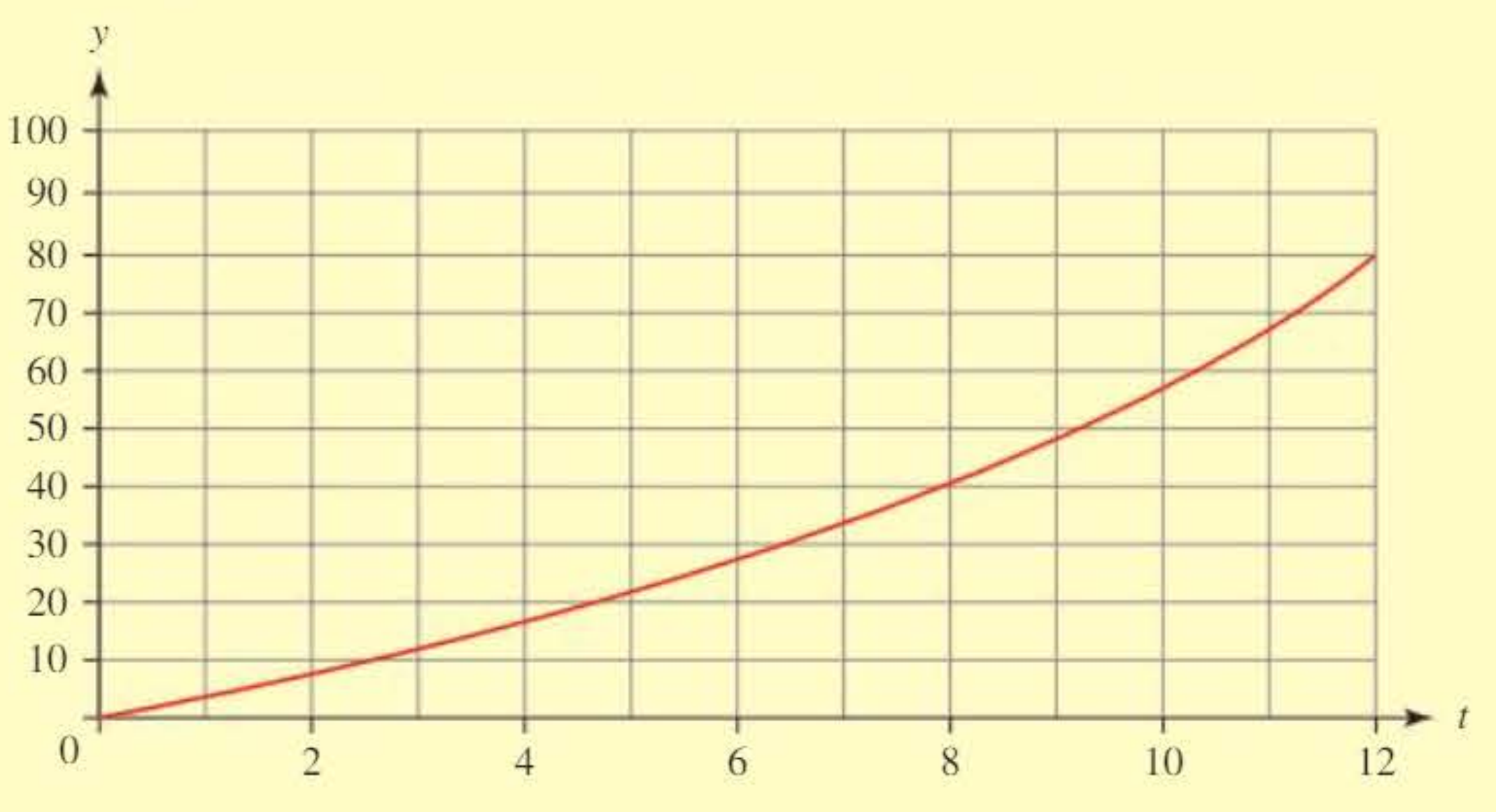
Part d: For , the square root becomes negative, so the solution does not make sense physically. The rocket has burned all of its fuel by , so the equation no longer applies. A different model would be needed to describe the motion after this point.
Problem-solving strategy for first order equations
When answering exam questions involving first order differential equations, follow this systematic approach:
Note
Four-step approach for solving differential equations:
Step 1: Decide on the method Determine whether to separate the variables or use an integrating factor. Look at the structure of the equation to make this decision.
Step 2: Find the general solution Apply your chosen method to find the general solution of the differential equation. This will include a constant of integration, .
Step 3: Find the constant If initial conditions are provided, substitute the given values into your general solution to find the specific value of . This gives you the particular solution.
Step 4: Answer in context Make sure your final answer addresses the original question. If the question asks about a real-world scenario, interpret your mathematical result in that context.
Summary
Key Points to Remember:
-
A first order differential equation contains only first derivatives like .
-
The standard form for using an integrating factor is , where and depend only on .
-
The integrating factor is always . After multiplying through by this factor, the left side becomes an exact equation.
-
An exact equation can be recognised as the derivative of a product, allowing you to integrate directly.
-
A general solution includes the constant of integration and represents a family of curves. A particular solution is found by using initial conditions to determine the specific value of .
-
When the equation cannot be solved directly, consider using a substitution to transform it into a more manageable form.
-
Always check whether the question requires a general or particular solution, and ensure your answer is in the requested form.