Mean Values (AQA A-Level Further Maths): Revision Notes
📚Revision Notes
Mean Values
Introduction to mean values
Integration provides a powerful tool for finding the area under a curve. When we have a function , the mean value of this function over an interval gives us important information about the average behaviour of the function.
The mean value is closely connected to the concept of area. If we know the area under a curve between two points, we can find the average height of the function over that interval. This average height is the mean value.
Note
The mean value represents a fundamental connection between integration and averaging. Just as we can find the area under a curve through integration, we can use that area to determine the average height of the function over any interval.
The Mean Value Theorem
Important
The Mean Value Theorem tells us that for any continuous function, there exists a rectangle with exactly the same area as the region under the curve. This is a fundamental concept in calculus that links geometric area to algebraic computation.
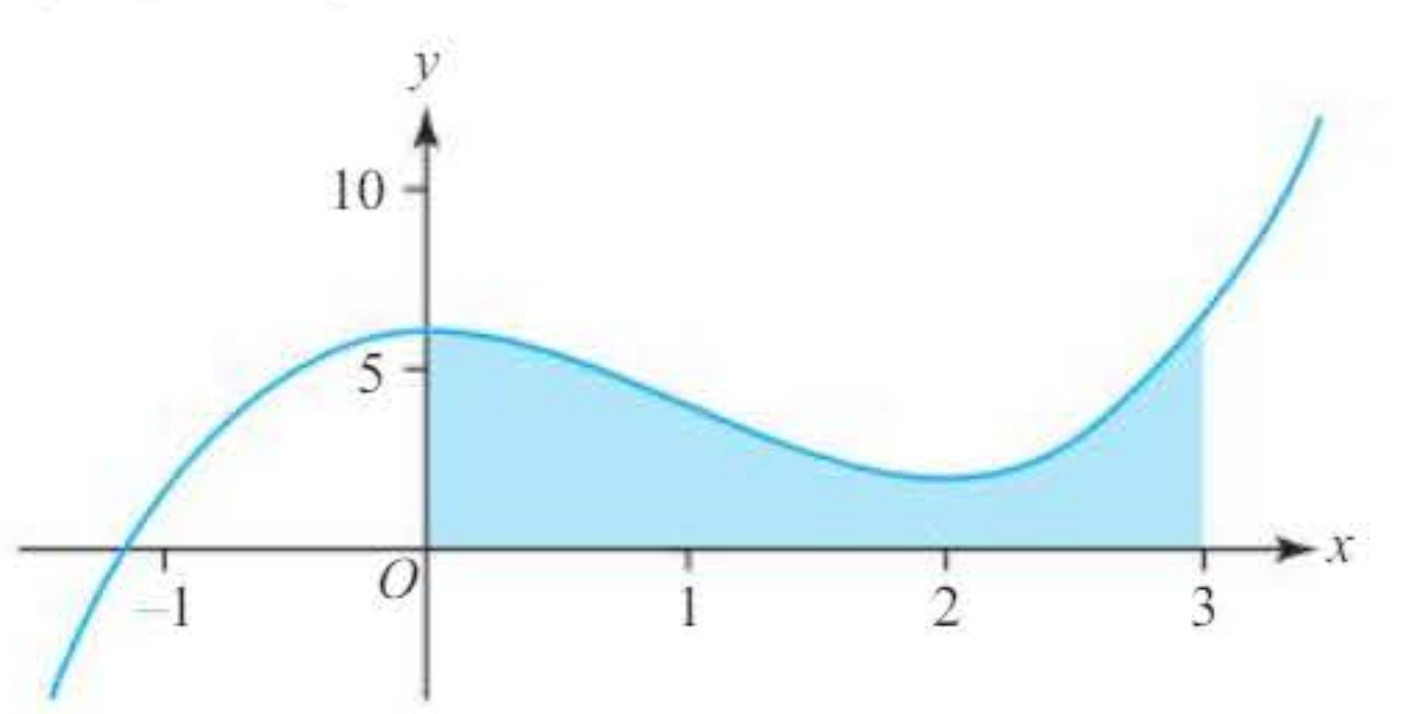
Consider a function between and . The area under the curve is given by:
Now imagine a rectangle with:
- Base from to (width = )
- Height (to be determined)
For this rectangle to have the same area as the region under the curve, we need:
Therefore, the height can be found by dividing the area by the width:
This height is called the mean value of the function over the interval .
Mean value formula
Important
Definition: The mean value of a function over the interval is given by:
This formula tells us:
- We integrate the function over the interval
- We divide by the width of the interval
- The result is the average height of the function
Note
Key points:
- The mean value represents the constant height that would give the same area as the actual function
- It is always calculated over a specific interval
- The interval width appears in the denominator
- The formula applies to any continuous function
Worked examples
Example
Worked Example 1: Mean value of a polynomial function
Question: Calculate the mean value of the function in the interval .
Solution:
Using the mean value formula with and :
Integrate term by term:
Substitute the limits:
Therefore, the mean value is or .
Example
Worked Example 2: Mean value with respect to a variable
Question: Calculate the mean value with respect to of the function for .
Solution:
First, expand the brackets:
Apply the mean value formula with and :
Substitute the limits:
Therefore, the mean value is or approximately .
Example
Worked Example 3: Mean velocity and mean acceleration
Question: The velocity of a particle after seconds is given by ms.
a) Show that the mean velocity for is ms to 3 significant figures.
b) Calculate the mean acceleration of the particle over the same time period.
Solution:
Part a:
First, simplify the velocity expression:
Apply the mean value formula:
Part b:
Acceleration is the rate of change of velocity:
From , we find:
Using the fundamental theorem of calculus:
Exam tip: When calculating mean acceleration from velocity, you can use the mean value of , which equals by the fundamental theorem of calculus.
:::
Example
Worked Example 4: Finding unknown limits
Question: The mean value of the function in the interval is and in the interval is . Calculate the values of and .
Solution:
For the first interval :
For the second interval :
From equation (1):
From equation (2):
Subtracting equation (1) from equation (2):
Substituting back into equation (1):
Therefore, and .
Example
Worked Example 5: Mean value with surds
Question: Given that , show that the mean value of for in the interval is .
Solution:
First, rewrite the function using index notation:
Apply the mean value formula:
Substitute the limits:
Exam tip: When dealing with surds or square roots, it's often helpful to rewrite them using fractional indices before integrating. This makes the integration process much clearer.
:::
Problem-solving strategy for mean values
When solving problems involving mean values, follow this systematic approach:
Note
Step 1: Use the formula for the mean value of a function
- Identify the function and the interval
- Write down:
Step 2: Form equations using the information provided
- If the mean value is given, set up an equation
- For multiple intervals, create multiple equations
- Simplify the expressions before solving
Step 3: Solve the resulting equations
- These may be linear, quadratic, or simultaneous equations
- Use appropriate algebraic techniques
- Check your solutions make sense in context
Applications in kinematics
Mean values have important applications in mechanics and kinematics, particularly when analyzing motion over time intervals.
Note
Mean velocity: If displacement is and velocity is , then:
Mean acceleration: If velocity is and acceleration is , then:
Important
The mean acceleration can often be calculated directly from the velocity values at the endpoints, rather than integrating the acceleration function. This provides a useful shortcut: use whenever possible.
Common exam tips
When tackling mean value problems in examinations, following a methodical approach will help you avoid common errors and present clear solutions.
When calculating mean values:
- Always show the setup with the formula
- Simplify the function before integrating where possible
- Use index laws to convert roots and fractions to power form
- Don't forget to divide by the interval width
- Check your limits carefully when substituting
Important
Common pitfalls to avoid:
- Forgetting to divide by after integrating - this is the most common error
- Using the wrong limits in the integral
- Arithmetic errors when evaluating at limits
- Not simplifying the function before integrating
- Confusing mean value with just the integral
For problem-solving questions:
- Read carefully to identify what is given and what to find
- Set up equations methodically for each condition
- Show all algebraic working clearly
- Factorise expressions to simplify equations
- Verify your final answer makes sense
Summary
Key Points to Remember:
-
The mean value of a function over an interval is given by the formula:
-
The mean value represents the height of a rectangle that has the same area as the region under the curve between and
-
Always simplify the function before integrating, particularly when dealing with products, fractions, or surds. Use index notation where helpful
-
For kinematics problems, the mean acceleration can be found using rather than integrating the acceleration function
-
When solving problems with unknown limits, set up equations using the mean value formula for each given condition, then solve the system of equations systematically