Numerical Integration (AQA A-Level Further Maths): Revision Notes
📚Revision Notes
Numerical Integration
Introduction to numerical integration
When finding the area under a curve, we normally integrate the function between appropriate limits. However, some functions cannot be integrated using standard analytical methods. Examples include:
Additionally, we may have experimental data from measurements where no equation for the curve exists. In these situations, we use numerical integration methods to estimate the area under the curve.
Note
Numerical integration is essential in two key scenarios:
- When functions are theoretically impossible to integrate using standard calculus techniques
- When working with real-world data where we only have measured values rather than a continuous function
Even though certain functions cannot be integrated analytically, they can still be plotted on a graph, and the area beneath them exists. Numerical methods allow us to approximate this area to a high degree of accuracy.
Mid-ordinate rule
What is the mid-ordinate rule?
The mid-ordinate rule is a straightforward numerical method that approximates the area under a curve by dividing the region into vertical rectangular strips. The height of each rectangle is determined by the y-value (ordinate) at the centre of that strip's width.
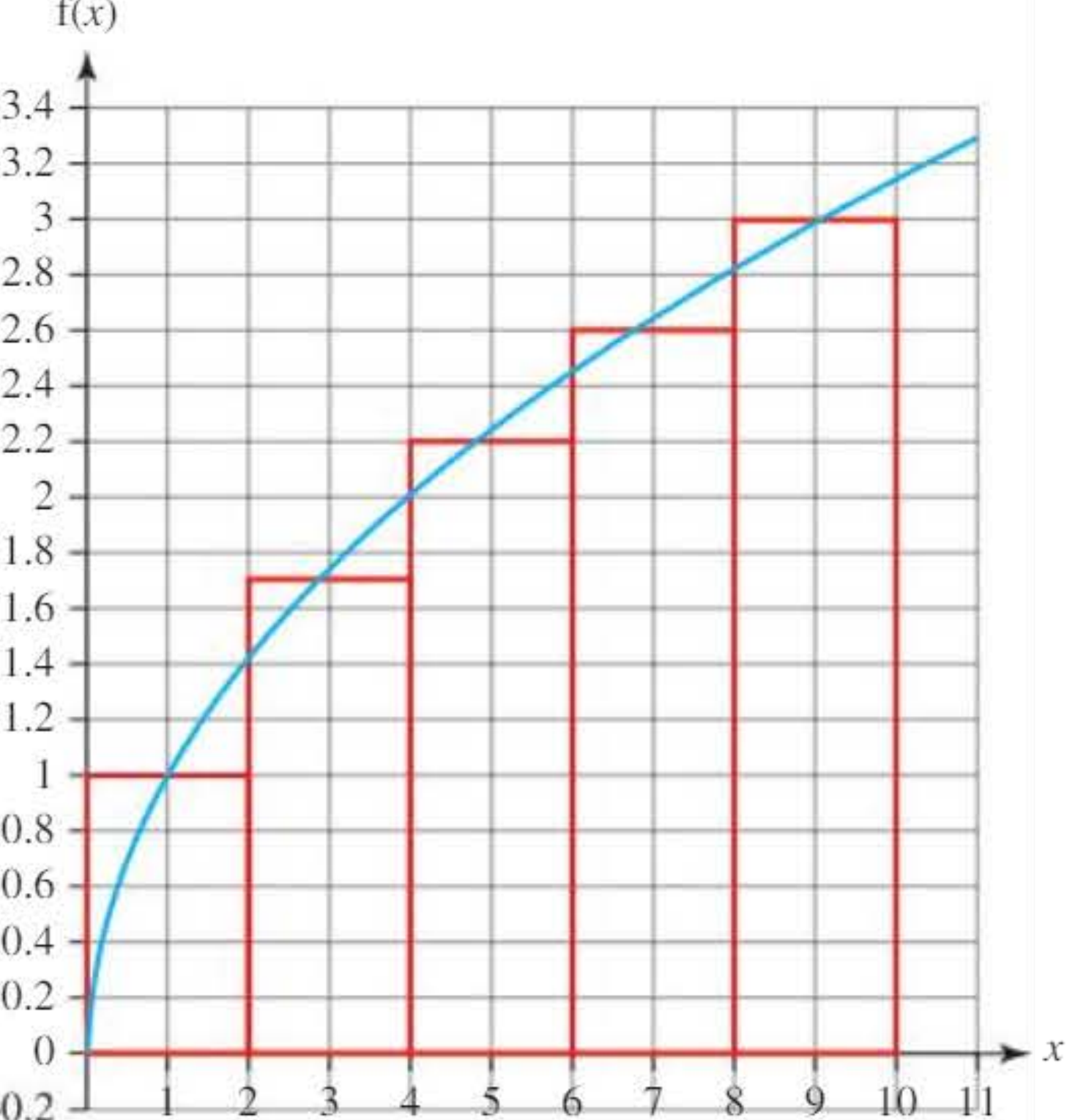
How the mid-ordinate rule works
To apply this method:
- Divide the required area into equal vertical strips
- Calculate the width of each strip: where is the interval
- Find the y-value at the midpoint of each strip
- Multiply each y-value by the strip width
- Sum all the rectangular areas
Important
Key advantage of the mid-ordinate rule:
Errors tend to balance out. Where a small area above the curve is included (over-estimate), there is usually a corresponding small area beneath the curve that is missed (under-estimate). This compensation improves the overall accuracy.
Mid-ordinate rule formula
Definition: If we divide the area to be estimated under a function from to into rectangles, and let the ordinates at the centre of each rectangle be , then the estimated area is:
Note
Key point: The more rectangles used, the more accurate the estimate becomes, because each strip width decreases and the rectangles fit the curve more closely.
Worked example 1: Mid-ordinate rule with quadratic function
Example
Worked Example: Applying the Mid-ordinate Rule
Problem: For the function :
- Draw the graph
- Divide the area between the curve and the x-axis into 10 rectangles
- Estimate the area using the mid-ordinate rule
- Find the exact area using calculus
- Calculate the relative error
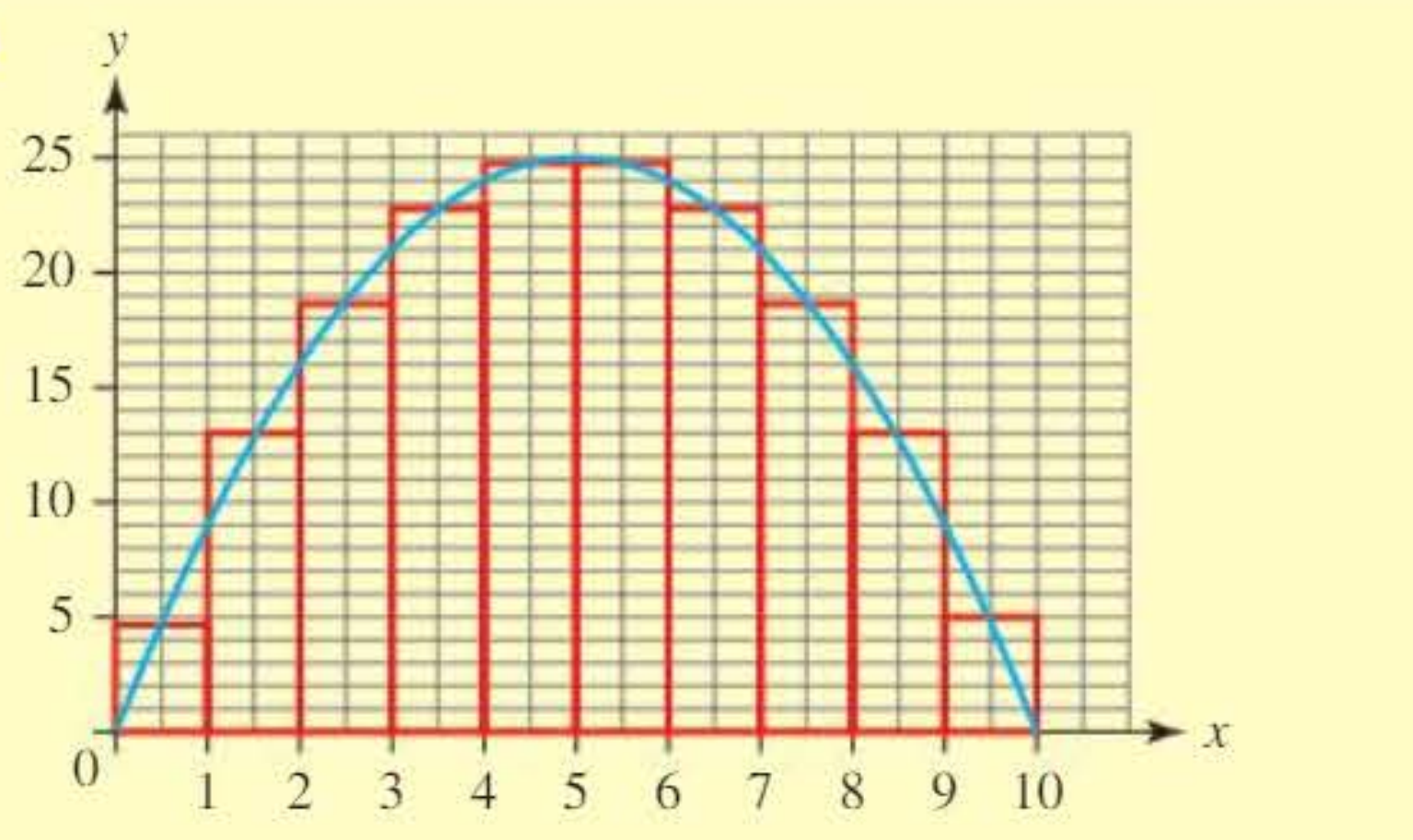
Solution:
Part (a): The graph shows a parabola opening downwards with maximum at .
Part (b): With 10 rectangles from to , the width of each rectangle is:
Part (c): The mid-ordinates occur at
Calculate each y-value:
- At :
- At :
- At :
Continuing this pattern and summing:
Part (d): Using integration to find the exact area:
Part (e): The relative error is calculated as:
The negative value indicates the approximation underestimated the true area by approximately 2.35%.
Simpson's rule
Why Simpson's rule?
While the mid-ordinate rule is simple to apply, Thomas Simpson published a more sophisticated method in 1743 that achieves greater accuracy. Simpson's rule eliminates the discrepancies at the top of each rectangle by replacing the mid-ordinates with a quadratic curve (parabola). Just as you can always draw a straight line between two points, you can always draw a parabola through three points.
Understanding Simpson's rule
Simpson's rule works by fitting a parabola through three consecutive points on the curve. The area under this parabola can be calculated exactly using integration.
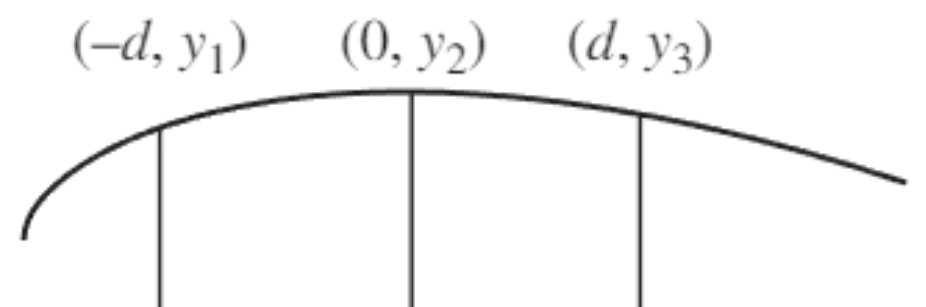
Consider three points on a parabola with equation , positioned symmetrically at , , and .
The area under this parabola from to is:
By substituting the three coordinate points into the parabola equation, we can show that:
Adding these equations:
Multiplying by :
This is Simpson's rule for three points:
Extension to multiple strips
To find the area under a longer section of curve, we divide it into an even number of strips, creating pairs of strips. Each pair uses Simpson's formula.
For example, with 8 strips (4 pairs), the total area is:
Collecting terms:
General Simpson's rule formula
Definition: If the area required is divided into strips of equal width , where is even, then:
Important
Critical requirement: Simpson's rule requires an even number of strips. This is non-negotiable for the method to work correctly.
Pattern of coefficients: 1-4-2-4-2-4-2-...-4-2-4-1
The pattern is:
- First and last ordinates: coefficient of 1
- Odd-numbered ordinates: coefficient of 4
- Even-numbered ordinates (except first and last): coefficient of 2
Note
Simpson's rule is much more accurate than dividing the area into just two strips using the mid-ordinate rule, even when using fewer strips overall.
Worked example 2: Simpson's rule with quadratic function
Example
Worked Example: Simpson's Rule with a Quadratic
Problem: Use Simpson's rule with ten strips to find the approximate area for from to .
Solution:
With strips, the width is .
Create a table of values:
| 0 | 1 | 2 | 3 | 4 | 5 | 6 | 7 | 8 | 9 | 10 | |
|---|---|---|---|---|---|---|---|---|---|---|---|
| 0 | 9 | 16 | 21 | 24 | 25 | 24 | 21 | 16 | 9 | 0 |
Apply Simpson's formula:
Comment: Since is a quadratic function and Simpson's rule uses parabolic approximation, the answer is exact rather than approximate.
Worked example 3: Volume of a vase
Example
Worked Example: Finding Volume Using Simpson's Rule
Problem: A decorative vase has circular cross-sections. The radius cm at height cm above the base is shown in the table below. The vase is 40 cm high. Estimate the volume in litres.
| 0 | 5 | 10 | 15 | 20 | 25 | 30 | 35 | 40 | |
|---|---|---|---|---|---|---|---|---|---|
| 6 | 5 | 11 | 13 | 15 | 13 | 11 | 5 | 6 |
Solution:
The volume can be found by calculating the area under a graph of circular cross-sectional area () plotted against height.
With 8 strips, width cm.
The areas of cross-sections are: , etc.
Using Simpson's rule:
Worked example 4: Estimating π
Example
Worked Example: Estimating π Using Numerical Integration
Problem: The equation of a circle with radius 12 is . Using Simpson's rule in the first quadrant with 12 equal intervals, find an estimate for correct to 2 decimal places. Calculate the relative error.
Solution:
From , we get
The area in the first quadrant is:
With 12 strips, . Calculate y-values:
| 0 | 1 | 2 | 3 | 4 | 5 | 6 | 7 | 8 | 9 | 10 | 11 | 12 | |
|---|---|---|---|---|---|---|---|---|---|---|---|---|---|
| 12 | 11.958 | 11.832 | 11.619 | 11.314 | 10.909 | 10.392 | 9.747 | 8.944 | 7.937 | 6.633 | 4.796 | 0 |
Apply Simpson's rule:
This area represents one quarter of the circle's area:
The relative error is:
The estimate is accurate to within 0.3%.
Accuracy and error calculation
Relative error formula
To assess how accurate an approximation is, we calculate the relative error:
This gives a proportional measure of the error. A negative relative error indicates the approximation is less than the exact value (underestimate), while a positive value indicates an overestimate.
Comparing methods
Note
Mid-ordinate rule:
- Simple to apply
- Reasonable accuracy with sufficient rectangles
- Errors partially cancel due to over and under-estimation
Simpson's rule:
- More accurate than mid-ordinate rule
- Uses parabolic approximation
- Requires even number of strips
- Gives exact results for quadratic functions
- Preferred for higher accuracy requirements
Exam tips
Important
Common Pitfalls to Avoid:
- Always check if n is even when using Simpson's rule
- Show your working clearly, including the coefficient pattern (1-4-2-4-...-1)
- Calculate relative error to 3 or 4 significant figures unless specified otherwise
- Remember: more strips generally means better accuracy, but Simpson's rule with fewer strips often beats mid-ordinate rule with more strips
- For quadratic functions, Simpson's rule gives the exact answer
- When creating tables of values, work systematically and check your arithmetic
Remember!
Summary
Key Points to Remember:
-
Numerical integration is used when functions cannot be integrated analytically or when working with experimental data only.
-
Mid-ordinate rule formula: where ordinates are taken at the centre of each strip. More rectangles improve accuracy.
-
Simpson's rule is more accurate because it uses parabolic curves instead of rectangles. The coefficient pattern is 1-4-2-4-2-...-4-2-4-1, and it requires an even number of strips.
-
Simpson's rule formula: where is the strip width.
-
Relative error measures accuracy: . A negative value means underestimation; positive means overestimation.