Series (AQA A-Level Further Maths): Revision Notes
📚Revision Notes
Maclaurin series 2
Introduction to Maclaurin series expansion
The Maclaurin series is a powerful tool for representing functions as infinite series of terms. When working with these series, we need to understand when they can be applied and how to use them effectively.
A convergent series is one where an infinite number of terms adds up to a finite sum. This is a crucial property because not all infinite series converge. For a function to be expanded using the Maclaurin series, three conditions must be met:
Note
Conditions for Maclaurin expansion:
- The function can be expressed as a convergent infinite series
- Each term in can be differentiated
- Each differentiated term has a finite value when
Important
Maclaurin series formula
The Maclaurin series formula for any suitable function is:
This formula is sometimes called the expansion of about . Notice that each term involves evaluating a derivative at and multiplying by the appropriate power of divided by a factorial.
Range of validity for standard functions
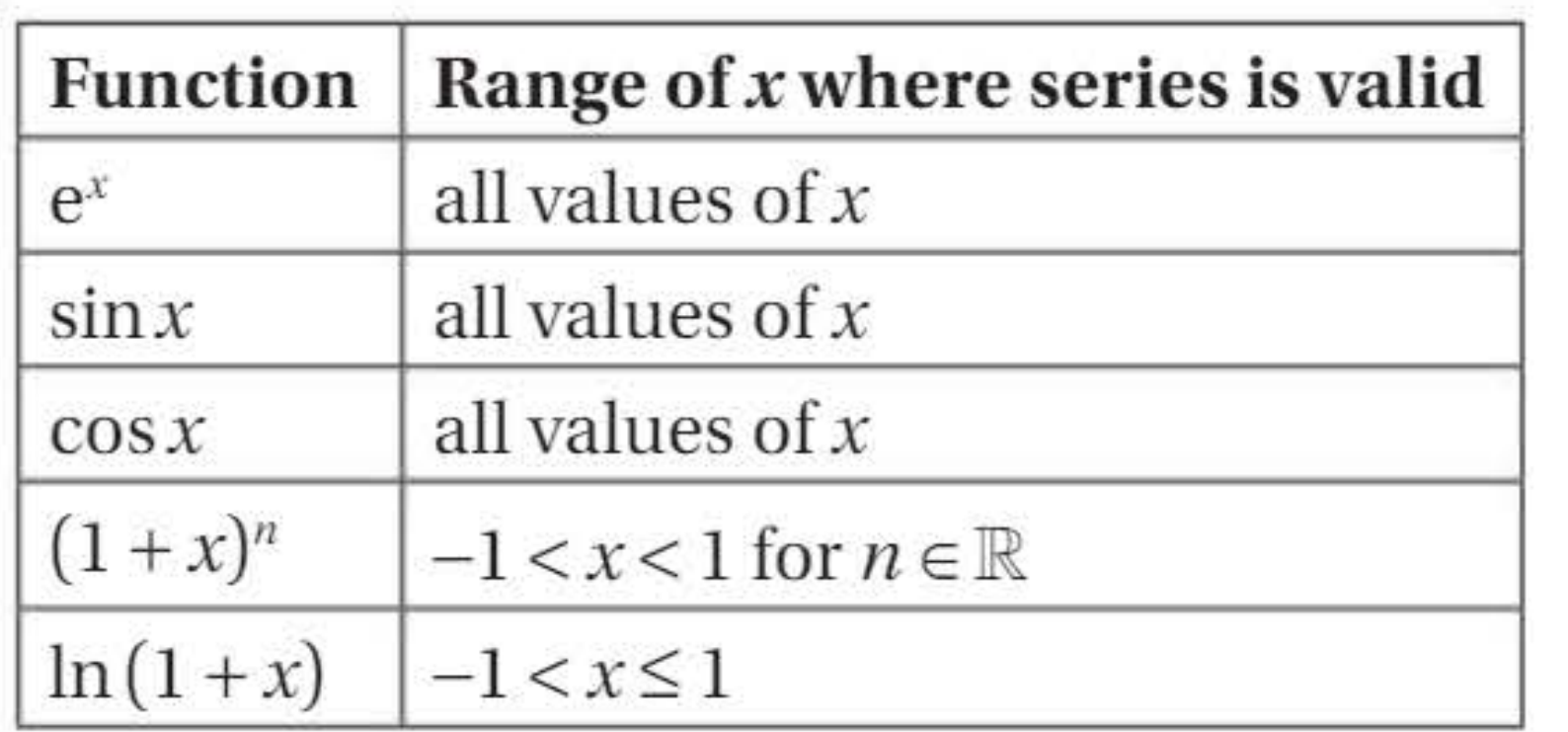
Not all Maclaurin series are valid for all values of . Different functions have different domains where their series expansions converge. Here are the ranges for commonly used functions:
Note
Key observations from the range of validity table:
- The exponential function and trigonometric functions and have series that work for all real values of
- The binomial series converges only when (provided )
- The natural logarithm series converges for
Exam tip: These ranges of validity are crucial. You should be able to derive these standard series yourself, not just memorise them.
Deriving Maclaurin series from first principles
To derive a Maclaurin series, we follow a systematic process of finding successive derivatives and evaluating them at .
Why some functions cannot be expanded
Important
Functions without Maclaurin series
Not every function has a Maclaurin series. Consider . When we try to find , we get , which is not finite. Therefore, a Maclaurin series for is not possible.
However, works because , which is finite.
Worked example: deriving
Let's derive the Maclaurin series for step by step.
Example
Worked Example: Deriving the Maclaurin series for
First, we need :
Next, find the first derivative using the chain rule:
Continue with higher derivatives:
Exam tip: The pattern becomes clear after a few terms and can be proved by induction if needed.
Now substitute these values into the Maclaurin formula:
Simplifying the factorials:
This shows the alternating pattern in the series for .
Multiplying Maclaurin series
Sometimes you need to find the expansion of a product of two functions by multiplying their individual Maclaurin series. When doing this, you only need to multiply terms up to the required power of .
Note
Technique for multiplying series:
When multiplying two Maclaurin series, you only need to multiply terms up to the required power of . This saves time and reduces the complexity of calculations. Focus on collecting like powers of after multiplication.
Worked example: expanding
Example
Worked Example: Expanding
Given that the first three terms of the series for are , we can find the expansion of up to the term in .
The method involves:
- Writing the series for by replacing with in the given series
- Using the series for that we derived earlier
- Multiplying the two series term by term, collecting like powers of
The final result is:
Exam tip: You only need to multiply terms as far as the highest power requested in the question. Don't waste time computing unnecessary higher-order terms.
Adapting standard series
You can create new series by adapting standard ones using algebraic manipulation and substitution. This is particularly useful for logarithmic functions.
Worked example: deriving
Example
Worked Example: Deriving the series for
To find the series for , we adapt the known series for .
The key steps are:
- Factor out the constant:
- Use laws of logarithms:
- Expand by replacing with in the expansion of
This gives:
Exam tip: When adapting series, always check that the substitution you make keeps the series within its range of validity.
General terms
Sequences and series can be represented by a formula for the general term, sometimes called the th term or th term. This provides a concise way to express patterns in sequences.
Note
Understanding general terms:
For example, the formula represents the sequence
When you know only the first few terms of a sequence, you need to find the th term by identifying patterns in the sequence structure. This skill is essential for working with Maclaurin series efficiently.
Worked example: finding general terms
Example
Worked Example: Finding general terms for series
For :
Starting with
We replace with to get :
The general term of the sequence for is or equivalently
For :
Starting with
We replace with :
The th term for is or equivalently
Exam tip: The general term formula must work for all values of from the starting index onwards. Test your formula with the first few terms to verify it's correct.
Using series to expand composite functions
When a function is the product of two functions, you can find its Maclaurin series by first finding the series for each component, then multiplying them together.
Worked example: expanding
Example
Worked Example: Expanding
To find the first four non-zero terms:
Step 1: Find the required derivatives using the product rule.
Starting with :
Step 2: Continue finding derivatives.
Step 3: Substitute into the Maclaurin formula.
Evaluate at :
Therefore:
Exam tip: When evaluating derivatives at , remember that and . This simplifies many calculations.
Limits
A limiting value, or limit, is a specific value that a function approaches or tends towards as the variable approaches a particular value. This concept is fundamental in calculus and is used extensively in differentiation from first principles.
The derivative of a function is defined as:
This gives the gradient of the curve at any value of .
Note
In the definition, is the limit as tends to zero. However, you can also find limits as variables approach other numbers, such as , , or .
Evaluating simple limits
Sometimes you can work out limits directly by substitution:
Manipulating expressions before finding limits
In other cases, you need to manipulate the function before finding the limit. For example, when finding , you must manipulate the expression first:
Worked example: evaluating limits
Example
Worked Example: Evaluating limits as
Part a:
Divide through by before finding the limit:
As ,
Therefore:
Part b:
Part c:
Part d:
Divide each term in numerator and denominator by :
Important
Exam tips for working with limits:
- Divide through by (or the highest power) before finding the limit
- Never write " if " or ""
- Instead, write " tends to as tends to "
- The symbol is not a number; " tends to " is a mathematical way of saying there is no limit to the size can take
Indeterminate forms
The expression is known as an indeterminate form when , because both numerator and denominator equal zero at this point, giving .
Important
When indeterminate forms occur
Indeterminate forms occur when, for an expression of the form in the limit as :
or
These forms cannot be evaluated directly because the result is ambiguous. Different functions giving rise to can have completely different limits.
For example:
- (not or undefined!)
All three expressions give when , but have different limits.
L'Hopital's rule
The French mathematician L'Hopital published a rule which provides a systematic method for evaluating limits of indeterminate forms.
Important
L'Hopital's rule
If is indeterminate, where is any real number or , then:
This method can be repeated as many times as necessary if is still indeterminate.
The rule says that when the limit of is indeterminate, it can usually be found by evaluating the limit of instead. In other words, differentiate the numerator and denominator separately, then find the limit of the resulting expression.
Worked example: using L'Hopital's rule
Example
Worked Example: Applying L'Hopital's rule
Part a:
This gives , so we apply L'Hopital's rule:
Therefore:
Part b:
This gives , so apply L'Hopital's rule:
This is still , so apply L'Hopital's rule again:
Therefore:
Exam tip: Sometimes you need to apply L'Hopital's rule more than once. Keep differentiating until you get an expression that can be evaluated directly.
Using Maclaurin series to evaluate limits
When you encounter an indeterminate limit such as or , you can use Maclaurin expansions as an alternative to L'Hopital's rule. This method is particularly elegant for certain types of problems.
Note
Strategy for solving problems involving Maclaurin series and limits:
- Derive the Maclaurin series from first principles or adapt a standard Maclaurin series
- Substitute the series into the expression
- Use the Maclaurin series or L'Hopital's rule to work out the limit of the function
Worked example: using series to find a limit
Consider
We need to adapt the known Maclaurin series for to calculate .
Example
Worked Example: Using Maclaurin series to evaluate
First, check if direct substitution works:
This is indeterminate, so we must use another method.
The standard Maclaurin series is:
Replace with to get :
Now substitute this series into the expression for :
Simplify the denominator:
Divide each term in numerator and denominator by :
Now find the limit:
Important
Exam tips for using Maclaurin series with limits:
- Substitute the series carefully, paying attention to signs
- Divide through by the lowest power of that appears in both numerator and denominator
- The Maclaurin series method often provides cleaner algebra than repeated application of L'Hopital's rule
Worked example: comparing methods
Consider and finding .
Example
Worked Example: Comparing Maclaurin series and L'Hopital's rule
Method 1: Using Maclaurin series
We know that
Replace with to get:
Therefore:
So:
Taking the limit:
Method 2: Using L'Hopital's rule
Direct substitution gives , so apply L'Hopital's rule:
Both methods give the same answer. The choice of method depends on the specific problem and personal preference.
Note
Exam tip: When asked to "use" a specific method (Maclaurin series or L'Hopital's rule), you must use that method. However, if asked to "find" a limit, you can choose the most efficient approach.
Remember!
Summary
Key Points to Remember:
-
Convergent series: An infinite series is convergent if the sum of all its terms equals a finite value. Only convergent series can be used as Maclaurin expansions.
-
Maclaurin series formula: This formula requires evaluating the function and all its derivatives at .
-
Range of validity: Each standard Maclaurin series has a specific range where it converges. For example, works for all , but only works for .
-
Multiplying series: When multiplying two Maclaurin series, multiply term by term and only calculate up to the required power of .
-
L'Hopital's rule for indeterminate forms: If gives or , then: Differentiate numerator and denominator separately, not as a quotient.
-
Alternative methods for limits: Maclaurin series provide an alternative to L'Hopital's rule. Substitute the series expansion, simplify, then take the limit. Both methods should give the same result.