The Equation of a Plane (AQA A-Level Further Maths): Revision Notes
📚Revision Notes
The Equation of a Plane
What is a plane?
A plane is a two-dimensional surface that extends infinitely in all directions. Think of it as a flat sheet that goes on forever in space. In three-dimensional geometry, we can describe planes using different mathematical forms.
Note
Understanding planes is fundamental to 3D geometry - they represent flat surfaces in space, similar to how lines represent one-dimensional objects in 2D geometry.
Vector equation of a plane
Defining a plane using position vectors
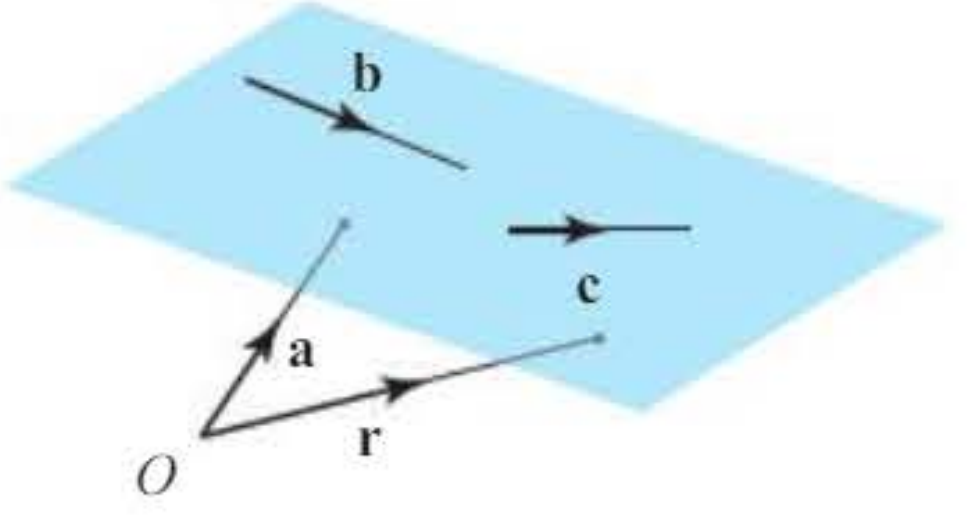
To define a plane, you need:
- A point on the plane with position vector a
- Two non-parallel vectors b and c that lie in the plane
Any other vector on the plane can be described as a combination of b and c. This means any point on the plane has position vector:
where and are scalar parameters that can take any real values.
Important
Key Definition: The vector equation of a plane containing point with position vector a and non-parallel vectors b and c is:
This equation describes every point on the plane by varying the parameters and .
Column vector form
You can also write the vector equation in column vector form:
Note
This form is particularly useful when working with coordinates directly, as it makes substitution and calculation more straightforward.
Worked example 1: Finding the vector equation
Example
Worked Example: Finding the Vector Equation of a Plane
Question: Find the equation of the plane containing the points , , and .
Solution:
First, choose one point as your reference. Let .
Now find two vectors in the plane by subtracting position vectors:
The vector equation is:
In column form:
Note: You can use any of the three points as a, and any combination of position vectors to create b and c, as long as they are not parallel.
Scalar product form
The normal vector
Consider a plane containing point with position vector a and with a perpendicular vector n. This perpendicular vector is called the normal to the plane.
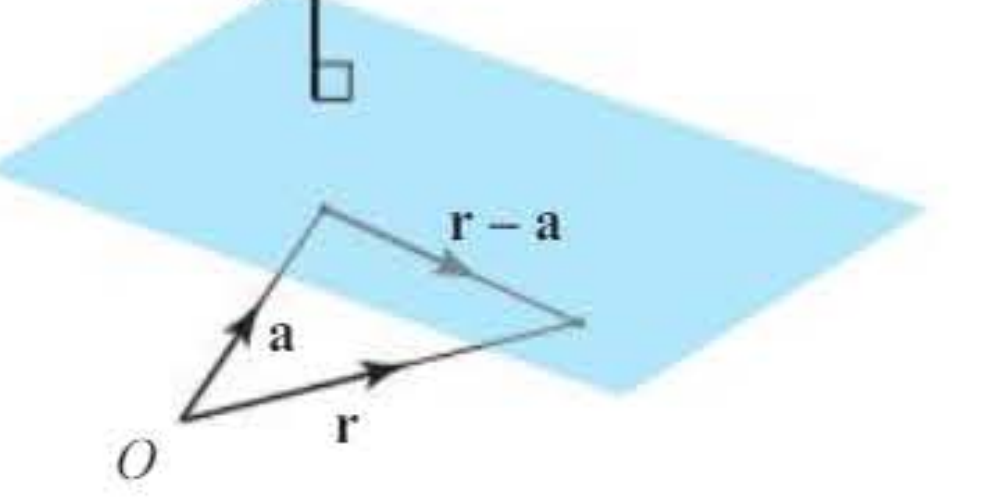
Any vector on the plane (such as ) will be perpendicular to the normal n.
Using the definition of scalar product:
Expanding the brackets:
Rearranging:
Important
Key Definition: The scalar product equation of a plane perpendicular to vector n and passing through point with position vector a is:
where
This form is particularly powerful because it uses the normal vector, which is perpendicular to the plane.
Finding the normal vector
If you know two vectors a and b that lie in the plane, you can find the normal vector using the vector cross product:
Note
The cross product gives a vector perpendicular to both a and b, hence perpendicular to the plane. This is one of the most important applications of the cross product in 3D geometry.
Cartesian form
Converting to Cartesian form
You can convert the scalar product form into Cartesian form by writing and calculating the scalar product.
Important
Key Definition: The Cartesian equation of a plane is:
where the vector is the normal (perpendicular) to the plane.
This is often the most convenient form for calculations and checking if points lie on the plane.
Worked example 2: Finding scalar product and Cartesian forms
Example
Worked Example: Converting Between Plane Equation Forms
Question: The plane contains vectors and , and passes through point . Find the equation of in:
- a) Scalar product form
- b) Cartesian form
Solution:
Part a) Scalar product form
First, find the normal vector using the cross product:
Calculate the determinant:
Now find the value of using point :
Position vector:
Therefore, the scalar product form is:
Part b) Cartesian form
Replace with :
Calculate the scalar product:
Rearranging:
Important
Exam Tip: Be careful with negative signs when calculating determinants and scalar products. Check your working carefully, especially the middle term in the cross product calculation.
Checking if two planes are the same
The vector equation of a plane is not unique because you can choose any two vectors and any point on the plane. However, the scalar product and Cartesian forms will simplify to a unique equation.
Strategy for checking if planes are identical
To check whether two equations represent the same plane:
- Check if the normal vectors are parallel - if they're not parallel, the planes are different
- Choose a point that you know is on one plane and check if it also lies on the other plane
- Conclude whether the planes are the same, parallel, or intersecting
Note
This two-step verification process is essential: parallel normals tell you the planes might be the same or parallel, and checking a common point confirms they are identical.
Worked example 3: Proving planes are identical
Example
Worked Example: Verifying Two Planes are Identical
Question: The planes and have equations and respectively. Show that and are the same plane.
Solution:
Step 1: Calculate the normal vector to using the cross product:
The normal vectors are parallel (one is times the other), so the planes are either the same or parallel.
Step 2: Check if point (from when ) lies on :
✓
Step 3: Since the normals are parallel and they share a point, and represent the same plane.
Angles between planes and lines
Angle between a plane and a line
Consider the intersection of plane and line .
The acute angle between the vectors n and b is given by:
Since , we have
Important
Key Formula: The acute angle θ between plane and line is:
Notice that we use sin for line-plane angles, not cos!
Angle between two planes
For two planes and , the angle between the planes is the same as the angle between their normal vectors.
Important
Key Formula: The acute angle θ between planes with normal vectors n₁ and n₂ is:
Notice that we use cos for plane-plane angles, not sin!
Note
Use the absolute value to ensure you get the acute angle. If the question asks for the obtuse angle, calculate .
Worked example 4: Obtuse angle between two planes
Example
Worked Example: Finding the Obtuse Angle Between Planes
Question: Calculate the obtuse angle between planes and .
Solution:
Step 1: Identify the normal vectors:
Step 2: Calculate the dot product:
Step 3: Calculate the magnitudes:
Step 4: Apply the formula:
Step 5: Since we need the obtuse angle:
Worked example 5: Angle between line and plane
Example
Worked Example: Finding the Angle Between a Line and Plane
Question: Calculate the acute angle between plane and line .
Solution:
Step 1: Identify the normal vector and direction vector:
- Normal to plane:
- Direction vector of line:
Step 2: Calculate the dot product:
Step 3: Calculate the magnitudes:
Step 4: Apply the formula:
Strategy summary
Summary
Key Strategy: Calculating Angles Between Planes or Between a Line and Plane
- Identify the normal vector(s) - from the plane equation(s)
- Identify the direction vector - if working with a line
- Use to find the acute angle between two planes
- Use to find the acute angle between line and plane
- Subtract from 180° if an obtuse angle is required
Important
Critical Distinction: Remember that for a line-plane angle you use sin, but for a plane-plane angle you use cos. This is because of the geometry involved - the angle between the line and plane is complementary to the angle between the line's direction vector and the plane's normal.
Common exam traps
Important
Watch Out for These Common Mistakes:
- Forgetting absolute values - angles should be positive, so use absolute values in the formulas
- Confusing sin and cos - line-plane uses sin, plane-plane uses cos
- Sign errors in cross products - be especially careful with the middle term when calculating determinants
- Using wrong point - when converting to scalar product form, make sure you use a point that actually lies on the plane
- Not checking if vectors are parallel - when finding the vector equation, ensure b and c are not parallel
Remember!
Summary
Key Points to Remember:
- A plane is defined by a point and two non-parallel vectors:
- The normal vector is perpendicular to the plane and can be found using the cross product:
- Scalar product form: where
- Cartesian form: where is the normal
- For angles: use sin for line-plane, cos for plane-plane, and always use absolute values to get positive angles