Biomass and Net Primary Productivity (AQA A-Level Geography): Revision Notes
📚Revision Notes
Biomass and Net Primary Productivity
How energy and matter flow through ecosystems
Ecosystems are dynamic systems where energy and matter constantly move between different components. Understanding these flows is essential for grasping how ecosystems function.
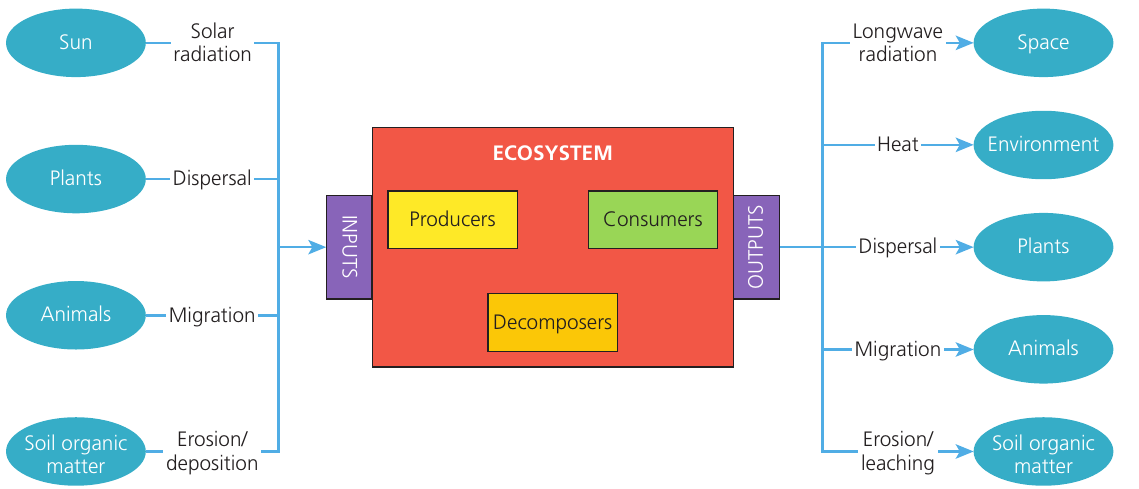
Energy enters ecosystems primarily through solar radiation from the sun. Producers (plants) capture this energy through photosynthesis. Matter also enters through several pathways:
- Plant dispersal (seeds and spores arriving from elsewhere)
- Animal migration (animals moving into the area)
- Erosion and deposition (bringing soil organic matter)
Energy and matter leave ecosystems through various outputs:
- Longwave radiation to space (heat energy escaping)
- Heat released to the environment
- Dispersal of plants to other areas
- Migration of animals to other locations
- Erosion and leaching removing soil organic matter
Note
Within the ecosystem, three key groups of organisms interact: producers (plants), consumers (animals), and decomposers (bacteria and fungi). These groups form the basis of energy transfer through the system.
Energy capture and transfer in ecosystems
The journey of energy through an ecosystem reveals important limitations. Only a tiny fraction of available sunlight actually becomes usable energy for life.
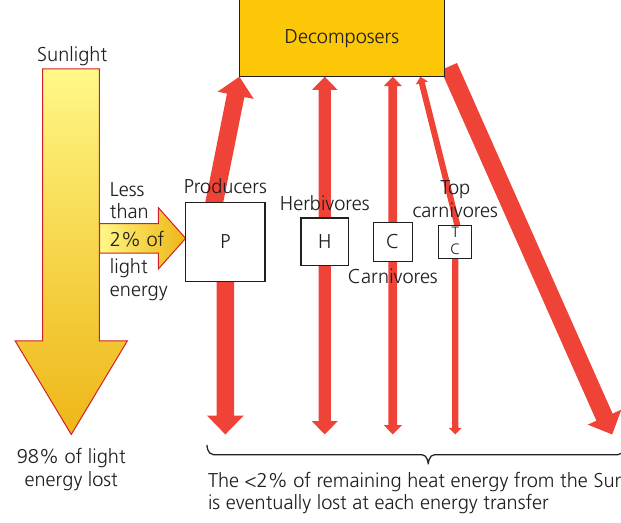
When sunlight reaches an ecosystem:
- 98% of light energy is lost and does not contribute to biological processes
- Less than 2% is captured by producers (plants) through photosynthesis
Important
At each stage of energy transfer through the ecosystem, significant amounts of energy are lost as heat. This explains why food chains rarely extend beyond four or five levels - there simply isn't enough energy remaining to support additional levels.
This captured energy then moves through different feeding levels:
- Producers (plants) convert light energy into chemical energy through photosynthesis
- Herbivores obtain energy by eating plants
- Carnivores gain energy by consuming herbivores
- Top carnivores feed on other carnivores
- Decomposers break down dead material from all levels
Understanding biomass
Important
Biomass refers to the mass of living organisms in a particular ecosystem. It can describe the total mass of all species in a community (community biomass) or the mass of a single species within that ecosystem.
Biomass includes more than just living tissue. It also encompasses:
- Dead organic material such as leaf litter
- Decaying matter on forest floors
- Dead wood and plant debris
Different ecosystems have different biomass compositions:
Terrestrial ecosystems:
- Plants typically comprise the greatest portion of biomass
- Trees, shrubs and forest floor material make up most plant biomass in forests
- Insects and other arthropods form a high percentage of animal biomass
- Large mammals contribute relatively little despite their size
Aquatic ecosystems:
- Phytoplankton and larger rooted plants (like kelp) dominate plant biomass
- Small aquatic organisms such as krill form a significant part of animal biomass
Note
Biomass can be measured and expressed in different ways:
- Average mass per unit area (for example, tonnes per hectare or grams per square metre)
- Total mass in the community
- Units of energy (such as joules per square metre)
The distribution of biomass within an ecosystem changes over time. Seasonal variations and year-to-year differences can significantly affect which species dominate the biomass.
Energy use by organisms
When herbivores consume plants, they access the energy stored in plant tissues. However, not all of this energy becomes available for growth. The energy divides into several pathways:
Herbivores:
- Use most energy intake for maintenance (respiration, keeping their bodies functioning)
- Small remaining portion goes to herbivore biomass (flesh and blood of the animal)
Carnivores:
- Nearly all energy intake goes to maintenance
- Very little remains for growth
Decomposers:
- Receive most of the plant energy in many ecosystems
- In grasslands, for example, only 10% of plant energy is consumed by grazing animals
- The remaining 90% eventually goes to decomposers
- Decomposers use over half their energy intake for maintenance
- Some energy becomes locked in soil organic material
- Some passes to organisms that feed on decomposers
Important
The ultimate fate of all captured energy is transformation to heat. Energy is not recycled in ecosystems - it flows through in one direction and is eventually lost as heat energy.
Net primary productivity
Understanding how much new biomass ecosystems produce helps us assess their productivity and capacity to support life.
Important
Primary productivity is the amount of biomass produced through photosynthesis per unit area and time by plants. It measures how quickly plants create new organic matter.
Primary productivity is usually expressed as:
- Units of energy (for example, joules per square metre per day)
- Units of dry organic matter (for example, kilograms per hectare per year)
Gross primary productivity (GPP)
Important
Gross primary productivity (GPP) represents the total energy fixed by plants in a community through photosynthesis. This is the complete amount of energy captured before any is used by the plants themselves.
The product of photosynthesis is carbohydrate (such as glucose and starch), along with oxygen released to the atmosphere.
Plant respiration
Plants don't simply store all the energy they capture. They use a significant portion for their own life processes.
Important
Respiration is the process by which plants use energy from photosynthesis for various physiological and morphological activities. This includes growth, reproduction, nutrient transport, and maintaining cellular functions.
Net primary productivity (NPP)
Important
Net primary productivity (NPP) is calculated by subtracting respiration from gross primary productivity. It represents the rate of biomass production that is available for consumption by heterotrophic organisms (bacteria, fungi and animals).
Formula:
This distinction is crucial because NPP represents the actual food available to support all other life in the ecosystem. It's the biomass that herbivores can eat, and therefore the foundation for all consumer populations.
Example
Calculating Net Primary Productivity
If a forest ecosystem has:
- Gross Primary Productivity (GPP) = 20,000 kJ/m²/year
- Plant Respiration = 8,000 kJ/m²/year
Then the Net Primary Productivity is:
This means 12,000 kJ/m²/year of energy is available for consumption by herbivores and other heterotrophic organisms.
Global estimates
Scientists estimate global terrestrial NPP ranges from 48 to 69 billion tonnes per year. When oceanic NPP is included, this figure nearly doubles. These enormous quantities highlight the vital role of primary producers in supporting life on Earth.
Food chains and trophic levels
Energy moves through ecosystems along specific pathways as organisms consume one another. These pathways form food chains.
Important
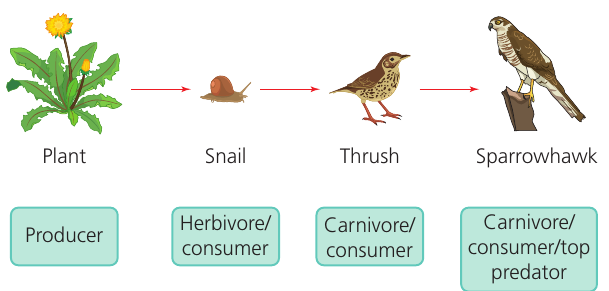
A food chain is a linear pathway showing how energy transfers from one organism to another through consumption. It follows a direct route from producers through various levels of consumers.
Example
Simple Food Chain Examples
Marine ecosystem: Phytoplankton → zooplankton → fish → seal → killer whale
Terrestrial ecosystem: Grass → grasshopper → frog → heron
Each position in a food chain is called a trophic level.
Important
The trophic level of an organism is its position in a food chain. The number of steps from the start of the chain determines the trophic level.
Trophic level structure
Food chains always start with primary producers:
Trophic Level 1: Producers
- Plants that capture energy through photosynthesis
- Form the base of all food chains
- Examples: grass, phytoplankton, trees
Trophic Level 2: Primary Consumers (Herbivores)
- Organisms that eat plants
- Examples: snails, grasshoppers, rabbits, zooplankton
Trophic Level 3: Secondary Consumers (Carnivores)
- Predators that eat herbivores
- Examples: thrushes, frogs, foxes
Trophic Level 4-5: Tertiary Consumers (Top Carnivores)
- Predators that eat other carnivores
- Apex predators with few or no natural predators
- Examples: sparrowhawks, herons, killer whales
Note
The trophic level indicates how many energy transfers have occurred from the original sunlight capture. Each transfer results in substantial energy loss, which limits the length of food chains. This is why ecosystems rarely support more than four or five trophic levels.
Understanding trophic levels helps explain the pyramid of biomass - why there is typically much more plant biomass than herbivore biomass, and more herbivore biomass than carnivore biomass. The decreasing energy available at each level constrains the amount of living tissue that can be supported.
Summary
Key Points to Remember:
-
Only 2% of sunlight energy is captured by producers - 98% is lost before it can be used by ecosystems.
-
NPP = GPP - Respiration - Net primary productivity is what remains after plants use energy for their own life processes.
-
Energy flows one way through ecosystems - unlike nutrients, energy is not recycled; it enters as light and eventually leaves as heat.
-
Each trophic level loses most energy to maintenance - this is why food chains rarely exceed four or five levels.
-
Biomass includes both living and dead organic matter - it's not just the living organisms but also leaf litter, dead wood, and other organic material.