Glacial Systems and Budgets (AQA A-Level Geography): Revision Notes
📚Revision Notes
Glacial Systems and Budgets
Introduction to glaciers as natural systems
Many aspects of physical geography can be understood using a systems approach. This method helps us simplify complex relationships between different components so they become easier to study and understand.
Important
A system is an assemblage of interrelated parts that work together through some driving process.
Glaciers and ice sheets function as open systems. This means they have inputs (things entering the system), stores (where materials are held), transfers (movements within the system), and outputs (things leaving the system). Understanding these components helps us predict how glaciers will respond to changes in climate and other environmental factors.
The glacial system
Glaciers operate as dynamic systems where energy and mass constantly move through various pathways. Let's examine each component in detail.
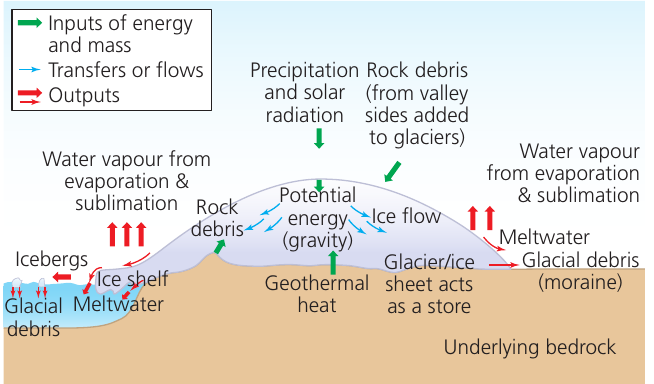
Inputs to the glacier system
Snow and ice are the primary inputs. These enter the glacier system through:
- Direct snowfall - precipitation falling directly onto the glacier surface
- Blown snow - snow transported by wind from surrounding areas
- Avalanches - large masses of snow and ice falling from slopes surrounding the glacier
Note
Other inputs include rock debris added from valley sides, solar radiation providing energy, and geothermal heat from below the glacier. These secondary inputs play important roles in glacier dynamics and behaviour.
The term accumulation is used to describe all the inputs that add mass to the glacier system. This is a fundamental concept in understanding glacier behaviour and response to climate.
Stores within the system
The glacier or ice sheet itself acts as the main store. It holds:
- Solid ice (the main component)
- Trapped air within the ice
- Rock debris and sediment
- Potential energy from gravity
Transfers and flows
Once inputs enter the system, they are transferred down-valley through several mechanisms. The primary transfer processes include:
- Ice flow - the main mechanism by which glaciers move downslope
- Gravity - provides the potential energy that drives glacier movement
- Internal deformation of ice
- Basal sliding (where the glacier moves over its bed)
Note
The rate of ice flow varies depending on factors such as ice temperature, ice thickness, and slope gradient. Understanding these transfer mechanisms is crucial for predicting glacier behaviour.
Outputs from the system
Mass and energy leave the glacier system through several processes:
- Water vapour - lost through evaporation and sublimation (ice turning directly to vapour)
- Meltwater - liquid water flowing from the glacier
- Glacial debris - sediment carried away in meltwater or deposited as moraine
- Icebergs - chunks of ice that break off (calving) from glaciers that reach the sea
The term ablation refers to all the outputs that remove mass from the glacier system. The balance between accumulation and ablation determines whether a glacier will advance or retreat.
Glacial budgets
Because glaciers are open systems, their size and mass will change depending on the balance between inputs and outputs. This concept is fundamental to understanding glacier behaviour.
Seasonal variations
During glacials (ice ages), the climate shifts seasonally:
- Winter conditions - more precipitation falls as snow, leading to greater accumulation
- Summer conditions - warmer temperatures cause increased melting, so ablation increases
- Summers also become shorter, reducing the time available for melting
This means less snow melts each year, allowing it to remain permanently on the upland areas.
The snow line
Important
The snow line is the lower edge of the area where snow remains permanently on the ground year-round.
As annual mean temperatures drop, the snow line migrates down the slope. Currently, the snow line sits at sea level in Greenland but around the Equator at 6,000 metres altitude.
Britain's climate is too warm for a snow line to exist. However, if Scottish mountains were approximately 250 metres higher, they would be cold enough to support permanent snow cover.
Slope aspect and the snow line
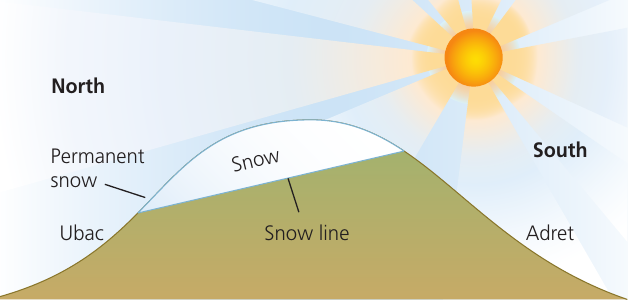
The orientation of a slope significantly affects where the snow line sits. In the northern hemisphere:
- North-facing slopes receive less direct sunlight and remain cooler
- South-facing slopes receive more insolation (incoming solar radiation) and are warmer
Note
The adret slope is the more habitable south-facing slope, whilst the ubac slope is the more inhospitable north-facing slope. These French terms are commonly used in alpine geography to describe these contrasting environments.
Because of these differences, permanent snow sits lower on north-facing slopes compared to south-facing slopes.
Formation of firn and solid ice
Snow doesn't immediately become glacial ice. The transformation occurs through several stages:
- Snow initially falls as flakes with an open, feathery structure that traps air
- As snow accumulates, upper layers compress the lower layers
- This compression squeezes out air and compacts the snow into a denser form
The term firn (or névé) is used to describe the more compact form of snow that develops after approximately two seasons of accumulation. The French term névé also refers to these layers of freshly accumulated snow, though it is often used interchangeably with 'firn'.
Note
Further accumulation continues to compress the material. Meltwater seeps into spaces between snow particles and refreezes, further compacting the mass. After considerable time (typically between 20 and 40 years), solid ice develops.
As the ice forms, its colour changes:
- White colour indicates air is still present
- Bluish colour indicates most air has been expelled
Once the mass of ice becomes large enough, it can develop into a glacier and begin flowing downhill.
Accumulation and ablation zones
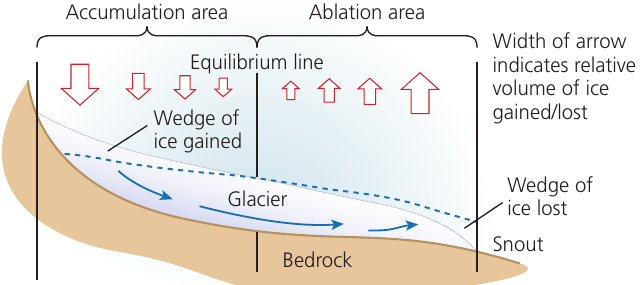
The glacier can be divided into two distinct areas based on whether it is gaining or losing mass.
Zone of accumulation
Important
The zone of accumulation refers to the upper part of the glacier where inputs exceed outputs, so more mass is gained than lost over a year.
In this area:
- Snowfall and other inputs dominate
- The glacier surface is typically covered in snow and firn
- Ice thickness increases over time
- The glacier gains volume (shown as a wedge of ice gained)
Zone of ablation
Important
The zone of ablation is the lower part of the glacier where outputs exceed inputs, so mass is lost rather than gained.
In this area:
- Melting and evaporation dominate
- Older ice is exposed at the surface
- Ice thickness decreases
- The glacier loses volume (shown as a wedge of ice lost)
The equilibrium line
Important
The equilibrium line is the boundary between the ablation zone and accumulation zone, where net gain and net loss are balanced.
This boundary represents the point where, over the course of a year, the amount of accumulation exactly equals the amount of ablation. It should not be confused with the firn line (the lower limit of firn), though these are similar concepts.
Net balance and seasonal patterns
Understanding net balance
Important
The net balance is the difference between the total accumulation and total ablation during one year.
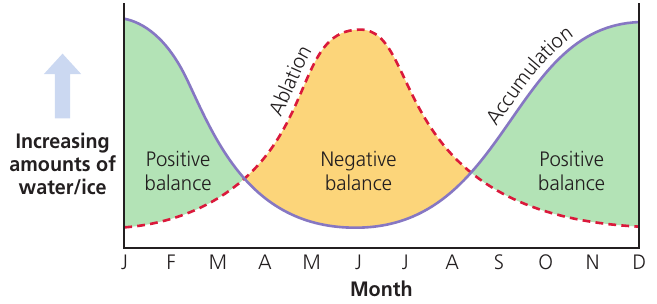
Temperate glaciers (those in alpine areas) typically show distinct seasonal patterns:
- Negative balance in summer - ablation exceeds accumulation as warmer temperatures cause melting
- Positive balance in winter - accumulation exceeds ablation as snow falls and temperatures remain below freezing
Note
If the summer and winter budgets cancel each other out, the glacier appears to be stationary. However, this doesn't mean the glacier is inactive - the snout (terminus) remains in the same position whilst ice continues advancing down the valley from the zone of accumulation into the zone of ablation.
Glacial advance and retreat
Changes in the balance between accumulation and ablation cause the glacier's snout to move either down-valley or up-valley.
Glacial advance
Important
Glacial advance occurs when accumulation begins to exceed ablation rates, causing the snout to move down the valley.
When this happens:
- The glacier increases in size
- The position of the snout migrates further down the valley
- More of the landscape becomes ice-covered
Important point: Even though the position of the snout moves down the valley, the ice itself continues to flow downslope from the upper parts of the glacier. This is the fundamental movement pattern of all glaciers.
Glacial retreat
Important
Glacial retreat occurs when ablation rates exceed accumulation, causing the glacier to shrink in size and the position of the snout to move up the valley.
During retreat:
- The glacier loses mass overall
- The snout position moves back up the valley
- More bedrock and previous glacial deposits become exposed
Note
Critical understanding: Despite the position of the snout moving back up the valley, the ice continues to move downslope from the upper parts of the glacier. The term "retreat" refers only to the changing position of the snout, not the direction of ice flow.
Historical patterns of ice advance and retreat
Glaciers respond to both long-term climate changes and shorter-term, more localised variations in weather patterns.
Long-term changes
During the Quaternary period, glaciers have advanced and retreated many times in response to glacial and interglacial cycles. Evidence for these changes exists throughout the landscape.
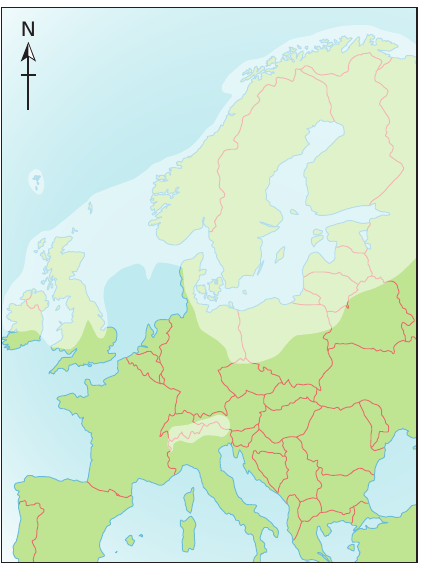
At present, glaciers cover approximately 6,000 km² in Europe. However, 22,000 years ago during the Last Glacial Maximum, ice coverage was much more extensive across the continent.
Short-term variations
Individual glaciers don't only respond to long-term climate shifts. They also gain and lose mass in response to more localised or short-term changes in climate patterns.
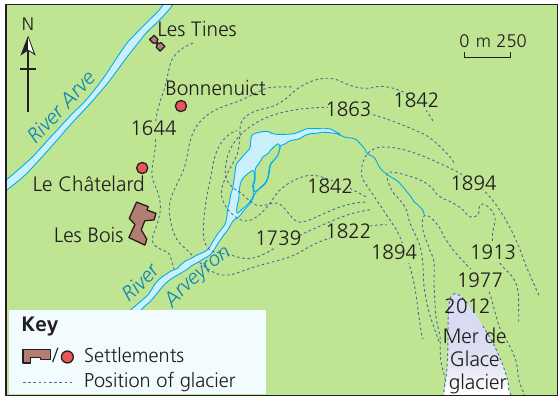
Case study: Mer de Glace, France
Example
Case Study: Mer de Glace Glacier Retreat
The Mer de Glace glacier in the French Alps provides an excellent example of glacier retreat over historical time periods.
Location: The glacier flows through a valley above settlements including Les Bois, Le Châtelard, and Bonnenuict. The River Arveyron flows from the glacier snout and joins the River Arve downstream.
Pattern of retreat:
The glacier's snout position has been documented at various dates:
- 1644 - Maximum historical extent, glacier snout near Les Tines
- 1739 - First measurable retreat upstream
- 1822 - Continued retreat
- 1842 - Snout position moved further back
- 1863 - Further retreat documented
- 1894 - Substantial retreat from 1644 position
- 1913 - Continued recession
- 1977 - Major retreat evident
- 2012 - Most recent position, showing dramatic overall retreat
Key observations:
- Over the 368-year period from 1644 to 2012, the glacier snout retreated several kilometres upstream
- The rate of retreat has not been constant - some periods show faster retreat than others
- The overall pattern demonstrates the impact of long-term climate warming on alpine glaciers
- This retreat pattern is representative of many European glaciers during this historical period
Significance: This case study illustrates how glaciers respond to climate change over timescales of centuries. The evidence clearly shows the glacier has been in an overall state of retreat, with the snout moving progressively up-valley as ablation has exceeded accumulation over this extended period.
Remember!
Summary
Key Points to Remember:
-
Glaciers are open systems with inputs (accumulation), outputs (ablation), stores, and transfers that all interact dynamically.
-
The zone of accumulation (upper glacier) gains more mass than it loses, whilst the zone of ablation (lower glacier) loses more mass than it gains, separated by the equilibrium line.
-
Glacial advance occurs when accumulation exceeds ablation (snout moves down-valley), whilst glacial retreat occurs when ablation exceeds accumulation (snout position moves up-valley), though ice always flows downslope.
-
The snow line (lower limit of permanent snow) is affected by both altitude and aspect, sitting lower on north-facing slopes (ubac) than south-facing slopes (adret) in the northern hemisphere.
-
Historical evidence, such as the Mer de Glace retreat from 1644 to 2012, demonstrates how glaciers respond to long-term climate change, with most European glaciers showing significant retreat over recent centuries.