Real operational amplifiers (AQA A-Level Physics): Revision Notes
📚Revision Notes
13.4.4 Real operational amplifiers
Note
In practical applications, operational amplifiers (op-amps) are not ideal. Instead, real op-amps exhibit properties that vary based on the design and intended application. Here, we compare the characteristics of an ideal op-amp with a real one, highlighting the differences that impact performance in actual circuits.
| Characteristic | Ideal Op-Amp | Real Op-Amp |
|---|---|---|
| Open-Loop Gain () | Infinite | Around |
| Input Resistance | Infinite, no current draw | Up to |
| Output Resistance | Zero | Around |
| Output Voltage | Bounded between | Limited, and can vary slightly due to resistance |
| Bandwidth | Infinite (at any frequency) | Limited, around Hz (open-loop), and up to MHz (closed-loop) |
Real op-amps are also affected by temperature, which can alter these values slightly.
Key Differences in Real Op-Amps
- Open-Loop Gain While real op-amps have high open-loop gain, it is not infinite. This gain remains sufficient for most applications, but deviations may occur, especially under varying temperature conditions or high frequencies.
-
Input Resistance Real op-amps have high input resistance, drawing very little current (on the scale of nanoamperes). This small current can impact sensitive measurements, but generally, high input resistance remains suitable for many applications.
-
Output Resistance Real op-amps have a non-zero output resistance, limiting the current they can deliver. When negative feedback is used in a circuit, output resistance decreases, which stabilises the output but may restrict available current.
-
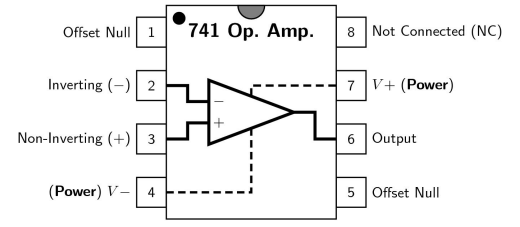
Offset Voltage In an ideal op-amp, when both inputs are grounded, the output should be zero. However, real op-amps have a small offset voltage (a slight non-zero output). To counter this, op-amps often include a mechanism for offset nulling to calibrate the device.
Frequency Response and Bandwidth
- Bandwidth Limitations Real op-amps exhibit limited bandwidth in open-loop configurations due to their high gain. Most data sheets specify the closed-loop bandwidth, as unity gain configurations (also called unity gain buffers) allow for wider bandwidth but lower gain.
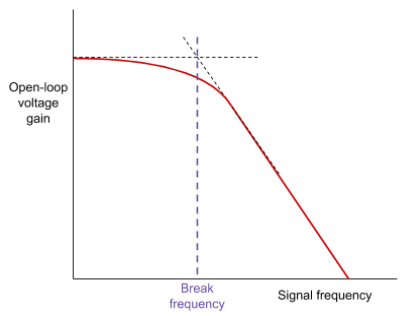
- Frequency Response Curves Frequency response curves illustrate how the gain of an op-amp changes with signal frequency. Typically, these curves are logarithmic to accommodate high values of frequency and gain.
- Break Frequency
- The break frequency is the point where the gain begins to drop. It is often determined by plotting straight-line approximations of the curve and locating their intersection.
- In open-loop configurations, the break frequency is low. However, closed-loop circuits have a much higher break frequency, making them preferable for high-frequency applications.
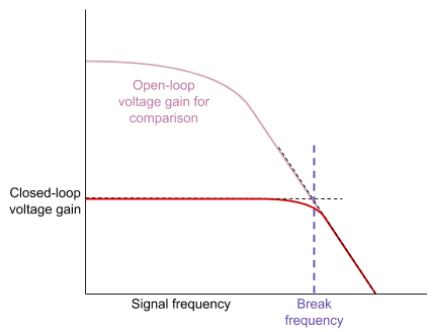
- Gain-Bandwidth Product The gain-bandwidth product remains constant for a given op-amp, summarised by:
This relationship means that increasing gain will reduce the available bandwidth and vice versa.
Note
Practical Example: Using Real Op-Amps in Circuits
Consider a real op-amp in a closed-loop configuration with feedback. By configuring resistors correctly, it is possible to control the gain within the device's limitations. For instance, if we want a stable, low-noise output, we may set the gain lower, increasing the bandwidth available to the circuit.
Note
Example: Determining Break Frequency in a Closed-Loop Circuit
If we have an op-amp with a known gain-bandwidth product, we can calculate the break frequency when operating at a particular gain. For instance, if the gain is set to and the gain-bandwidth product is , the break frequency would be:
This analysis is crucial in applications like audio amplifiers, where understanding the frequency limits helps maintain sound quality across the audible range.