Nuclear instability (AQA A-Level Physics): Revision Notes
📚Revision Notes
8.1.4 Nuclear instability
Note
Nuclei are bound together by the strong nuclear force. However, protons within the nucleus experience a force of repulsion due to the electromagnetic force. If these forces are imbalanced, the nucleus becomes unstable, resulting in radioactive decay. There are four primary reasons why a nucleus may become unstable, each leading to different types of decay:
- Too Many Neutrons
- The nucleus may decay via beta-minus emission (or in some cases, neutron emission).
- In beta-minus decay, a neutron in the nucleus transforms into a proton and emits a beta particle (an electron) and an antineutrino.
- Nucleon number (total number of protons and neutrons) remains constant, while proton number increases by .
- Too Many Protons
- Decay occurs through beta-plus emission or electron capture.
- In beta-plus decay, a proton converts to a neutron, releasing a beta-plus particle (positron) and a neutrino.
- In electron capture, an orbiting electron is drawn into the nucleus, where it combines with a proton to form a neutron and a neutrino.
- In both decay types, nucleon number remains constant, but proton number decreases by .
- Too Many Nucleons
- The nucleus may undergo alpha emission, where it emits an alpha particle ( protons and neutrons).
- This results in a decrease in nucleon number by and proton number by .
- Excess Energy
- The nucleus may release energy via gamma emission, often following another type of decay (e.g., alpha or beta).
- Gamma decay does not alter nucleon or proton numbers; it only reduces the energy of the nucleus.
Decay Process Diagram
- Nuclei may undergo multiple decay types sequentially before stabilising.
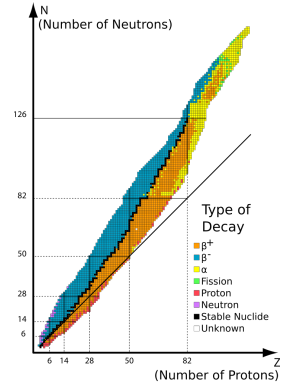
Graph of Stability
A graph of neutron number () vs proton number () reveals that:
- For stable nuclei with low values, the neutron-to-proton ratio is approximately .
- As increases, the ratio becomes greater than . This is because the electromagnetic repulsion among protons grows stronger, necessitating additional neutrons to separate protons and lower the force of repulsion.
Energy Level Diagrams for Decay Processes
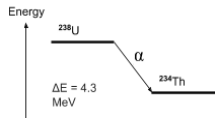
Energy level diagrams illustrate the energy changes during nuclear decays. For example:
- Alpha Decay:
- to
- This decay involves a drop in energy, with the released alpha particle carrying away some of this energy.
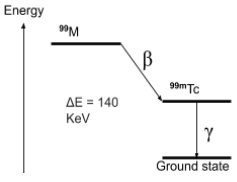
- Beta-Minus Decay:
- This decay leaves the technetium-m nucleus in an excited state, which subsequently releases a gamma ray as it moves to its ground state.
- Technetium-m has a half-life of hours and emits gamma radiation. Its properties make it ideal for medical imaging.
Note
Key Points
- Alpha particles: Heavily ionising and strongly interact with matter, hence they have short penetration ranges.
- Beta particles: Less ionising and penetrate further than alpha particles.
- Gamma rays: Weakly ionising with high penetration capability; used in various applications such as imaging and sterilisation.