Nuclear radius (AQA A-Level Physics): Revision Notes
📚Revision Notes
8.1.5 Nuclear Radius
Understanding Nuclear Radius
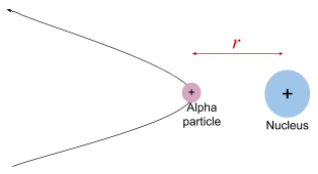
The nuclear radius of an atom can be estimated by calculating the distance of closest approach of a charged particle, such as an alpha particle, fired at a gold nucleus.
Distance of Closest Approach:
- As the alpha particle moves towards the positively charged nucleus, it experiences a repulsive electrostatic force.
- The particle's kinetic energy is converted into electric potential energy as it slows down.
- The point at which the alpha particle stops and has zero kinetic energy marks the distance of closest approach, symbolised as .
- The electric potential at this point is given by:
Where:
- is the permittivity of free space,
- is the charge of the nucleus,
- is the distance of closest approach.
Electric Potential Energy Calculation:
- Electric potential energy at this distance can be calculated as:
- This energy represents the work done to bring the charges to this distance apart.
Electron Diffraction as an Alternative Method:
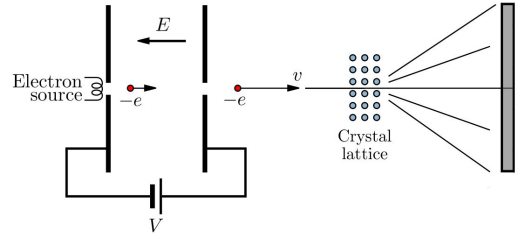
- Electron diffraction offers a more accurate measure of nuclear radius as it avoids interaction with the strong nuclear force.
- Electrons, being leptons, do not experience this force, unlike alpha particles, providing a clearer measure.
- High-speed electrons with a De Broglie wavelength around 10^-15 m pass through a thin material, creating a diffraction pattern.
Diffraction Pattern Analysis:
- The pattern observed is a series of concentric circles.
- The intensity of these circles diminishes as distance from the centre increases.
- By plotting a graph of intensity against diffraction angle, we can measure the diffraction angle of the first minimum to estimate nuclear radius using:

Where:
- is the diffraction angle,
- is the electron's De Broglie wavelength,
- is the nuclear radius.
Graphical Method for Nuclear Radius:
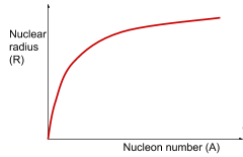
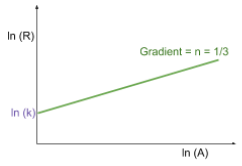
- A logarithmic plot of nuclear radius against nucleon number (mass number) provides further insight:
- Taking logs, we get:
- Plotting against , the gradient of this line (approximately 1/3) and the intercept help determine the relationship.
Nuclear Density:
- Using the above relationship, it can be shown that nuclear density is constant across all nuclei.
- Calculation shows nuclear density around 1.45 × 10^17 kg/m³, which indicates that most of an atom's mass is concentrated in the nucleus, with the rest being mostly empty space.