Producing larger-diameter telescopes (AQA A-Level Physics): Revision Notes
📚Revision Notes
Producing larger-diameter telescopes
Why larger diameters are needed
The performance of a telescope depends heavily on the diameter of its objective. As we learned from the Rayleigh criterion, the minimum angular resolution of a telescope is given by:
where is the minimum angular resolution in radians, is the wavelength of light being observed, and is the diameter of the telescope's objective.
This relationship shows that increasing the diameter improves the resolving power - the ability to distinguish between two closely spaced objects. A larger diameter means a smaller minimum angular resolution, allowing the telescope to see finer detail.
Note
The inverse relationship between diameter and angular resolution means that doubling the telescope diameter cuts the minimum angular resolution in half, providing twice the resolving power. This is why astronomers constantly push for larger telescopes.
For radio telescopes, there is an additional benefit. Radio waves have very low energy compared to visible light, so a large collecting area is needed to gather enough signal. The collecting power of a telescope depends on the area of its objective, which increases with the square of the diameter. This is why radio telescopes typically have much larger diameters than optical telescopes - they need to compensate for observing at much longer wavelengths (often centimetres or metres) while also maximizing signal collection.
Limitations of single-piece mirrors
For optical reflecting telescopes, there is a practical limit to how large a primary mirror can be made from a single piece of glass with a reflective coating. When a mirror becomes very large, its own mass causes it to deform under the force of gravity. This distortion changes the mirror's shape and ruins the image quality.
Important
Critical Size Limitation
Single-piece primary mirrors are limited to a few metres in diameter due to gravitational deformation. Larger mirrors sag and distort under their own weight, destroying image quality. This fundamental physical limitation cannot be overcome simply by using stronger materials - the problem worsens as mirrors get larger.
Additional factors such as manufacturing cost and mechanical strength further restrict the size. Currently, the largest single-piece primary mirrors are limited to a few metres in diameter. The Subaru Cassegrain telescope in Hawaii has one of the largest single primary mirrors at 8.2 m in diameter.
Telescope designers have developed two main approaches to overcome these limitations while still achieving large effective diameters: segmented mirror telescopes and interferometry.
Segmented mirror telescopes
A segmented mirror telescope uses an objective made from an array of smaller mirrors that work together to function as one large curved mirror. Rather than building one enormous piece of glass, engineers construct many smaller mirror segments that are easier to manufacture and support.
Each segment is precisely curved and ground to match a specific part of the overall mirror shape. The segments are then mechanically positioned using a computer-controlled system. Actuators - devices that produce mechanical movement - constantly adjust the position and orientation of each segment to keep them perfectly aligned with one another.
This computer-controlled alignment system is called active optics. It continuously monitors and corrects the positions of the mirror segments, compensating for factors such as gravity, temperature changes, and mechanical stress. Active optics allows telescope designers to construct objective mirrors with very large effective diameters that would be impossible to achieve with a single piece of glass.
Example
Real-World Example: Gran Telescopio Canarias
The Gran Telescopio Canarias (GTC) located on the Canary Islands demonstrates the power of segmented mirror technology. This telescope uses:
- 36 separate hexagonal mirror segments
- Effective aperture diameter of 10.4 m
- Each segment individually controlled for precise alignment
- Active optics system maintaining positioning accuracy
This 10.4 m effective diameter significantly exceeds the practical limit for single-piece mirrors, demonstrating how segmented technology breaks through physical barriers.
Note
Advantages of Segmented Mirrors
The segmented mirror approach offers several key benefits:
- Much larger effective diameters than single-piece mirrors
- Easier manufacturing of individual segments
- Better weight distribution and structural support
- Ability to replace individual segments if damaged
- More cost-effective construction for very large telescopes
Radio telescope interferometers
A radio interferometer provides another solution to achieving high resolution without building impossibly large single-dish telescopes. This technique uses multiple separate telescopes working together rather than trying to construct one giant telescope.
Basic principle
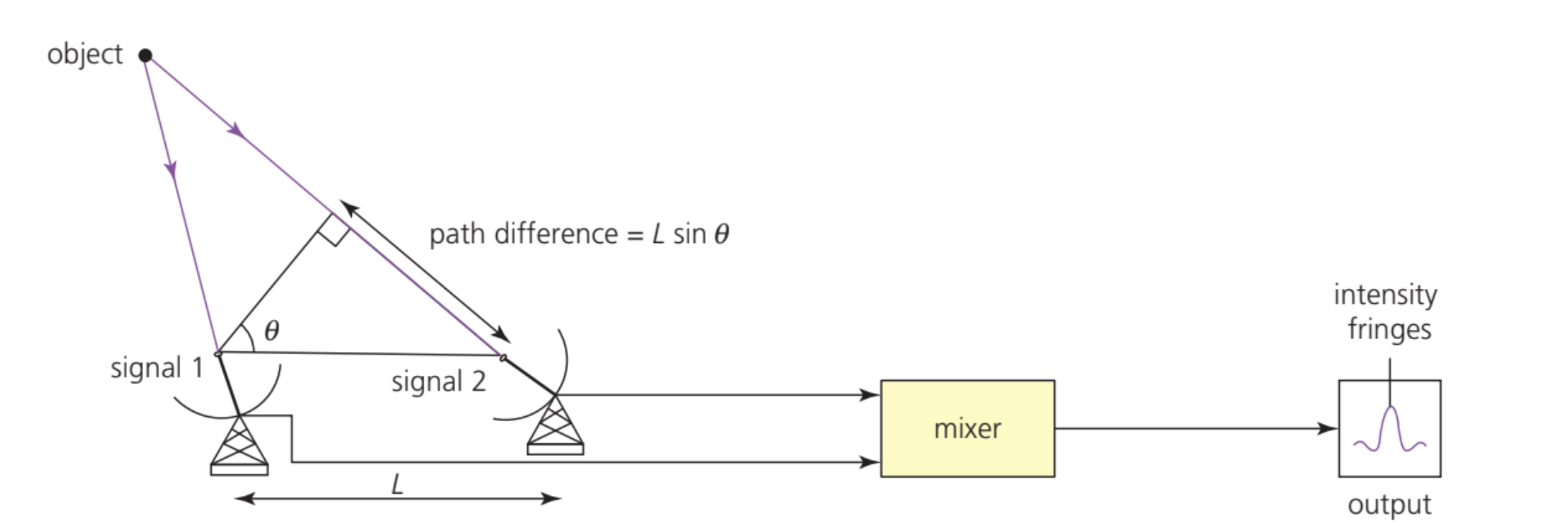
The simplest radio interferometer consists of two identical parabolic dish antennas placed at a distance apart. This separation distance is called the baseline. Both antennas receive radio signals from the same astronomical source, and these signals are fed into a receiver that combines them.
When radio waves from a distant source reach the two antennas, they may travel slightly different distances depending on the source's position in the sky. This creates a path difference between the two signals. If this path difference equals a whole number of wavelengths, the signals arrive in phase and produce constructive interference - they add together to give a strong combined signal. When the path difference equals an odd number of half-wavelengths, the signals arrive out of phase and produce destructive interference - they cancel each other out.
Note
As the astronomical source moves across the sky due to Earth's rotation, the path difference continuously changes. This creates an interference pattern of alternating bright (constructive) and dark (destructive) fringes, similar to the pattern produced when light passes through a double slit.
Angular resolution of interferometers
The angular distance between successive maxima in this interference pattern represents the angular resolution of the radio interferometer. This angular resolution is approximately:
where is the baseline distance between the two antennas.
Important
Key Insight: Effective Telescope Size
This formula is remarkably similar to the resolution formula for a single telescope (), except the baseline L replaces the diameter D. In effect, the interferometer behaves like a single telescope with a diameter equal to the baseline separation.
This means if we separate two radio telescopes by kilometres, we achieve resolution equivalent to a single dish kilometres in diameter - something that would be impossible to construct physically.
More sophisticated interferometers use more than two telescopes, which further improves both the resolution and the overall collecting power of the system.
Very large baseline interferometry
Very large baseline interferometry (VLBI) extends this concept to truly enormous baselines. In VLBI, radio telescopes separated by very long distances - potentially on different continents - observe the same radio source simultaneously.
Note
How VLBI Works
Rather than transmitting signals between telescopes in real time, each telescope:
- Records the received signals along with very precise timing information
- These recordings are later brought together and processed by computers
- By knowing the exact observation times and precise telescope locations, astronomers combine the signals to construct detailed images
VLBI provides the highest angular resolution possible with current technology, effectively creating a telescope as large as the Earth itself when using intercontinental baselines.
Optical interferometers
The same interferometry principle can be applied to optical telescopes, though it is technically more challenging due to the much shorter wavelengths of visible light. Optical interferometers connect multiple optical telescopes together, combining their light to improve resolving power beyond what any single telescope could achieve.
Examples of optical interferometers include the Very Large Telescope (VLT) interferometer in the Atacama Desert in Chile and the Keck interferometer on Mauna Kea in Hawaii. These systems demonstrate that interferometry works across the electromagnetic spectrum, not just for radio waves.
Example
Worked Example: Calculating Equivalent Telescope Diameter
Question: A radio interferometer has an angular resolution of one milliradian (1 mrad) and is observing the 21 cm wavelength emission from hydrogen gas in the Milky Way. What diameter would a single-dish radio telescope need to have to achieve the same resolving power?
Solution:
We start with the minimum angular resolution formula:
We need to find , so we rearrange:
Now substitute the values:
- m (21 cm converted to metres)
- radians (1 milliradian)
Answer: A single-dish radio telescope would need a diameter of 210 m to match the resolution of this interferometer. This demonstrates why interferometry is so valuable - achieving this resolution with a single dish would require an impossibly large structure.
Summary
Key Points to Remember
-
The Rayleigh criterion () shows that larger diameter telescopes have better resolving power, and this is especially important for radio telescopes observing long wavelengths
-
Single-piece mirrors are limited to a few metres in diameter because larger mirrors deform under their own weight, but segmented mirror telescopes overcome this by using arrays of smaller mirrors controlled by active optics systems
-
Radio interferometers achieve high resolution by combining signals from multiple telescopes separated by a baseline distance , giving angular resolution equivalent to a single telescope of diameter
-
Very large baseline interferometry (VLBI) extends interferometry to intercontinental distances, providing the highest possible angular resolution by recording and later combining signals from widely separated telescopes
-
Optical interferometers apply similar principles to visible light telescopes, demonstrating that interferometry is a versatile technique applicable across the electromagnetic spectrum