Detection of exoplanets (AQA A-Level Physics): Revision Notes
📚Revision Notes
9.3.4 Detection of Exoplanets
Exoplanets
Exoplanets are planets located outside of our solar system that orbit stars other than our Sun. Due to the brightness of their host stars, exoplanets are often challenging to observe directly, as the starlight tends to obscure them. Instead, astronomers use indirect methods to detect their presence.
Methods for Detecting Exoplanets:
- Radial Velocity Method:
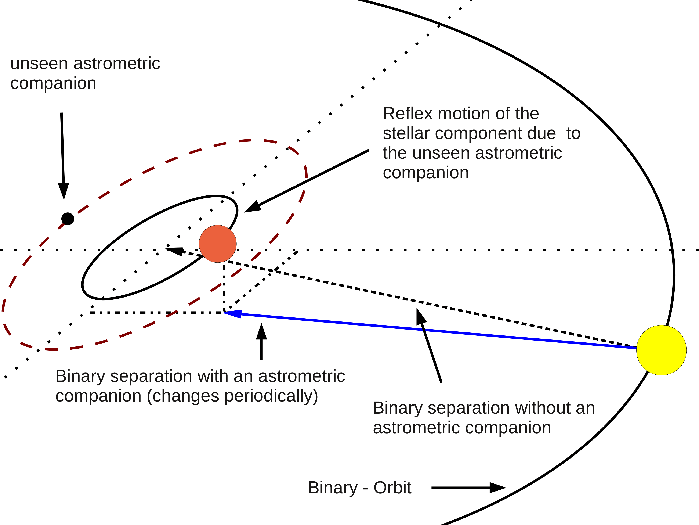
- This method relies on detecting a Doppler shift in the light coming from a star. When a star has an orbiting planet, both the star and the planet orbit a common centre of mass. This causes the star to move slightly back and forth, creating a small "wobble."
- As the star moves towards Earth, the light from it experiences blue-shift (shifted towards the shorter wavelengths), and as it moves away, the light experiences red-shift (shifted towards longer wavelengths). The Doppler shift provides evidence of a gravitational pull exerted by an unseen object, which could be an exoplanet.
- The time period (T) of the star's wobble corresponds to the time period of the exoplanet's orbit, which can help determine the planet's orbital characteristics.
- This method is particularly effective for high-mass planets since they exert a stronger gravitational pull, creating a more noticeable effect on the star's motion.
- Transit Method:
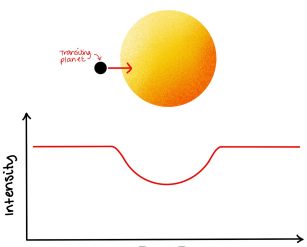
- In the transit method, astronomers observe a dip in the intensity of starlight when a planet passes in front of (or transits) its host star, partially blocking the light.
- If the star's light dips periodically and consistently, this can indicate the presence of a planet. The regularity of these dips suggests a stable orbit.
- By analysing the amount of light blocked (which correlates to the size of the planet) and the duration of the dip (indicating the orbital period), scientists can infer properties of the exoplanet, such as its size and distance from the star.
- Limitations: This method only works if the planet's orbit is aligned so that it passes directly between its star and Earth, which is relatively rare. Additionally, inclined orbits or planets with small orbits (which orbit closer to the star) may cause only partial transits or none at all from our viewpoint.
Note
Example Diagram: Light Curve for a Transiting Planet
- A typical light curve for a transiting exoplanet shows a sudden drop in brightness as the planet blocks part of the star's light, followed by a return to normal brightness after the transit. This curve can reveal information about the planet's size and orbital characteristics based on the depth and duration of the dip in light intensity.