Objectives of Growth (Edexcel A-Level Business): Revision Notes
📚Revision Notes
Objectives of Growth
What is business growth?
Business growth occurs when a company expands its operations, increases revenue, and gains market share. Most businesses begin small and then pursue expansion opportunities. Growth is attractive because it can lead to higher revenues, lower unit costs, and a stronger market position.
Example
Real-World Growth Examples
Missguided: The online fashion retailer demonstrated remarkable expansion, growing from $2.1 million in sales two years after founding to $51 million by 2014, representing an impressive annual growth rate of 191%.
The Cambridge Satchel Company: Started with just $600 investment and grew to $10 million turnover by 2014, showing how small businesses can achieve substantial growth through strategic expansion.
Key objectives of growth
Achieving economies of scale
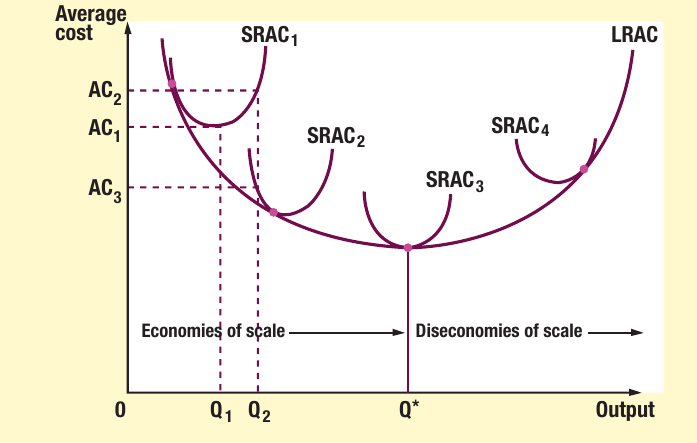
Economies of scale occur when a business experiences falling average costs as output increases. This is one of the primary reasons businesses pursue growth. When average costs decrease, larger firms gain a competitive advantage over smaller rivals because they can produce goods more cheaply.
Note
The diagram above illustrates how economies of scale work in the long run. Initially, a firm operates with a small plant (SRAC₁). As the firm expands to larger plants (SRAC₂, SRAC₃), average costs fall along the long-run average cost curve (LRAC) until reaching the minimum efficient scale at output Q*. This represents the point where average costs are lowest, known as productive efficiency.
Internal economies of scale
Internal economies of scale are cost reductions that arise from within the firm as it grows. There are several types:
Purchasing and marketing economies
Large firms can negotiate better prices when buying raw materials and components in bulk. The administrative costs of processing orders don't increase proportionally with order size. For example, processing an order for 30,000 tonnes of materials doesn't cost three times more than processing an order for 10,000 tonnes.
Marketing costs also benefit from scale. A sales team can sell 30 product lines without doubling the cost compared to selling 15 lines. Large companies can afford their own distribution fleets, spreading fixed costs over more deliveries.
Technical economies
Larger production facilities are often more efficient because capital and running costs don't rise in proportion to capacity. This is called the principle of increased dimensions. A double-decker bus doesn't cost twice as much as a single-decker, even though it carries twice as many passengers.
The concept of indivisibility also creates technical economies. Small businesses may underutilize equipment. A laptop costing $400 delivers the same value whether used twice weekly or daily. As the business expands, the equipment is used more intensively, reducing average costs.
Large-scale operations can adopt mass production techniques using specialized machinery. Flow production breaks down manufacturing into many small operations, allowing highly specialized equipment to replace labour, dramatically improving efficiency.
Note
The Law of Multiples
This principle helps firms balance production capacity. Different machines in a production line may have different speeds. As output increases, firms can add more slower machines to match the capacity of faster ones, ensuring all equipment runs at full capacity and maximizing efficiency.
Specialization and managerial economies
Growing firms can employ specialist managers rather than relying on generalists who handle multiple functions. In small businesses, one manager might oversee finance, marketing, production, and human resources, which can be overwhelming. Specialist managers improve efficiency in their areas of expertise, reducing average costs.
Financial economies
Large firms have advantages when raising finance. They access a wider variety of funding sources and can offer substantial assets as security, making lenders more willing to provide capital. Very large borrowers often negotiate better interest rates. Sole traders cannot sell shares to raise funds, but large public limited companies can easily access equity markets.
Risk-bearing economies
As firms grow, they can diversify to spread risk across different products or markets. For instance, breweries have expanded into food service and entertainment alongside traditional beverage sales. Large businesses can also invest in research and development to create new products, giving them competitive advantages over smaller rivals.
Example
Economies of Scale in Dairy Farming
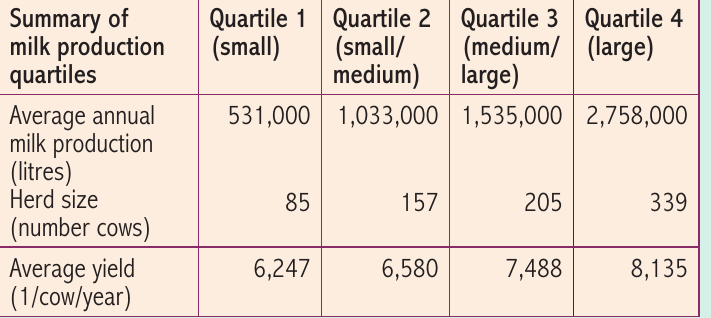
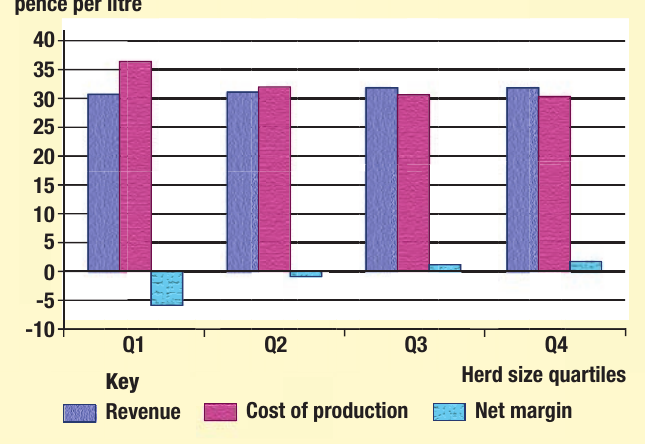
The data above demonstrates economies of scale in practice:
- Smaller herds (85 cows): Produced 6,247 litres per cow annually
- Larger herds (339 cows): Produced 8,135 litres per cow annually
The cost per litre falls significantly as herd size increases, while revenue remains relatively stable, improving profit margins dramatically. This shows how increased scale directly translates into improved operational efficiency and profitability.
External economies of scale
External economies of scale are cost reductions that benefit all businesses in an industry as that industry grows, particularly when firms concentrate in specific regions.
Labour benefits
Industry concentration creates a skilled labour pool. Workers gain experience at different firms in the same industry, reducing training costs for new employers. Local educational institutions may offer specialized training courses tailored to the industry's needs.
Ancillary and commercial services
Growing industries attract specialist support businesses offering banking, insurance, marketing, waste disposal, maintenance, cleaning, components, and distribution services specifically designed for that industry.
Co-operation opportunities
Firms in the same region and industry are more likely to collaborate, perhaps funding joint research and development centers or publishing industry journals to share information and best practices.
Disintegration
When industries concentrate geographically, firms may specialize in producing specific components, transporting them to main assembly plants. For example, the West Midlands has major car assembly plants supported by numerous component suppliers.
Note
Internal vs External Economies
While internal economies of scale arise from within a firm's own growth, external economies benefit all firms in an industry as the industry itself grows. Both types can occur simultaneously, providing cumulative cost advantages for businesses in expanding industries located in concentrated geographic regions.
Increased market power
As businesses grow larger, they become more dominant in their markets. This increased market power can affect two key stakeholder groups:
Power over customers
Dominant businesses with limited competition may charge higher prices because customers have fewer alternatives. Without competitive pressure, these firms also have less incentive to innovate, meaning product choice may remain limited and development costs are avoided.
Power over suppliers
Large businesses can pressure suppliers to reduce prices, especially when buying in large quantities from relatively small suppliers. The power imbalance is greatest when suppliers depend heavily on one large customer for most of their revenue. A supplier selling all output to a single large buyer must often accept whatever price the customer offers.
Important
Regulatory Attention
Businesses that become too dominant may attract regulatory attention. In 2014, energy companies faced criticism for high prices, and some supermarkets were accused of bullying suppliers. Authorities may investigate industries where dominant firms appear to exploit consumers or suppliers. This represents a significant risk for businesses pursuing aggressive growth strategies.
Increased market share and brand recognition
Growing businesses naturally acquire larger market shares, making customers increasingly aware of their brand through advertising and retail presence. Strong brand recognition delivers several benefits:
- Premium pricing - recognized brands can charge higher prices
- Product differentiation - brands stand out from competitors
- Customer loyalty - familiar brands retain customers more easily
- Enhanced recognition - visibility increases with market presence
- Stronger image - brands develop clear market positioning
- Easier product launches - established brands can extend into new products more readily
Larger market share also attracts media attention, providing free publicity that further promotes the company.
Increased profitability
Making more profit is a fundamental growth objective. Larger businesses typically generate bigger profits than smaller ones, benefiting owners through higher returns.
Example
Whitbread's Growth and Profitability
Whitbread (owner of Premier Inn, Costa Coffee, Beefeater Grill, and Brewers Fayre) demonstrated how growth drives profitability:
- Revenue increase: From $1,599.6 million (2010-11) to $2,294.3 million (2013-14) - a 43.4% increase
- Profit growth: Profit before tax grew 44% from $287.1 million to $411.8 million during the same period
This shows how revenue growth translates directly into improved profitability for well-managed businesses.
Example
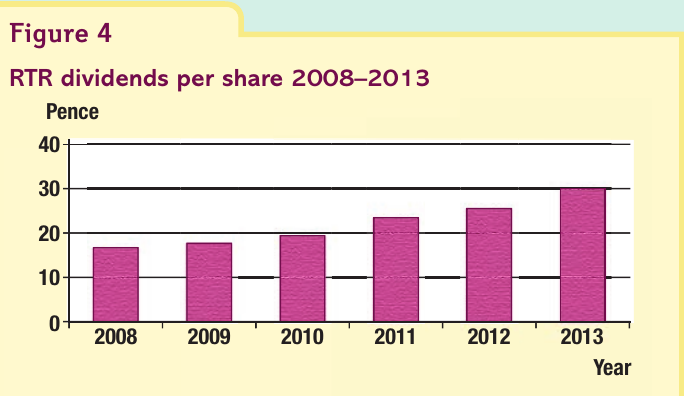
RTR Ltd: Shareholder Benefits from Growth
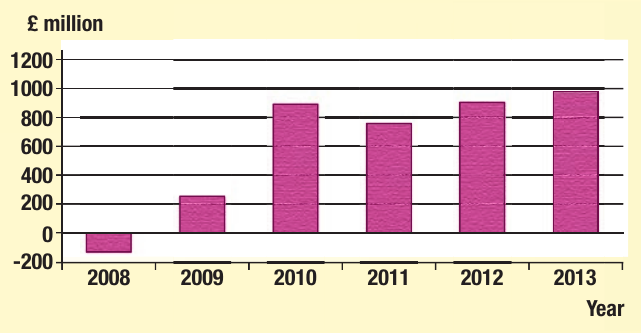
The case study demonstrates how growth translates into shareholder benefits:
Profit Recovery and Growth:
- After recovering from losses in 2008, profit after tax grew steadily to around $1 billion by 2013
Dividend Growth:
- Dividends per share nearly doubled from approximately 17 pence in 2008 to 30 pence in 2013
Share Price Appreciation:
- Whitbread's share price increased by 300% over five years to exceed $53 in April 2015
These metrics demonstrate the direct financial benefits of growth for shareholders through both income (dividends) and capital gains (share price increases).
Higher profitability provides more funds for investment and innovation. This enables businesses to develop new products and make acquisitions, potentially driving further growth in a virtuous cycle.
Problems arising from growth
While growth offers significant benefits, businesses must ensure expansion is sustainable. Growing too large or too quickly can create serious problems.
Diseconomies of scale
When businesses expand beyond their minimum efficient scale, they may experience diseconomies of scale - where average costs rise as output increases. Most internal diseconomies stem from management challenges in large organizations.
Communication difficulties
Communication becomes more complex in large firms divided into multiple departments. Messages may be distorted, delayed, or lost entirely as they pass through organizational layers. Coordination between departments becomes increasingly challenging.
Control and coordination problems
Managing thousands of employees, billions of pounds of assets, and dozens of facilities creates enormous responsibility. The complexity of coordinating such large operations requires extensive supervision systems, which themselves add to costs and inefficiency.
Motivation issues
Individual workers may feel like a small, insignificant part of a massive workforce. This can damage morale and reduce motivation. When employees feel disconnected from the organization's success, productivity may fall and relations between management and workforce deteriorate.
Important
Warning Signs of Diseconomies
Businesses should monitor for these indicators of diseconomies of scale:
- Rising average costs despite increasing output
- Slowing decision-making processes
- Increasing employee turnover and falling morale
- Growing number of management layers
- Declining productivity and efficiency
Early identification of these problems allows businesses to restructure before serious damage occurs.
Internal communication problems
As organizations grow, communication channels multiply and information flow becomes more difficult. Important messages may not reach the right people at the right time. Decision-making slows down as more people need to be consulted. Misunderstandings increase, leading to costly errors and inefficiencies.
Overtrading
Overtrading occurs when a business expands too quickly without adequate financial resources. The company may accept more orders than it can fulfill with available working capital. This creates cash flow problems even though the business appears successful. Overtrading can lead to:
- Inability to pay suppliers on time
- Cash shortages despite growing sales
- Quality problems due to rushed production
- Damaged reputation from unfulfilled orders
- Potential business failure despite growth
Important
The Overtrading Paradox
A business can fail even while experiencing rapid growth if it expands faster than its financial resources allow. This is particularly dangerous because success appears imminent - the business has customers and orders - but lacks the working capital to fulfill them. This makes overtrading one of the most common causes of failure in otherwise promising businesses.
Exam guidance
Note
Tips for Analyzing Growth Objectives
When analyzing growth objectives in exams:
- Always link to the specific business context - don't just list general benefits of growth
- Use data to support your points - calculate percentage changes and interpret trends
- Consider both benefits and drawbacks - growth has costs as well as advantages
- Evaluate whether growth is appropriate - not all businesses should pursue maximum growth
- Distinguish between short-run and long-run effects - economies of scale are long-run phenomena requiring changes to fixed factors
For evaluation questions on growth:
- Consider the sustainability of growth strategies
- Assess whether growth objectives align with stakeholder interests
- Analyze whether the business has the resources and capabilities to manage growth
- Consider external factors like market conditions and competition
- Weigh the costs of growth against the benefits
Remember!
Summary
Key Points to Remember:
-
Economies of scale occur when average costs fall as output increases, giving larger firms a competitive cost advantage over smaller rivals.
-
The four main growth objectives are: achieving economies of scale (both internal and external), gaining increased market power over customers and suppliers, building market share and brand recognition, and increasing profitability.
-
Internal economies include: purchasing and marketing economies, technical economies, specialization and managerial economies, financial economies, and risk-bearing economies.
-
Growth creates problems including diseconomies of scale (rising average costs), internal communication difficulties, and overtrading (expanding faster than financial resources allow).
-
Minimum efficient scale represents the output level where long-run average costs are lowest - the point of productive efficiency where a business produces at optimal scale.