Problems Arising from Growth (Edexcel A-Level Business): Revision Notes
📚Revision Notes
Problems Arising from Growth
Introduction
While business growth offers many advantages, it's essential to understand that growth can create significant challenges. A business aiming to expand must ensure the growth is sustainable. Growing too large or too rapidly can lead to serious operational and financial problems that may threaten the business's survival.
Note
Understanding the balance between growth opportunities and potential challenges is crucial for long-term business success. Not all growth is beneficial – the key is ensuring that expansion is manageable and supported by adequate resources.
Diseconomies of scale
When a business expands beyond its minimum efficient scale (the output level that minimises long-run average costs), it may experience diseconomies of scale. This occurs when average costs begin to rise as output increases, reversing the benefits previously gained from economies of scale.
Internal diseconomies of scale
Most internal diseconomies stem from the challenges of managing large, complex organisations. As businesses grow, several management-related problems emerge:
Communication difficulties: As firms expand, they typically divide into multiple departments and divisions. This departmentalisation makes communication more complicated and co-ordination increasingly difficult. Messages must travel through longer chains of command, increasing the likelihood of miscommunication and error.
Control and co-ordination challenges: Managing thousands of employees, billions of pounds in assets, and dozens of production facilities creates enormous supervisory demands. The sheer scale of operations means senior managers must delegate more responsibility, but maintaining effective oversight becomes progressively harder. This can lead to inconsistent decision-making and duplication of effort across the organisation.
Motivation problems: Individual workers may feel insignificant when they become a small part of a massive workforce. This sense of disconnection can damage employee morale and productivity. Workers may feel their contributions go unnoticed, leading to demotivation and poor industrial relations between management and staff.
Important
Common Pitfall: Many businesses underestimate the human cost of rapid expansion. As organisations grow, maintaining employee motivation and engagement becomes progressively more difficult. Workers who feel disconnected from the organisation's mission are significantly less productive and more likely to leave.
Technical diseconomies: In some industries, such as chemicals, construction limitations mean that operating two smaller plants proves more cost-effective than one very large facility. Additionally, relying on a single huge plant creates vulnerability – if a breakdown occurs, all production stops. Multiple smaller plants provide operational resilience, allowing production to continue even if one facility experiences problems.
External diseconomies of scale
These problems affect all businesses in a particular area or industry. When many firms cluster in the same location, overcrowding in industrial areas can drive up costs. Businesses must compete for limited resources, pushing up prices for land, labour, services and raw materials. Traffic congestion delays both workforce travel and deliveries, creating inefficiency throughout the supply chain.
Note
External diseconomies are particularly challenging because they're largely beyond an individual firm's control. Even well-managed businesses can suffer from rising costs if their entire industry or region experiences overcrowding effects.
Real-world example: BHP Billiton

Example
Worked Example: BHP Billiton and Diseconomies of Scale
In 2014, mining giant BHP Billiton announced plans to sell approximately \£15 billion of non-core assets in response to declining productivity. The mining industry had previously operated under the assumption that "bigger was better," believing costs would continue falling as individual mines grew larger.
However, Chief Executive Andrew Mackenzie expressed concerns about diseconomies of scale affecting the company. A consultant report from EY revealed that individual mining operations were becoming too large to manage effectively, resulting in lower productivity. Paul Mitchell, EY's global mining and metals advisory leader, noted: "It is bad enough [managing a mine] with 100 people on site – with 1,000 it becomes much more complex."
The rapid expansion of mine operations created several specific problems:
- Resource costs (labour and materials) rose sharply, increasing average costs
- High staff turnover meant inexperienced managers were running complex operations without adequate support
- Poor cross-departmental communication developed
- A "silo mentality" emerged in some areas, where departments hoarded information rather than sharing it
This example demonstrates how even large, established corporations can struggle with the practical realities of managing operations beyond their optimal size.
Internal communication problems
Internal communication refers to the exchange of messages and information flow within a business – between individual workers or across departments. As businesses grow, communication systems become strained in several ways.
Lengthening communication chains
Growth typically increases the number of management layers in the organisational structure. This creates longer channels of communication, with messages passing through more people before reaching their destination. Each additional link in the communication chain increases the scope for error, misunderstanding or distortion of information.
When information passes through multiple levels of the managerial hierarchy, its meaning can become distorted. This may lead to misunderstandings between workers and managers, potentially escalating into disputes. Such conflicts drain resources and reduce productivity, as time and effort must be diverted from productive work to resolve disagreements.
Important
Critical Concept: The length of communication chains directly impacts message accuracy. Research has found that each additional layer in the communication chain increases the risk of distortion by approximately 20-30%. In organisations with five or more management layers, original messages can become significantly altered by the time they reach their destination.
Impact of information and communication technology (ICT)
Modern ICT offers both solutions and challenges for internal communication. Email allows important messages to be transmitted instantly to thousands of employees worldwide. Video conferencing enables staff in different geographical locations to communicate face-to-face, potentially reducing some traditional communication barriers.
Note
Technology's Double-Edged Nature: While ICT can dramatically improve communication speed and reach, it also creates new vulnerabilities. Studies show that the average office worker receives over 120 emails per day, making it increasingly difficult to distinguish critical communications from routine messages.
However, technology has also introduced new problems. When IT systems fail, communications can be severely disrupted, potentially bringing business operations to a halt. Additionally, the sheer volume of electronic communication can overwhelm employees, making it difficult to identify truly important messages.
Duplication of resources
Poor communication can lead to duplication of resources, where two or more identical activities or projects proceed simultaneously in different parts of the same organisation. For example, if the UK division of a company develops a new grievance procedure policy while the Australian division independently creates an identical policy, significant resources are wasted. Effective communication would ensure only one policy is developed and then shared across all divisions.
Important
Warning: Duplication of resources can cost businesses millions annually. According to research, large multinational corporations may waste 15-25% of their project budgets on duplicated efforts due to poor inter-departmental communication. This inefficiency directly impacts profitability and competitiveness.
Silo mentality
When communication between departments deteriorates, a silo mentality can develop. This occurs when individual departments become reluctant to share information with other parts of the organisation, often because they're competing for company resources. This behaviour can trigger:
- Conflict between departments
- Stifled innovation and development
- Missed opportunities for collaboration
- Higher operational costs
- Reduced overall efficiency
Note
The silo mentality is particularly problematic because it's self-reinforcing. Once departments begin hoarding information, other departments respond in kind, creating a destructive cycle that's difficult to break without significant management intervention.
Overtrading
Overtrading represents one of the most serious risks for rapidly growing businesses, particularly younger firms. It occurs when a business attempts to fund a large volume of new orders without having sufficient financial resources. The business essentially runs out of cash, and in severe cases, this can lead to business failure despite having plenty of orders.
Important
Critical Warning: Overtrading is one of the leading causes of business failure among growing firms. Data indicates that approximately 80% of business failures are due to cash flow problems rather than lack of profitability. A business can be profitable on paper but still fail if it cannot access sufficient cash to meet immediate obligations.
Causes of overtrading
Businesses are most likely to experience overtrading when they:
Lack adequate capital: New businesses often start undercapitalised, meaning they begin trading with insufficient capital. They lack the cash reserves needed to purchase resources for fulfilling growing order volumes. Even though sales are increasing, they cannot afford to buy the materials, hire the staff or rent the facilities needed to meet customer demand.
Offer excessive trade credit: It can be tempting for growing businesses to offer customers generous payment terms – perhaps 90 or 120 days trade credit. However, this creates a dangerous cash flow gap. The business must wait three or four months to receive payment while simultaneously needing cash to buy resources for fulfilling new orders. During this waiting period, the business may struggle with severe cash shortages.
Operate with slim profit margins: To establish market presence, new businesses often set low prices. While this strategy may win customers, the resulting low profit margins mean insufficient profit is generated to fund the growing volume of business. Each sale brings in less cash than needed to sustain rapid expansion.
Example: RTR Ltd financial performance
Example
Worked Example: RTR Ltd – Sustainable Growth Management
RTR Ltd, originally established as a satellite TV company in 1991, expanded from sports channels into broadband and telephony services. The company's growth is illustrated in the following financial data:
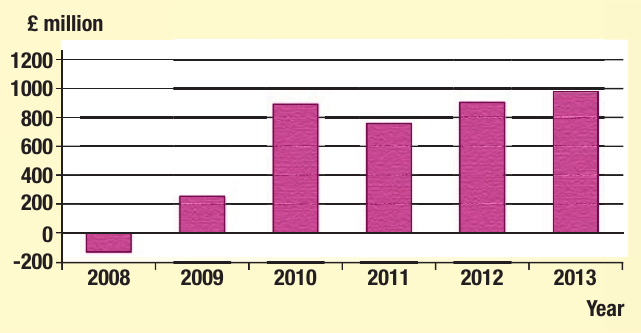
The bar chart shows RTR's profit after tax from 2008 to 2013. Starting from near zero in 2008, profits grew substantially to approximately \£250 million in 2009, jumped dramatically to around \£900 million in 2010, before experiencing some volatility but generally maintaining levels between \£750-1000 million through 2013.
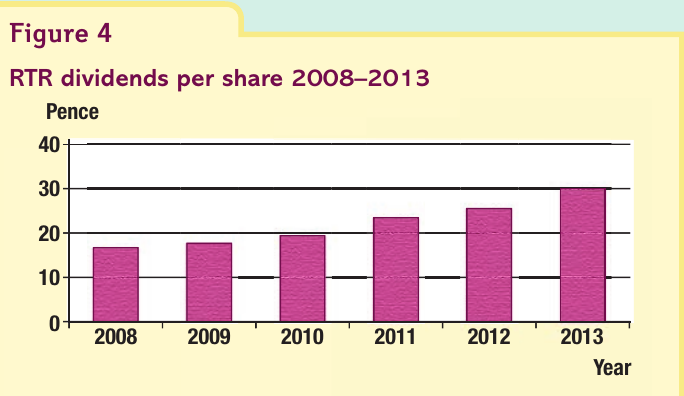
RTR's dividends per share show a consistent upward trend from approximately 17 pence in 2008 to 30 pence in 2013, demonstrating the company's ability to maintain sustainable growth and reward shareholders despite revenue expansion from \£5,200 million (2008) to \£7,691 million (2013).
This case illustrates successful growth management – the company increased revenue by nearly 48% while maintaining profitability and consistently increasing shareholder returns, suggesting they avoided overtrading through careful financial management.
Managing the risk
Whatever the underlying cause, if a business is overtrading, it can run out of cash. This threatens the business's very survival. Therefore, growth must be managed carefully with attention to:
- Adequate capitalisation before expanding
- Careful management of trade credit terms
- Realistic pricing that ensures sufficient profit margins
- Cash flow forecasting and monitoring
- Possibly seeking additional external finance during growth phases
Note
Proactive Risk Management: The key to avoiding overtrading is anticipating cash requirements before they become critical. Businesses should develop comprehensive cash flow forecasts that account for the timing gap between incurring costs and receiving payment from customers. Many successful businesses maintain a cash reserve equivalent to 3-6 months of operating expenses as a buffer against unexpected shortfalls.
Exam application
When analysing problems arising from growth, consider:
Note
Exam Strategy Tips:
For "explain" questions: Clearly define the problem, then work through the logical chain of how it develops and impacts the business. Use business terminology precisely.
For "analyse" questions: Develop a clear line of reasoning showing cause and effect. For example: growth → more departments → longer communication chains → increased miscommunication → higher costs and lower productivity.
For "evaluate" questions:
- Consider the severity of problems in context (industry, size, rate of growth)
- Weigh problems against potential benefits of growth
- Consider whether problems are temporary or permanent
- Assess whether problems can be managed or are inevitable
- Make a supported judgement about whether growth should proceed
Remember!
Summary
Key Points to Remember:
-
Diseconomies of scale occur when average costs rise as output increases beyond the minimum efficient scale
-
Internal diseconomies mainly result from management challenges: communication difficulties, co-ordination problems, and motivation issues
-
External diseconomies arise from overcrowding in industrial areas, driving up resource costs
-
Poor communication in growing businesses leads to inefficiency, duplication of resources, and silo mentality
-
Overtrading threatens business survival when firms grow too fast without adequate financial resources – caused by undercapitalisation, excessive trade credit, or slim profit margins
-
Growth must be sustainable and carefully managed to avoid these problems overwhelming the benefits of expansion