Corporate Objectives (Edexcel A-Level Business): Revision Notes
📚Revision Notes
Corporate objectives
Introduction
Corporate objectives are the targets set by senior managers and directors that guide a business towards achieving its overall aims. These objectives sit within a hierarchy that flows from the business's fundamental aims down to specific departmental targets. Understanding this structure is essential for analyzing how businesses plan and implement their strategies.
Note
Corporate objectives don't exist in isolation—they're part of a structured framework that connects the business's broadest aims down to day-to-day operational targets. This hierarchical approach ensures that every level of the organization works towards the same overarching goals.
Business aims
Every business has aims, which represent the long-term purpose or reason for the organization's existence. These aims define what the business is ultimately striving to achieve. Unlike objectives, aims are intentionally less specific and often expressed as a vision for the business's future direction.
Business aims typically represent the fundamental purpose of the organization. For example, a fitness center might aim "to encourage targeted activity to improve levels of fitness." This broad statement captures the essence of why the business exists, but doesn't specify exactly how or when this will be achieved.
Most businesses communicate their aims through a mission statement, which translates the business's purpose into a clear, accessible format for stakeholders.
Note
Aims vs. Objectives: Understanding the Difference
While aims and objectives are related, they serve different purposes:
- Aims are broad, long-term, and often qualitative statements about what the business wants to achieve
- Objectives are specific, measurable targets that help achieve those aims
Think of aims as the destination and objectives as the roadmap to get there.
Mission statements
What is a mission statement?
A mission statement is a formal declaration of a business's overriding purpose. It serves multiple functions by reflecting the organization's goals, values, and identity. An effective mission statement describes the company's core activities and may reference:
- The markets in which the business operates
- Key commercial objectives
- How the business values its stakeholders
- The ethical principles guiding the organization
Purpose of mission statements
Mission statements serve two primary purposes:
1. Customer commitment A mission statement creates a promise to customers about what they can expect from the business. It establishes the standards and principles that will guide the organization's interactions with its customer base.
2. Workforce unity Mission statements bring employees together around a shared purpose. When employees believe in the organization's mission, it contributes to a strong corporate culture. This is particularly important because most people want to feel their work contributes to something beyond simply generating profit.
Characteristics of effective mission statements
Good mission statements should guide business decision-making. Running a business involves complex choices and detailed considerations. When faced with difficult decisions, a well-crafted mission statement can clarify direction by reminding leaders why the business exists.
Mission statements vary in length and detail. Some are short and direct, while others provide more comprehensive information:
Example
Real-World Mission Statements
-
Fitness center: "We improve levels of fitness by providing individual plans for people of all ages and helping them to achieve their aims"
-
Furniture maker: "To help create practical and beautiful homes for our customers"
-
Energy company: "To achieve sustainable energy that delivers shareholder value" (followed by specific commitments to research, safety, excellence, and customer value)
-
NGO: "To undertake research and action focused on preventing and ending grave abuses of human rights"
Notice how each statement reflects the organization's unique purpose while remaining clear and accessible to stakeholders.
Development of corporate objectives
Corporate objectives are the specific targets set by senior managers and directors for the entire company. These objectives should:
- Be specific to the company's particular history and future vision
- Align with the mission statement
- Focus primarily on desired performance and results over time
- Cover areas such as market share, profit levels, new product creation, resource usage, economies of scale, people management, and ethical behaviors
SMART criteria
For corporate objectives to effectively support a business in achieving its aims, they must meet SMART criteria:
Important
The SMART Framework for Effective Objectives
Specific The objective must clearly state what the business aims to achieve. It should reference a particular aspect or function of the business, leaving no ambiguity about the intended outcome.
Measurable There must be evidence available to demonstrate whether the objective has been achieved. Most corporate objectives include financial or quantifiable elements because these make measurement straightforward and objective.
Agreed Everyone responsible for achieving the objective must agree with it and understand its implications for their work. Without agreement and buy-in from those involved, there will be insufficient motivation or commitment to achieve the target.
Realistic The objective must be achievable within available resources and prevailing market conditions. Unrealistic objectives lead people to ignore them, and failing to achieve objectives can negatively impact business morale and performance.
Time specific Every objective needs a stated timeframe for achievement. Deadlines create urgency and provide a clear point for assessment of success or failure.
Examples of corporate objectives
Corporate objectives may include targets such as:
- Market share goals
- Profit level targets
- Creation of new products or processes
- Resource usage efficiency
- Achievement of economies of scale
- People management standards
- Ethical behavior commitments
Departmental and functional objectives
From the general mission statement flow more specific corporate objectives, which then cascade down to even more detailed departmental and functional objectives. These operational-level objectives set the day-to-day goals for specific business functions including:
- Human resources
- Finance
- Operations
- Logistics
- Marketing
Alignment and support
All departmental objectives must refer back up the hierarchy to corporate objectives and the mission statement. This ensures consistency across the organization's goals and activities. Functional objectives directly support corporate objectives, and because all business functions follow corporate objectives, they should align with one another.
Example
Worked Example: Cross-Departmental Alignment
Scenario: The operations department sets an objective to reduce waste by 25% within one year.
Impact on HR: The human resources department must support this through aligned objectives. HR might need to ensure all production workers complete specific training programs focusing on quality management to enable the operations target to be achieved.
Key Insight: This demonstrates how objectives in one department create responsibilities in others, ensuring the entire organization works cohesively towards corporate goals.
The objectives hierarchy
The relationship between different levels of objectives can be visualized as a hierarchy:
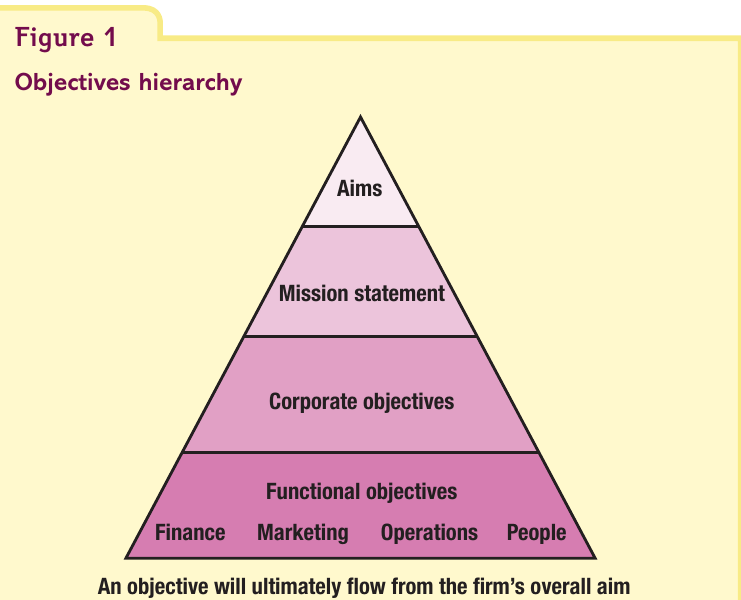
Note
Understanding the Objectives Hierarchy
This structure shows how objectives flow from top to bottom:
- Aims (at the top) - the overall purpose
- Mission statement - the declared purpose and values
- Corporate objectives - specific company-wide targets
- Functional objectives - departmental targets (Finance, Marketing, Operations, People)
Each level supports the level above it. An objective is effective when it contributes to achieving the objectives at the next level up in the hierarchy.
The difference between small and large firms
Business objectives vary significantly depending on the size and complexity of the organization.
Small business objectives
Small businesses typically have a wider variety of objectives covering different aspects of the business:
Example
Typical Small Business Objectives
- Financial survival: "To ensure the company breaks even at the end of the tax year"
- Liquidity management: "To improve the firm's liquidity in the next six months"
- Sales growth: "To increase sales by 10% over the next three years"
- Profitability: "To increase pre-tax profits by 5% over the next 12 months"
- Team development: "To hire five new staff with skills in sales and marketing"
- Sustainability: "To reduce energy consumption by 2% and cut use of non-recyclable packaging"
These objectives reflect the diverse challenges small businesses face and their need to balance multiple priorities simultaneously.
Large firm objectives
In contrast, large firms and multinationals tend to focus predominantly on financial objectives. This occurs because:
- Multiple stakeholders: Large businesses must satisfy many stakeholders, with shareholders being the primary group
- Ease of communication: Financial objectives are more objective and quantifiable, making them easier to communicate to diverse interested parties
- Measurability: Financial metrics provide clear benchmarks for success
Example
Large Firm Objective Example
A major supermarket chain might state: "To increase market share by 5% over the next two years" - a clear, measurable financial objective covering the entire operation.
This single objective is much simpler than the multiple objectives a small business might pursue, but it must satisfy the expectations of thousands of shareholders and stakeholders.
Critical appraisal of mission statements and corporate aims
Mission statements and corporate aims require regular assessment to maintain their relevance and effectiveness. Organizations must critically examine whether their stated values align with their actual practices and strategies.
When mission statements fail
Important
Warning: When Mission Statements Lose Credibility
Mission statements become inappropriate when they don't align with business behavior. For example:
- A company with a mission statement emphasizing "respect and integrity" loses credibility if fraud is reported within the organization
- If employees don't believe in or follow the mission statement, customers will quickly lose faith in the business
Actions must match words - otherwise, the mission statement becomes a liability rather than an asset.
Balancing stakeholder interests
Businesses commonly include objectives relating to:
- Corporate social responsibility
- Ethical practices
- Sustainable business growth
However, organizations must carefully balance the appeal of these objectives to customers against the need to generate profits for shareholders. Impressive-sounding commitments mean little if the business cannot maintain financial viability.
Framework for critical assessment
A thorough re-assessment of mission statements should address:
- Purpose: What is the mission statement trying to achieve?
- Audience: Who is the intended audience for this statement?
- Strategic alignment: How does the business's actual strategy fit with its stated mission?
- Realism: Are the aims and objectives realistic and achievable given available resources and market conditions?
Real-world application
Consider how a major retailer might express its commitment to community well-being and environmental protection. The organization must then demonstrate how this translates into:
- Marketing objectives: Supporting community initiatives, communicating environmental credentials
- Operations objectives: Reducing environmental impact, implementing sustainable practices
- Consistency: Ensuring actions match words across all business functions
Note
When mission statements are genuine and followed throughout the organization, they strengthen corporate culture and stakeholder relationships. When they're merely aspirational or contradicted by business behavior, they become marketing exercises that ultimately damage credibility.
Key definitions
Corporate objectives — The targets set by senior managers and directors that apply to a medium-to-large business as a whole. These objectives flow from the mission statement and guide strategic decision-making.
Departmental and functional objectives — Specific targets set for individual departments within a business, such as finance, marketing, operations, or human resources. These support corporate objectives.
Mission statement — A brief written statement by the business describing its fundamental purpose and objectives, designed to capture its present operations and future direction.
Objective (or goal) — A specific target or desired outcome that allows a business to achieve its broader aims. Objectives should be SMART to be effective.
SMART — An acronym describing the essential attributes of effective objectives: Specific, Measurable, Agreed, Realistic, and Time specific.
Remember!
Summary
Key Points to Remember:
-
Corporate objectives sit within a clear hierarchy: Aims lead to mission statements, which inform corporate objectives, which cascade to functional objectives across all departments.
-
SMART criteria are essential for effective objectives: Objectives must be Specific, Measurable, Agreed, Realistic, and Time specific to provide genuine direction and enable assessment of success.
-
Mission statements serve dual purposes: They create commitments to customers while uniting the workforce around shared values and purpose, contributing to strong corporate culture.
-
Business size influences objective focus: Small businesses typically set diverse objectives across multiple areas, while large firms tend to emphasize financial objectives to satisfy shareholders and enable clear communication.
-
Regular critical appraisal is vital: Mission statements and corporate aims must be continuously assessed to ensure they remain relevant, align with business strategy, and genuinely guide organizational behavior rather than serving as empty marketing statements.