Corporate Influences (Edexcel A-Level Business): Revision Notes
📚Revision Notes
Corporate Influences
Understanding corporate timescales
Corporate timescales refer to the time period over which business decisions have an impact. Every decision made by a business can affect the company in different ways and over different timeframes.
Long-term decisions are strategic choices that shape the vision, mission and overall objectives of the company. These decisions typically have consequences that play out over five years or more, sometimes even a decade. They are fundamental to the direction and future of the business.
Short-term decisions are more operational in nature and focus on achieving goals within a shorter timeframe, typically around 12 months. These decisions address day-to-day issues and immediate challenges facing the business.
Note
The choice between short-term and long-term focus significantly influences the types of decisions managers make. Businesses must carefully evaluate which timeframe is most important at any given point in their development.
Short-termism
Short-termism occurs when a business prioritises immediate results over long-term sustainability and growth. Companies that adopt a short-termist approach tend to make decisions that deliver quick wins, even if this comes at the expense of future prosperity.
Characteristics of short-termism
Maximising short-term profits
Companies focused on the short term aim to increase shareholder value quickly by maximising profits in the immediate future. They achieve this through several methods:
- Charging higher prices to boost revenue rapidly
- Investing heavily in persuasive advertising to drive immediate sales
- Cutting costs by reducing spending on research and development
- Using cheaper, potentially lower-quality resources
- Frequently switching suppliers to find the lowest prices
Reducing investment in research and development
Research and development (R&D) requires substantial financial investment and acts as a drain on cash reserves. Short-termist companies avoid this because:
- The returns from R&D projects are uncertain and may never materialise
- Even successful R&D projects can take many years before generating financial returns
- The money can be used instead to fund immediate objectives
Important
While cutting R&D spending may boost short-term profits, it can severely damage a company's ability to innovate and compete in the long run. Many successful companies that stopped investing in R&D eventually lost their competitive edge.
Cutting back on training
Staff training programmes are expensive and do not deliver instant results. While training typically improves motivation, enhances employee capabilities and reduces staff turnover, the benefits take time to appear. Short-termist businesses prefer to avoid this investment.
Returning cash to shareholders
Instead of reinvesting profits into the business for long-term growth, short-termist companies may pay special dividends to shareholders.
Example
Case Study: Rexam
Rexam, a beverage can manufacturer, returned £450 million to shareholders in 2014 (paying 57p per share) after selling its healthcare division for £490 million. This represented a clear short-term approach to returning value to shareholders rather than reinvesting in business development.
Asset stripping
Asset stripping is the practice of buying businesses (often in financial difficulty) and breaking them up. Profitable parts are sold off for cash whilst loss-making sections are closed down. This approach is controversial because it disregards the future of the company and its stakeholders, but it generates quick returns for the acquiring company's shareholders.
Preference for short-term contracts
Short-termist businesses favour temporary arrangements:
- Short-term contracts with suppliers
- Agency and temporary staff rather than permanent employees
- Short-term leases for machinery and equipment
Note
These flexible arrangements avoid long-term commitments but can be more expensive than permanent alternatives. The trade-off is between flexibility and cost-efficiency.
External growth over organic growth
Organic growth (expanding from within) may be too slow for short-termist companies. Instead, they pursue external growth through mergers and acquisitions, which delivers faster expansion and potentially quicker returns.
Drawbacks of short-termism
Threats to long-term profitability
Focusing excessively on short-term gains can damage the business's long-term profit potential. Highly lucrative opportunities may be missed. For instance, failing to invest in R&D might mean losing the chance to discover a potentially revolutionary innovation.
Loss of competitive advantage
International competitiveness suffers when businesses neglect long-term performance. Without investment in new products and cost-reducing technology, businesses gradually lose market share to competitors. This reduces job creation, wealth generation and ultimately harms the wider economy.
Important
Warning: The Innovation Gap
Companies that consistently underfund R&D and innovation eventually find themselves unable to compete with rivals who have invested in new technologies and products. This competitive disadvantage can be extremely difficult to reverse once established.
Distraction caused by quarterly reporting
Short-termist companies often focus heavily on quarterly financial reports. While these reports promote financial discipline, they create problems:
- Senior managers and CEOs spend valuable time preparing reports that could be used more productively
- Focusing on meeting short-term quarterly targets may lead to poor long-term strategic decisions
- Eliminating just two quarterly reports could free up two weeks of executive time per year
Higher costs from temporary arrangements
Over-reliance on short-term contracts can be counterproductive. Resources acquired on a temporary basis often cost more than long-term alternatives. For example, agency staff typically receive higher wages than equivalent permanent employees.
Additionally, committing only to short-term contracts sends negative signals. It becomes difficult to recruit high-quality staff or establish reliable relationships with good suppliers.
The causes of short-termism
Short-termism in corporations often stems from executive remuneration structures. Senior managers are typically rewarded based on short-term share price performance rather than long-term value creation. Institutional investors also pressure companies to deliver quick returns for their investment funds, showing little concern for long-term prosperity.
Note
Research suggests that the average holding period for shares on the New York Stock Exchange has dropped from six years to just six months, reflecting this short-term mentality.
A 2013 report for the Labour Party by Sir George Cox, former Institute of Directors boss, argued that short-termism was becoming entrenched in British business. He suggested it curtailed ambition, inhibited long-term thinking and discouraged investment in research, capabilities, products, training, recruitment and skills development.
Summary
Key Drawbacks of Short-termism:
- Threatens long-term profitability by missing lucrative opportunities
- Erodes competitive advantage through underinvestment in innovation
- Distracts management with frequent reporting requirements
- Increases costs through temporary arrangements
- Damages relationships with employees and suppliers
- Results from misaligned executive incentives and investor pressure
Long-termism
Long-termism represents the opposite approach to short-termism. Businesses with a long-term outlook avoid the pitfalls associated with short-term thinking.
Characteristics of long-termism
Investment in research and development
Long-termist businesses commit resources to R&D, new product development and innovation. This investment helps them build and maintain competitive advantages over time.
Focus on sustainable profitability
Rather than chasing immediate gains, long-termist companies pursue opportunities that deliver sustainable profits over extended periods. They are less likely to overlook valuable long-term opportunities.
Reduced emphasis on quarterly reports
Long-termist businesses place less importance on short-term financial reporting, instead emphasising the long-term strategic outlook and performance trends.
Investment in human capital
These businesses prioritise:
- Recruiting high-quality staff
- Providing comprehensive training programmes
- Building employee loyalty
- Retaining talented workers
Note
Investing in human capital creates a virtuous cycle where well-trained, motivated employees contribute to better business performance, which in turn allows for further investment in staff development.
Long-term relationships
Long-termist companies seek to develop meaningful and profitable long-term relationships with suppliers and other business partners, rather than constantly switching to find short-term savings.
The long-term approach aims to build sustainable competitive advantage and create lasting value for all stakeholders.
Evidence-based versus subjective decision making
When making important strategic decisions, businesses can adopt different approaches. The two main methods are evidence-based decision making and subjective decision making.
Evidence-based decision making requires a systematic and rational approach to researching and analysing all available information before reaching a conclusion.
Subjective decision making occurs when the personal opinions of the key decision maker strongly influence the chosen course of action.
Evidence-based decision making
Many business experts argue that evidence-based approaches produce the best informed decisions. For complex and strategic decisions, more data is typically available, making a scientific approach both possible and necessary.
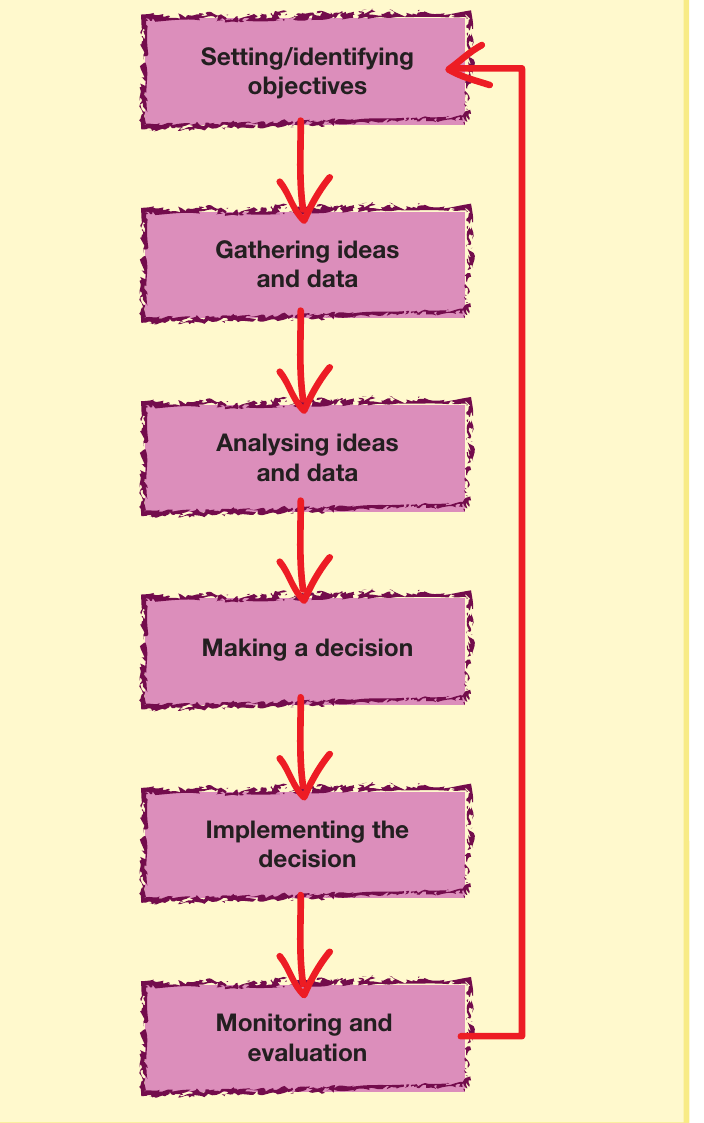
The evidence-based approach follows a structured process with distinct stages:
Stage 1: Setting and identifying objectives
The first stage involves clearly identifying what the business wants to achieve. The objective might be a corporate goal such as growth or survival during difficult trading conditions. Complex strategic decisions are usually taken by the board of directors.
For lower-level objectives (such as filling a part-time vacancy), decisions may be made by junior managers. Objectives often vary depending on the business's growth stage and ownership structure.
Note
The business must also establish criteria to measure whether objectives have been achieved. Often, the objective involves solving a specific problem, such as planning for an uncertain future or addressing poor profitability.
Stage 2: Gathering ideas and data
Decision makers need information and ideas to make informed choices. The amount and type of information required depends on the decision's nature and complexity.
Example
Example: New Product Launch Decision
Deciding whether to launch a new product might require:
- Data on potential sales levels and consumer reactions
- Information about production costs
- Analysis of competitor responses
This information gathering could take several months of market research, competitor analysis, and financial modelling.
Other decisions might use information the business already possesses, such as human resources data when considering employee dismissal.
Businesses can obtain ideas through several methods:
- Setting up working parties to collect information from within the organisation
- Receiving submissions from individuals or departments
- Holding staff discussions and brainstorming sessions
Stage 3: Analysing ideas and data
The next stage involves analysing the information to identify alternative courses of action. Possible solutions may build on previous ideas or introduce completely new approaches.
The aim is to determine which course of action best achieves the business's objective or solves the identified problem. Where possible, alternatives should be tested before the final choice is implemented.
Stage 4: Making a decision
This is the most critical stage in the process. Decision makers must commit to one specific course of action. Changing the decision later is often difficult, making it vital to get it right first time.
Important
Once production begins following a new product launch decision, reversing course becomes very challenging. If the product fails to sell, the business faces significant financial losses.
Some decisions can be reversed more easily. For instance, if a shop owner decides to close on Tuesday afternoons but finds the lost sales intolerable, reopening is straightforward.
Sometimes decision makers cannot reach a conclusion. In these cases, they must gather more information and repeat the previous stages.
Stage 5: Implementing the decision
Once a decision is made, relevant personnel must be informed and the decision carried out. Often, the people making decisions are not those who implement them.
Instructions typically pass from decision makers to managers, explaining what actions should be taken. For example, if directors decide to sell products in a new country, they must instruct the marketing manager accordingly.
Note
In smaller businesses, decision makers are more likely to implement their own decisions directly, creating shorter communication chains and faster implementation.
Stage 6: Monitoring and evaluation
Decision makers need time to see results after implementation. Sometimes this timeframe can be quite long. For example, companies that built the Channel Tunnel will not know for several decades whether it represents a commercial success.
The final stage involves evaluating the decision's outcome, often presented as a formal report. Based on this evaluation, it may be necessary to modify the course of action. The process may require revisiting objectives or collecting additional information, creating a feedback loop.
Challenges with evidence-based decision making
The evidence-based approach faces several potential problems:
- Objectives may be difficult to identify or unrealistic
- Information may be limited, incorrect or misleading
- Different people in the decision-making process may hold conflicting views about the best course of action
Important
Common Pitfall: Analysis Paralysis
Businesses can become so focused on gathering and analysing data that they delay making critical decisions. This "analysis paralysis" can result in missed opportunities and competitive disadvantages.
The role of models and simulations
Businesses often use models or simulations as part of evidence-based decision making. Models are simplified representations of problem areas, expressed through theories, laws or equations.
Common features of business models include:
- Reflecting key characteristics or behaviours of the area of concern
- Simplifying complex situations
- Simulating real-world actions and processes
- Providing aids to problem solving or decision making
- Using formulae to express concepts
Note
Computer software can run many models, allowing quick decisions and incorporating numerous variables. This technological capability has dramatically enhanced the sophistication of business decision making.
Management science and operations research make extensive use of decision-making models. For example, linear programming helps determine optimal solutions to various business problems, such as:
- Minimising production waste
- Allocating resources between competing tasks
- Finding the least-cost ingredient mix for a product
In marketing, Ansoff's Matrix helps consider the relationship between strategic direction and marketing strategy.
Simulations attempt to mimic real-world outcomes, allowing businesses to test ideas and make decisions without bearing the consequences if things go wrong. Businesses can run simulations multiple times, quickly and cheaply, to test alternative decisions without risk or resource consumption. Simulations are particularly useful for problems involving queues in business operations.
Subjective decision making
Subjective decision making involves choosing a course of action based on what you 'feel' is right, rather than systematic analysis of data.
Example
Example: Navigating Without Information
When driving to an unfamiliar destination and encountering an unmarked fork in the road, you choose the route that 'feels' right. This is not an evidence-based decision – it relies purely on intuition.
Some argue that subjective decision making is too risky for strategic decisions because it relies on the opinions and emotions of perhaps just one person. However, subjective approaches are appropriate in certain circumstances.
When subjective decision making is appropriate
Lack of reliable information
When current, accurate and meaningful information is unavailable, decision makers may be forced to take a subjective approach.
Example
Example: Credit Decision
A business contemplating a $5 million sale to a new customer without trading history might make a subjective decision about the customer's reliability, particularly if the customer promises to pay in 90 days and meet various contractual obligations.
Powerful and experienced leadership
Some corporations are dominated by powerful and persuasive leaders. These leaders may make strategic decisions single-handedly, without consultation and with only limited information. This can be acceptable when:
- The leader has extensive experience
- The leader has a good track record with previous decisions
- The organisation has a culture of trust
Industry norms
In certain industries, subjective decision making is normal practice. In the fashion industry, for instance, people must decide which design collections to purchase based purely on intuition. Successful fashion buyers often have excellent instincts for predicting popular trends.
Time pressure
Some decisions must be made very quickly, leaving insufficient time for the systematic evidence-based approach. In these situations, making a quick decision based on 'gut feeling' may be preferable to waiting for comprehensive information gathering and analysis. Opportunities can be lost if decisions are delayed.
The prevalence of subjective decision making
The extent of subjective decision making in business may be surprising. A 2014 study by global creative agency gyro and the Fortune Knowledge Group examined business decision making among 720 US senior executives.
Note
The report, titled Only Human: The Emotional Logic of Business Decisions, found that emotion plays a significant role in business decision making. Many executives believed that subjective factors had substantial impact on their decisions.
These subjective factors included:
- Corporate culture
- Corporate values
- Trust
- Reputation
- Gut instinct
Risks of subjective decision making
The success of subjective decisions varies considerably because they involve more risk.
Important
Cautionary Example: Kodak's Digital Camera Decision
Kodak's decision not to exploit digital camera technology (which Kodak actually developed) may have been subjective, based on misplaced confidence in the long-term future of film photography. This decision contributed to the company's eventual decline and serves as a warning about the dangers of subjective decision making without supporting evidence.
Exam technique guidance
When answering exam questions on corporate influences:
Analysis questions
- Explain the specific consequences of the decision-making approach
- Link the approach to the business context provided
- Use the short-term/long-term distinction to develop your analysis
Evaluation questions
- Consider which approach is most appropriate for the specific business situation
- Weigh up the benefits and drawbacks of different approaches
- Consider contextual factors such as industry type, business size, competitive position
- Make a justified judgement about the best approach
- Remember that both approaches have merits in different circumstances
Note
Command words
- Analyse: Break down the decision-making approach and explain the consequences
- Evaluate: Make judgements about which approach is most suitable
- Assess: Similar to evaluate – weigh up different factors and reach a conclusion
Remember!
Summary
Key Points to Remember:
-
Corporate timescales distinguish between short-term operational decisions (typically under 12 months) and long-term strategic decisions (affecting vision, mission and objectives over 5+ years)
-
Short-termism prioritises immediate profits and shareholder returns but threatens long-term profitability, competitive advantage and sustainable growth
-
Long-termism focuses on sustainable value creation through investment in R&D, training, and long-term relationships, avoiding the pitfalls of short-term thinking
-
Evidence-based decision making follows a systematic six-stage process: setting objectives, gathering data, analysing data, making the decision, implementing it, and monitoring results
-
Subjective decision making relies on intuition and gut feeling, and is appropriate when information is limited, decisions must be made quickly, or in industries where instinct is valued (such as fashion)
Key Terms:
- Asset stripping: buying struggling businesses and breaking them up to sell profitable parts
- Strategic decisions: policy decisions with long-term impacts that carry significant risk
- Evidence-based decision making: systematic, rational approach using data analysis
- Subjective decision making: decisions based on personal opinions and emotions rather than data
Critical Frameworks:
- The six-stage evidence-based decision-making process provides a structured approach to complex strategic choices
- Understanding when to use evidence-based versus subjective approaches is crucial for effective business decision making