Factors Influencing Growth and Development: Further Exploration (Edexcel A-Level Economics A): Revision Notes
📚Revision Notes
Factors Influencing Growth and Development: Further Exploration
This revision note explores the various factors that can either support or hinder economic growth and development in emerging and developing economies. While external resources can help finance development, each source has potential downsides that may limit their effectiveness.
External resources and their limitations
Developing countries often seek external resources to fund domestic investment. These include overseas assistance, transnational company investment, and international borrowing. However, each approach carries risks:
- Overseas aid may come with conditions requiring the purchase of goods from donor countries, sometimes at inflated prices, reducing the actual benefit
- Transnational companies often repatriate profits rather than reinvesting them in the host country
- International borrowing creates debt obligations that many developing countries have struggled to repay
Important
Understanding the full range of factors that influence development outcomes is crucial because external resources alone cannot guarantee successful development. Each source of external finance comes with trade-offs that must be carefully considered.
Demographic factors
Demographics play a crucial role in determining a country's development prospects. Population size, growth rates and age structure all affect the resources available for development.
Population growth and real wages
Early development theorists, particularly Thomas Malthus, held pessimistic views about population growth. Malthus, influenced by David Ricardo's ideas, believed in diminishing returns to labour. This concept suggests that as a country's population increases, average wages will fall because a larger labour force becomes inherently less productive.
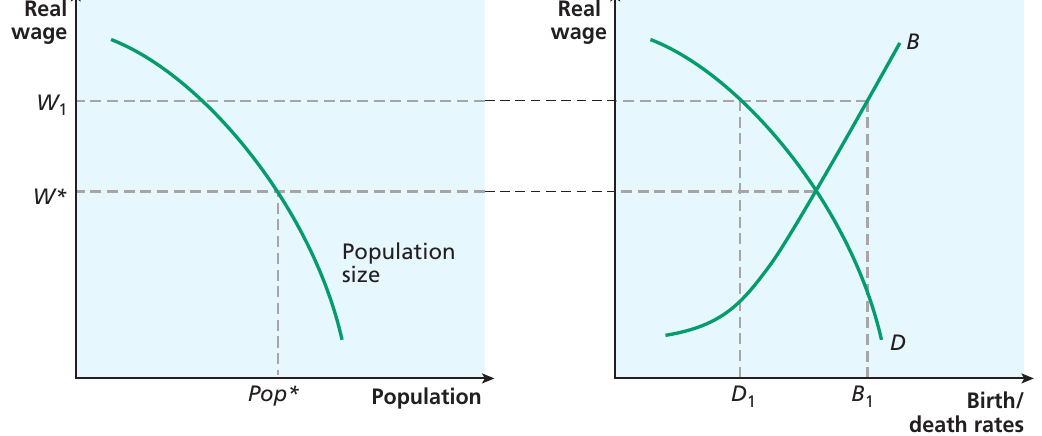
Malthus developed a theory linking population growth to real incomes. He argued that birth rates would rise with real wages, as families with more resources would have more children. Simultaneously, death rates would fall with higher real wages, as better-fed people would be healthier. This relationship creates a mechanism where population adjusts to wage levels.
Note
The diagram illustrates Malthus's theory through two panels. The left panel shows the inverse relationship between population size and real wages. The right panel displays birth rate (B) and death rate (D) functions against real wages. When wages are relatively high (), the birth rate exceeds the death rate, causing population growth. As population grows, wages must fall (as shown in the left panel), eventually converging to an equilibrium wage ().
Malthus believed sustained increases in real wages were impossible because population could grow exponentially whilst food supply could only grow arithmetically due to diminishing returns. Although agricultural productivity improvements proved him wrong, the question of whether population growth constrains development remains relevant. The answer depends on the balance between population size and available resources.
Rapid population growth
Global population is growing rapidly, adding over 80 million people annually. In November 1999, world population reached 6 billion, and by November 2022 it hit 8 billion—approximately eight times the 1800 level. However, this growth is distributed unevenly:
- Germany and Japan expect declining populations between 2015-2025
- Sub-Saharan African population continues growing at 2.5% per annum
- Countries with 2.5% annual growth will double their population in just 28 years
Important
This rapid growth creates considerable pressure on resources to provide education and healthcare. For many sub-Saharan African countries, the high proportion of young dependants (those aged under 15) strains limited resources, potentially hindering development efforts.
The demographic transition
Demographic transition describes the process many countries have experienced where improved health lowers death rates, followed by declining birth rates, leading to stable population growth.
Demographic transition in developed countries
Developed countries have followed a common pattern as development progressed. This pattern is illustrated by data from England and Wales between 1750 and 2000.
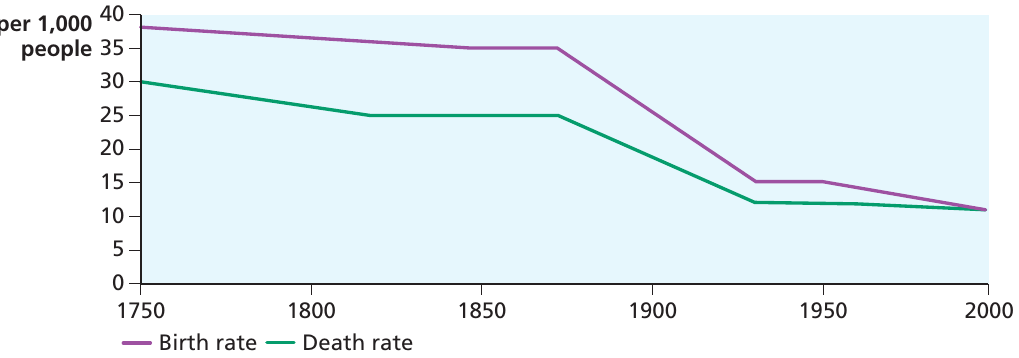
The graph shows birth and death rates per 1,000 people over 250 years. Between 1750 and 1820, the death rate fell more steeply than the birth rate, meaning population growth accelerated. This period coincided with Britain's Industrial Revolution and the early "take-off" phase of economic growth. Birth rates remained high initially.
After 1870, death rates continued falling, but birth rates declined even more steeply, slowing population growth. By 2000, natural population growth had nearly reached zero. The natural rate of increase equals the birth rate minus the death rate.
Note
This demographic transition has occurred in most developed countries. The supporting explanation suggests that when development begins, death rates fall as incomes rise. Over time, families adapt to this change and new social norms emerge where typical family sizes become smaller. For example, as more women join the workforce, the opportunity cost of having children rises—by taking time away from careers to raise children, foregone earnings increase.
Demographic transition in developing countries
Countries experiencing demographic transition later have not followed the same smooth path. Sri Lanka's pattern illustrates this difference.
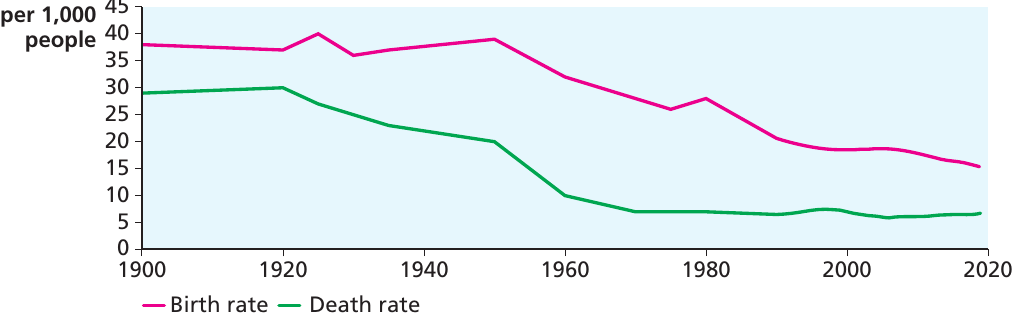
In Sri Lanka, death rates only began falling after about 1920, dropping more steeply than in early England and Wales. After 1950, death rates fell even more rapidly, partly due to improved hygiene methods and modern medicine enabling faster reductions.
Important
More crucially, birth rates in Sri Lanka remained high for much longer. Households' family size decisions did not adjust as rapidly as in England and Wales. This led to a period of relatively rapid population growth before stabilisation—a pattern common among developing countries experiencing later demographic transitions.
Example
Example: Uganda's Demographic Transition
In Uganda, the demographic transition demonstrates the challenge of rapid population growth:
- 1990: Death rates were 18.3 per 1,000
- 2019: Death rates fell to 6.4 per 1,000
- 1990: Birth rates were 50 per 1,000
- 2019: Birth rates fell to 37.4 per 1,000
Result: Despite falling birth rates, the gap between births and deaths remained large, resulting in a natural population growth rate of 3.1% per annum by the end of the period.
The microeconomics of fertility
Household family size choices can be analysed as an externality issue. In the diagram below, MPB (= MSB) represents the marginal benefit households receive from having different numbers of children, whilst MPC represents the marginal private costs incurred.
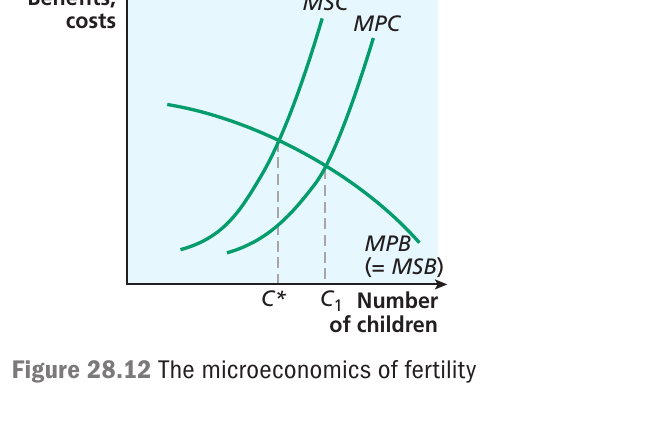
If education is subsidised, or if households don't perceive the costs imposed on society by having many children, then the marginal social cost (MSC) exceeds the marginal private cost. Households will choose to have children rather than , which is optimal for society. This suggests large family sizes might represent market failure. The analysis assumes households can choose their desired family size through access to and knowledge of contraception methods.
Fertility rates across countries
Fertility rates vary considerably between countries, reflecting different stages of demographic transition and development levels.
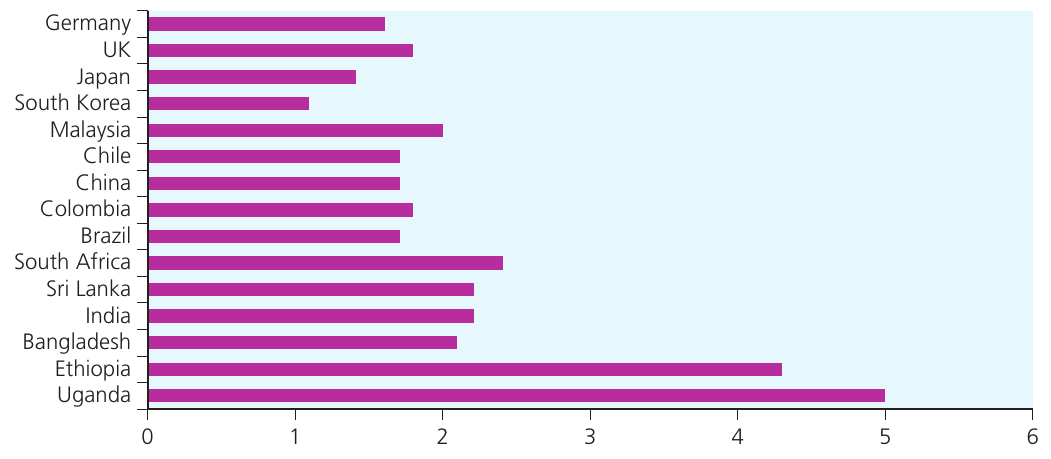
The chart shows fertility rates (births per woman) for selected countries in 2019, ranked by GNI measured in PPPs. Uganda shows the highest fertility rate at approximately 5.0 births per woman, whilst South Korea shows the lowest at around 1.1. Generally, lower-income countries display higher fertility rates than more developed nations.
Note
High fertility rates have implications for population age structure, leading to high proportions of young dependants. For example, in 2020, 46% of Uganda's population was aged 14 or younger. This creates strain on limited resources due to the need to provide education and healthcare for many children. High population growth can therefore prove an obstacle to development.
However, people themselves constitute a resource for the country. The key question concerns the balance between population and resource availability.
Debt
By the 1990s, some developing countries had accumulated substantial amounts of outstanding international debt. This constituted a severe drain on resources, as export revenues had to be allocated to debt repayments rather than development priorities. This position became unsustainable for many countries, especially in sub-Saharan Africa.
Access to credit and banking
For many developing countries, a particular challenge has been providing finance for small but important projects in rural areas. Where large portions of the population live in rural areas, the difficulty of raising funds for investment has impeded improvements in agricultural productivity—despite agriculture's significance in many developing countries.
Rural credit markets experience market failure, particularly information failure. Without branch banking, rural people lack access to the formal financial sector. Urban-based commercial banks don't have the information needed to assess loan applications for rural projects. Furthermore, property rights are not secure, making it difficult to provide collateral against loans when land ownership cannot be proven.
Important
Consequently, many rural people must depend on informal markets for credit, borrowing from local moneylenders or merchants at high, sometimes punitive, interest rates. Informal sector interest rates tend to be much higher than formal sector rates, partly due to the risk premium from difficulty assessing default probability. Additionally, local moneylenders may have monopoly power if villagers cannot access other finance sources.
Access to credit and banking issues extend beyond rural areas. Urban firms also face problems starting new businesses, with lack of access to commercial banks and, in many cases, the absence of stock markets.
Infrastructure
Infrastructure encompasses a range of important facilities needed to support the development process. Transport and communications networks enable trading activity and market facilities. Schools, clinics and hospitals are needed to provide education and healthcare to the population. Some types of infrastructure constitute public goods.
The provision of transport and communications systems, or market facilities improvements to enable trading, may prove crucial for smooth country development, but will be under-provided if left to the free market.
Note
Good infrastructure is especially important for developing countries wanting to attract transnational companies to bring foreign direct investment. Such companies won't be prepared to operate in economies where transport and communications infrastructure is inadequate to allow efficient and effective trade.
Education and skills
For developing countries wishing to develop manufacturing activity, skilled labour is needed to operate capital goods. Human capital in the form of skilled, healthy and well-trained workers is as important as physical capital if investment is to be productive.
In principle, today's developing countries have an advantage over countries that developed in earlier periods. They can learn from earlier mistakes and import already-developed technology rather than developing it anew. This suggests a convergence process should occur, whereby developing countries can adopt already-produced technology, thereby growing more rapidly and closing the gap with more developed countries.
Important
However, this convergence has largely not been happening, and lack of human capital has been suggested as a key reason for this failure. This underlines education's importance in laying foundations for economic growth as well as contributing directly to quality of life.
Example
Example: The Tiger Economies' Education Advantage
In the tiger economies case, education systems had been well established, either through British colonial legacy (Singapore and Hong Kong) or through past Japanese occupation periods (Taiwan and South Korea).
Key Success Factors:
- Education received high priority from governments
- Cultural influences encouraged high demand for education
- Countries benefited from highly skilled and well-disciplined labour forces
- Workers were able to make effective use of acquired capital goods
A problem for many developing countries is that people don't fully perceive the future benefits to be gained from educating their children, so they demand less education than is desirable for society. In many rural areas, education is commonly undervalued this way, and drop-out rates from schooling are high. This may arise both from failure to perceive the potential future benefits children will derive from education, and from the high opportunity cost of education in villages where child labour is widespread.
Note
The situation in many countries has been worsened by poor curriculum design, whereby colonial rule's legacy was a school system and curriculum not well directed at providing the type of education most beneficial within a developing country context. Furthermore, there has tended to be bias towards providing funds to the tertiary sector (which benefits mainly rich elites within society) rather than ensuring all children receive at least primary education.
The benefits from developing people as resources may overflow into other component areas. For example, increased labour productivity occurs if healthy and educated people can work better. Ensuring products can better meet international standards reinforces linkages with the rest of the world.
Property rights
The lack of property rights may prevent individuals from obtaining credit, as commercial banks tend to insist on collateral to safeguard their loans. The legal framework ensuring secure rights over property is undeveloped in many developing countries. This not only creates difficulty in gaining credit but also affects the incentives people have to invest. For example, if an individual has no established ownership over a piece of land, there is no incentive to invest in improving its productivity.
Governance and corruption
Good governance is vital for growth and development for many reasons. For a developing country to make the best use of its resources, there needs to be a framework in which a responsible government can provide an environment for growth, allowing markets to work effectively wherever possible, but being able to intervene where necessary to correct market failures.
Where governments have raised funds for development purposes through borrowing or from aid donors, it has sometimes been the case that such funds have been employed for prestige projects which impress lenders (or donors) but do little to further development. Other funds have been diverted into private use by government officials, and there are well-documented examples of politicians, officials and civil servants who have accumulated personal fortunes at the expense of their countries' development.
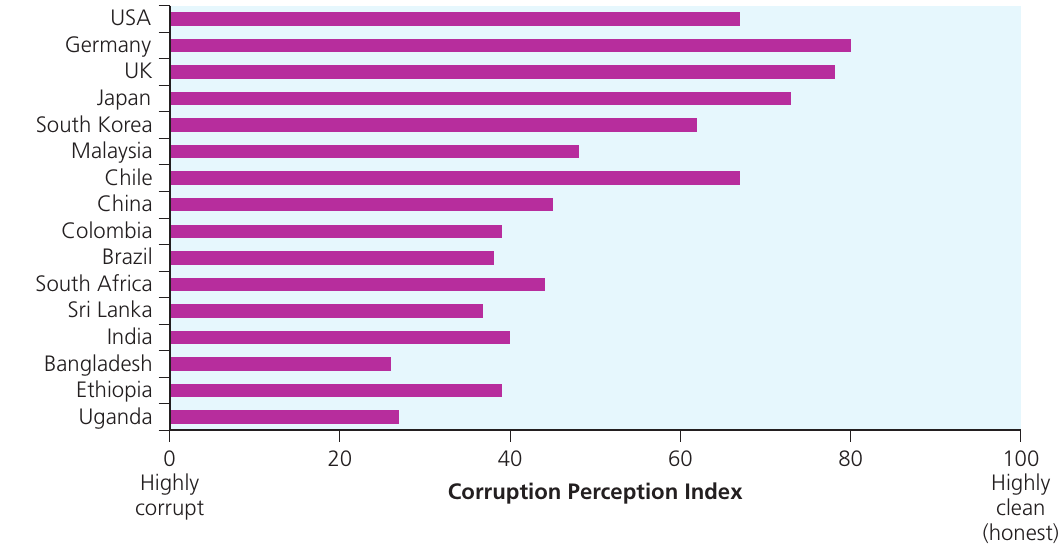
Note
The chart presents data for a Corruption Perception Index, produced regularly by the non-governmental organisation Transparency International since 1995. The index ranges from 0 (highly corrupt) to 100 (highly clean/honest). Germany shows the highest score around 80, whilst Uganda displays the lowest at approximately 28. This data illustrates how perceptions of corruption vary significantly across countries.
Important
Care is needed with such indicators, as corruption by its nature is difficult to identify and measure. Corruption may be disguised more successfully in some countries than others. Nonetheless, the way firms and governments perceive the relative state of corruption in different countries may affect their decisions on where to locate foreign direct investment or provide overseas assistance.
Corruption tendencies are likely to be more significant in countries with relatively little political stability, where governments know they won't remain in power long. Even without corruption, this discourages governments from taking long-term perspectives and encourages short-termism.
The lack of effective tax collection infrastructure may make it difficult for governments to raise funds. Even with sound governance, there is a tendency for bureaucracy to impede the development process.
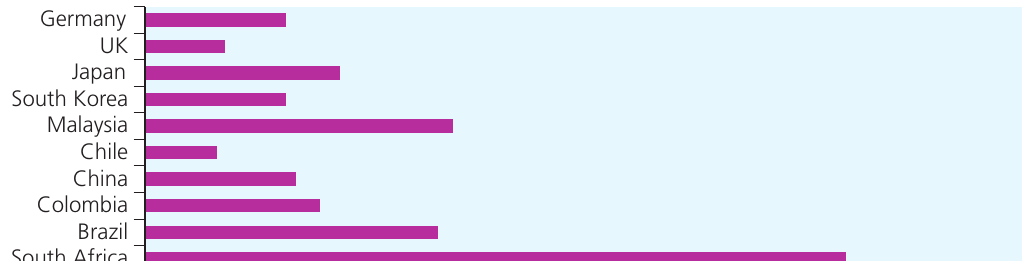

These charts show the time needed to set up a new business in selected countries. South Africa appears as a bit of an outlier, but notice also the observations for lower-income countries shown. The time required varies from under 10 days for some countries to over 40 days for others, illustrating bureaucratic barriers to business creation.
Economic instability
Stability in the macroeconomy is important to encourage investment. If the macroeconomic environment is unstable, firms will not be sufficiently confident of the future to want to risk investing in projects. Additionally, if the government becomes overactive in the economy, this may starve the private sector of resources.
A key aim for a developing country should be ensuring that prices can act as effective signals in guiding resource allocation. If overall inflation is allowed to get out of hand, then allocative efficiency cannot be expected. On the other hand, a stable macroeconomy should serve to improve the operation of microeconomic markets. An economy that is stable should also be better able to withstand external shocks.
Note
Prices acting as effective signals can create a climate for enterprise, enabling people to exploit their capabilities. In the past, many governments in developing countries tended to intervene strongly in markets, distorting prices away from market equilibrium values—especially food prices, which were kept artificially low in urban areas, thus damaging farmers' incentives. Additionally, it is important to encourage the development of financial markets that will channel savings into productive investment.
Civil and international conflict
In sub-Saharan Africa particularly, there have been further problems resulting from civil or international conflicts. These have often diverted resources away from development priorities. If a country's government doesn't expect to be in power very long, it has little incentive to develop policies to stimulate development in the long term, but will concentrate on gaining short-run popularity in hope of hanging onto power. In some African cases, civil conflict has lasted for decades, and this may also discourage firms and individuals from undertaking much-needed investment.
Political stability
Political stability can promote development by encouraging leaders to take a long-term view. This was the case for Singapore, where Lee Kuan Yew, who was prime minister from 1959 until 1990, guided the economy through a period of rapid growth and development. However, political stability by itself doesn't guarantee success—as demonstrated by Zimbabwe, where Robert Mugabe enjoyed a long period of rule until 2017 but demolished rather than built up the economy.
Example
Example: Government Intervention in Tiger Economies
In the tiger economies case, governments did have strong influence—although less so in Hong Kong's case:
Singapore:
- Kept a tight rein on the macroeconomy
- Encouraged savings
- Nurtured the education system
- Guided the development of key strategic sectors
- Provided good infrastructure for trade and industry
- Maintained an open economy
South Korea:
- Subsidised the development of large conglomerate firms
- These firms provided the foundations for economic growth
Geography
It is important to remember that developing countries vary considerably in many ways, not least in their geographic location and character. Land-locked economies such as Uganda face challenges with transport and trading. Some countries are dominated by adverse conditions such as arid desert lands or mountainous terrain. Others may have fertile and favourable climatic conditions, or advantageous strategic locations. These natural disadvantages and advantages may of course influence the prospects for growth and development.
Health emergencies
Developing countries have suffered from adverse health events that have interrupted growth and development. Inadequate and under-resourced healthcare systems have hindered the process of recovery from such events, not to mention the ability to prevent and control outbreaks. Sub-Saharan African economies have been particularly affected.
Famines
Famine is one form of health emergency that has affected a range of economies across the African continent. Perhaps best known is the famine that hit Ethiopia in 1984, in which it is estimated that more than a million people died and more were displaced. Famines may occur when there is a drought causing harvests to fail, or when civil war interferes with normal production.
Important
Nobel laureate Amartya Sen argued that the key cause of famines is people lacking the entitlement to food. He highlighted examples of famines in which food was available but poor members of society were not able to obtain it, either because of high prices or because the procedures needed to apply for assistance in accessing food were not understood.
HIV/AIDS
The HIV/AIDS epidemic had a major impact on developing countries, especially those in sub-Saharan Africa. The epidemic began in Uganda in 1981 but soon spread to other African countries—and beyond. The disease prevalence became unimaginably high in some African countries during the epidemic. For example, in Botswana it was estimated that in 2003 some 37.3% of the population aged 15-49 were affected. In Swaziland (now Eswatini) the prevalence rate was 38.8%.
The disease's repercussions are especially marked because of its impact on people of working age. This affected the labour force size and left many orphans with little hope of receiving an education, which in turn has implications for future generations' productivity. Even after the epidemic's height had passed, the effects lingered. As late as 2016, Botswana was still showing a prevalence rate of 21.9% and in Swaziland the rate was 27.2%.
Example
Example: Contrasting Government Responses to HIV/AIDS
Governments reacted to the disease in very different ways, with dramatically different outcomes:
Thailand's Approach:
- In 1990, incidence among adults was about 1%
- Government was open about the disease's onset
- Promoted safe sex through widespread public campaigns
- Result: By 2001, incidence was still about 1%
South Africa's Approach:
- In 1990, incidence among adults was about 1% (similar to Thailand)
- Government did little to stop the disease's spread
- President chose to downplay the problem
- Minister of health recommended beetroot as a treatment
- Result: By 2005, incidence had risen to nearly 20%
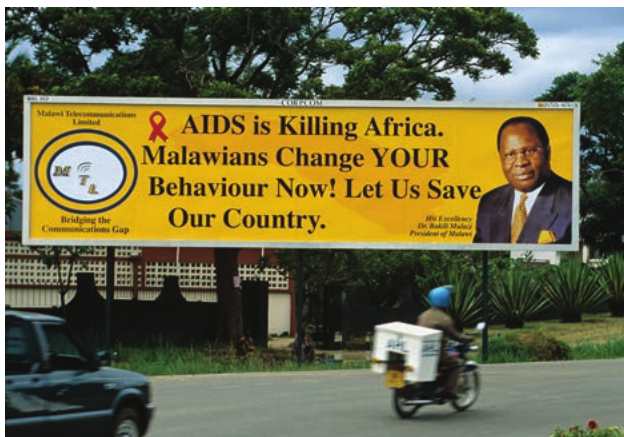
Some other governments have also kept silent, perhaps not wanting to admit it is a problem, and the disease has run rampant. There may also have been problems measuring HIV/AIDS incidence accurately, as individuals may be hesitant to seek treatment or report that they have the disease for fear of social stigma. The disease incidence has been in decline, but in 2020 the incidence of HIV/AIDS among adults aged 15-49 in Eswatini was still over 10%.
Note
According to the World Health Organization (WHO), there had been 36.3 million deaths from HIV/AIDS by the end of 2021, and there were 37.7 million people living with the disease, two-thirds of whom were in Africa. However, the disease's true impact may never be known.
Ebola
The disease Ebola was first identified in 1976. It has a fatality rate of 50% (higher in some outbreaks). The biggest outbreak occurred in 2014-16 in the West African countries of Guinea, Liberia and Sierra Leone. Cases were also found in Nigeria and elsewhere. In this outbreak there were a total of 28,652 cases, with 11,325 deaths.
Another outbreak was reported in the Democratic Republic of the Congo in April 2022—the fourteenth outbreak to occur in that country. The disease is feared because of its high fatality rate, but experience has shown how the spread could be controlled.
COVID-19
The first known case of COVID-19 was identified in China in December 2019, and the disease soon spread to almost every country in the world, causing widespread disruption to the economies most affected (including the UK, USA and other advanced economies).
Intuition suggests that African countries should be vulnerable to the COVID-19 virus, having less well-developed healthcare systems and less access to vaccines. However, although there has been widespread exposure to the virus, infection and death rates have been relatively lower than expected. Several reasons have been advanced for this:
- African countries have a relatively warm climate, whereas the virus appears to spread more readily in cold conditions
- African countries have younger populations (partly due to the HIV/AIDS epidemic's long-term effects), and younger people seem to be less susceptible to the virus's most serious effects
- African countries have more experience of how to cope with outbreaks of infectious diseases
Important
However, a word of caution is desirable here. African countries had low testing rates, which suggests the data may be unreliable and may understate the virus's impact.
Contrasting patterns of development
Different regions of the world have experienced very different development paths. Understanding these contrasting patterns provides valuable insights into the factors that promote or hinder economic growth and development.
The East Asian experience
The rapid growth achieved by the East Asian tiger economies was undoubtedly impressive, and held out hope that other developing countries could begin to close the gap in living standards. Indeed, the term "East Asian miracle" was coined to describe how quickly these economies had been able to develop. At the success's heart were four economies: Hong Kong, Singapore, South Korea and Taiwan. Others, such as Malaysia and Thailand, were not far behind.
Note
None of these countries enjoys a rich supply of natural resources. For example, Singapore is a small city-state whose key natural resources are its harbour and strategic location.
The tigers soon realised that to develop manufacturing industry, it would be crucial to tap into economies of scale. This meant producing on a scale that would far outstrip their domestic markets' size—which meant they would have to rely on international trade.
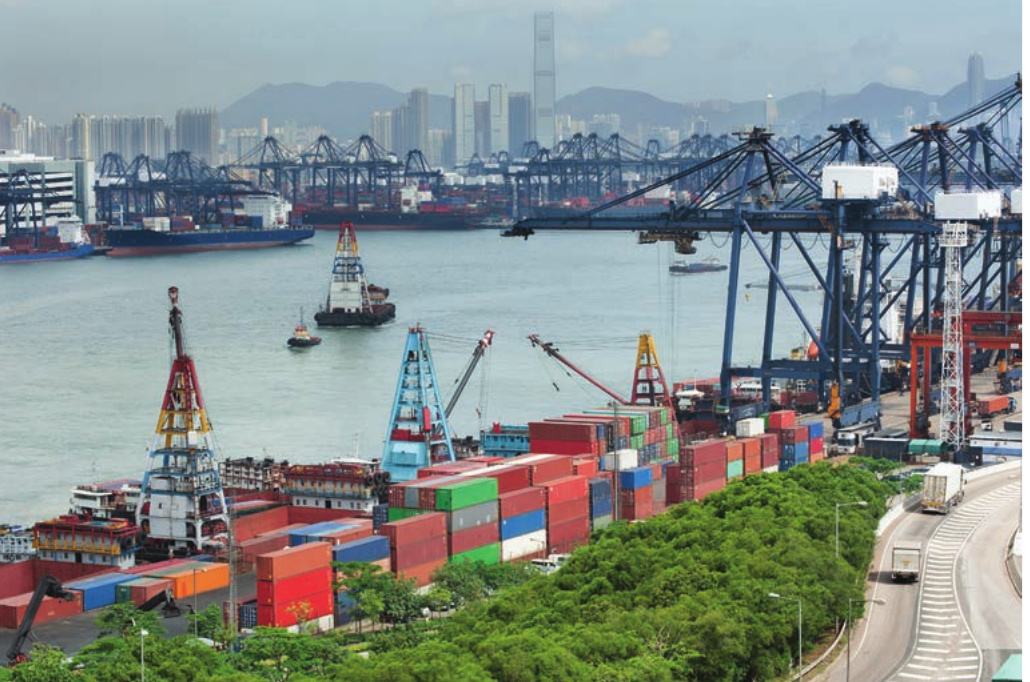
By being very open to international trade and focusing on export markets, the tigers were able to sell to a larger market, and thereby improve their efficiency through economies of scale. This enabled them to enjoy a period of export-led growth. In other words, the tiger economies expanded by selling their exports to the rest of the world, and building a reputation for high-quality merchandise. This was helped by their judicious choice of markets on which to focus. They chose to move into areas of economic activity that were being vacated by more developed nations, which were moving up to new sorts of products.
Export-led growth describes a situation in which economic growth is achieved through the exploitation of economies of scale, made possible by focusing on exports and reaching a wider market than would be available within the domestic economy.
Note
The export-led growth hypothesis explains part of the tiger economies' success, but there were other contributing factors. The tiger economies nurtured their human capital and attracted foreign direct investment. Their governments intervened to influence the economies' direction but also encouraged markets to operate effectively, fostering macroeconomic and political stability and developing good infrastructure. Moreover, these countries embarked on their growth period at a time when world trade overall was buoyant.
Sub-Saharan Africa
The experience of countries in sub-Saharan Africa is in total contrast to the tiger economies' success story. Even accepting the GNI per capita measure's limitations, the fact that GNI per capita was lower in the region as a whole in 2000 than it had been in 1975 (or even earlier) paints a depressing picture. Can sub-Saharan Africa learn from the tiger economies' experience?
Important
Part of the explanation for the failure of growth in this region lies in the fact that sub-Saharan Africa lacks many of the positive features that enabled the tiger economies to grow. Export-led growth is less easy for countries that have specialised in producing goods for which demand is not buoyant. Furthermore, it is not straightforward to develop new specialisations if human and physical capital levels are low, the skills for new activities are lacking and poverty is rife. Encouraging development when there is political instability, and when markets don't operate effectively, is a major challenge.
Latin America
Countries in Latin America followed yet another path. There was a period in which the economies of Argentina, Brazil and Mexico, among others, were able to grow rapidly, enabling them to qualify as "newly industrialised economies". However, such growth could not be sustained in the face of the high rates of inflation that afflicted many countries in this region, especially during the 1980s. Indeed, many of them experienced bouts of hyperinflation, inhibiting economic growth.
In part this reflected fiscal indiscipline, with governments undertaking high levels of expenditure which they financed by printing money. In many cases, countries in this region have tended to be relatively closed to international trade. International debt reached unsustainable levels, and continued to haunt countries such as Argentina, which in 2005 offered its creditors about 33% of its outstanding debt's value. Around three-quarters of the creditors accepted the deal, knowing that otherwise they would probably get nothing at all.
Summary
Key Points to Remember:
Demographic Factors:
- Rapid population growth can strain resources, whilst demographic transition can lead to more stable population growth
- The balance between population size and available resources is crucial for development
Essential Foundations:
- Access to credit and banking enables investment in productive activities
- Good infrastructure supports trade, attracts foreign investment, and facilitates economic activity
- Education and human capital are as important as physical capital for productive investment
Governance and Stability:
- Good governance, low corruption and political stability create environments conducive to investment
- Economic stability ensures prices can act as effective signals for resource allocation
- Bureaucratic barriers and weak tax collection infrastructure can impede development
Health and Development:
- Health emergencies like HIV/AIDS, Ebola and COVID-19 have had major impacts on developing countries
- Government responses to health crises can significantly affect outcomes
- Sub-Saharan Africa has been particularly affected by health emergencies
Contrasting Development Paths:
- The East Asian tiger economies achieved remarkable success through export-led growth, investment in human capital, political stability and good governance
- Sub-Saharan Africa has struggled due to lack of these positive features, political instability and specialisation in goods with weak demand
- Latin America experienced growth but could not sustain it due to high inflation and fiscal indiscipline
- Geography and natural resources play important but not deterministic roles in development prospects