FDI, Credit, and Privatisation (Edexcel A-Level Economics A): Revision Notes
📚Revision Notes
FDI, Credit, and Privatisation
Introduction
Developing countries face significant challenges in promoting economic growth and development due to limited resources. A key question for these nations is whether to adopt market-oriented strategies that rely on markets working efficiently, or whether interventionist approaches are needed to address market failures. This note explores three important market-oriented strategies: foreign direct investment, credit provision through microfinance, and privatisation.
Note
The debate between market-oriented and interventionist strategies is central to development economics. Market-oriented approaches emphasize allowing markets to function efficiently, while interventionist strategies focus on correcting market failures where they occur.
Foreign direct investment (FDI)
What is FDI?
Foreign direct investment occurs when transnational companies establish production facilities in developing countries. Transnational companies (TNCs) are businesses that operate in multiple countries, typically having their headquarters in developed nations. Many TNCs have annual revenues exceeding the GDP of some developing countries where they operate.
TNCs may be motivated to invest abroad for three main reasons:
- Seeking new markets for their products
- Accessing natural resources or cheaper labour
- Improving production efficiency through economies of scale
These companies operate across various sectors, including primary production (such as oil extraction), manufacturing (like automotive production), and services (such as fast food chains).
Potential benefits of FDI
Attracting FDI can provide substantial advantages for developing countries, particularly by injecting resources into the development process.
Investment and capital provision
TNCs bring much-needed investment capital and advanced technology to developing countries. This helps address the shortage of capital goods that constrains economic growth. By increasing the capital stock, developing countries can expand their productive capacity and boost output levels.
Technology and human capital development
Beyond physical capital, TNCs often transfer valuable technology and management expertise. They may provide training programmes for local workers, developing skills that are scarce in the host country. This investment in human capital can include technical skills, management capabilities, and entrepreneurial knowledge.
Note
Human Capital Development
The transfer of skills and knowledge from TNCs to local workers represents one of the most valuable long-term benefits of FDI. Workers who gain experience with modern production techniques and management practices can later apply these skills throughout the economy.
Employment creation
FDI can generate modern sector employment opportunities for local workers. Given the high rates of rural-urban migration in many developing countries, creating urban employment helps absorb the growing labour force. This employment provides income for workers and their families, contributing to poverty reduction.
Tax revenue
Governments can collect tax revenues from TNCs through both direct taxation of company profits and indirect taxes on workers' incomes. Additionally, when TNCs export their products, they generate foreign exchange earnings for the host country, which is essential for importing capital goods and technology.
Spillover effects
Over time, positive spillover effects may occur. Local workers who gain skills and knowledge from working at TNCs may later transfer to domestic companies or establish their own businesses. This knowledge transfer can enhance the competitiveness and productivity of local firms, creating broader economic benefits beyond the direct TNC operations.
Potential costs of FDI
While FDI offers significant potential benefits, developing countries must also consider the costs and challenges associated with attracting TNCs.
Employment concerns
The employment benefits may be limited if TNCs use capital-intensive production methods that require relatively few workers. Some TNCs may also employ expatriate managers and skilled workers rather than hiring locally, reducing the employment and skills development benefits for the host country. Additionally, TNCs might pay wages above market rates to attract the best local talent, which could make it difficult for domestic firms to retain skilled workers.
Tax revenue issues
The expected tax revenues may not fully materialise. To attract TNCs, governments often offer tax incentives or holidays as a "carrot" to encourage investment.
Important
Transfer Pricing
TNCs may engage in transfer pricing to minimise their tax liability. Transfer pricing occurs when TNCs set prices for internal transactions between their various international operations to shift profits to low-tax jurisdictions. This practice is difficult for developing country governments to monitor and control effectively, potentially resulting in significant revenue losses.
Foreign exchange repatriation
A significant concern is whether TNCs will reinvest their profits locally or repatriate them to shareholders abroad. If profits flow out of the country, the host nation benefits less from export earnings. However, even if profits are repatriated, the country gains international recognition for its products, which may create spillover opportunities for local firms and improve the country's reputation in global markets.
Market power concerns
TNCs may exercise considerable market power within developing countries. They can restrict output and raise prices, limiting competition for local producers. There have also been accusations that some TNCs exploit weaker environmental regulations in developing countries, keeping production costs low by polluting. The anti-globalisation movement has raised awareness of corporate social responsibility, encouraging TNCs to improve their practices.
Location and inequality
TNCs typically establish operations in urban areas unless they are specifically seeking natural resources in rural locations. This concentration of investment in urban regions can widen the inequality gap between urban and rural areas, exacerbating a problem that already exists in many developing countries.
Evaluating FDI
Evidence suggests that countries with higher levels of human capital are more successful at attracting FDI. This may explain why East Asian countries and China have received substantially more FDI inflows compared to sub-Saharan African nations.
Note
Negotiating with TNCs
Governments can negotiate terms with TNCs to maximise benefits for their countries. For example, some nations like Indonesia have negotiated agreements requiring TNCs to employ a certain proportion of local workers after an initial period. This ensures that benefits are not entirely lost to the host country, particularly when the TNC possesses resources that cannot easily be obtained elsewhere.
Credit provision and microfinance
The problem of rural credit
Many developing countries struggle with inadequate credit provision, especially in rural areas. This represents a significant form of market failure that constrains small-scale economic activities and entrepreneurship.
Microfinance schemes
Microfinance schemes provide small-scale loans to individuals and groups in developing countries who would otherwise have no access to formal credit. These schemes have emerged as an important tool for promoting grassroots economic development.
The Grameen Bank
Origins
The Grameen Bank was founded in Bangladesh in 1976 by Muhammad Yunus, an economics professor. In 1974, Bangladesh experienced a devastating famine. Yunus was struck by the contrast between the abstract economic theories he taught and the desperate poverty he witnessed around him.
Example
The Bamboo Stool Maker
During field visits with his students, Yunus met a woman making bamboo stools who had to borrow money at extremely high interest rates (up to 10% per week) just to buy raw materials. Her profit margin was only 1p per stool, trapping her in a cycle of poverty. This encounter inspired Yunus to find a way to provide credit to poor people on more reasonable terms.
How it works
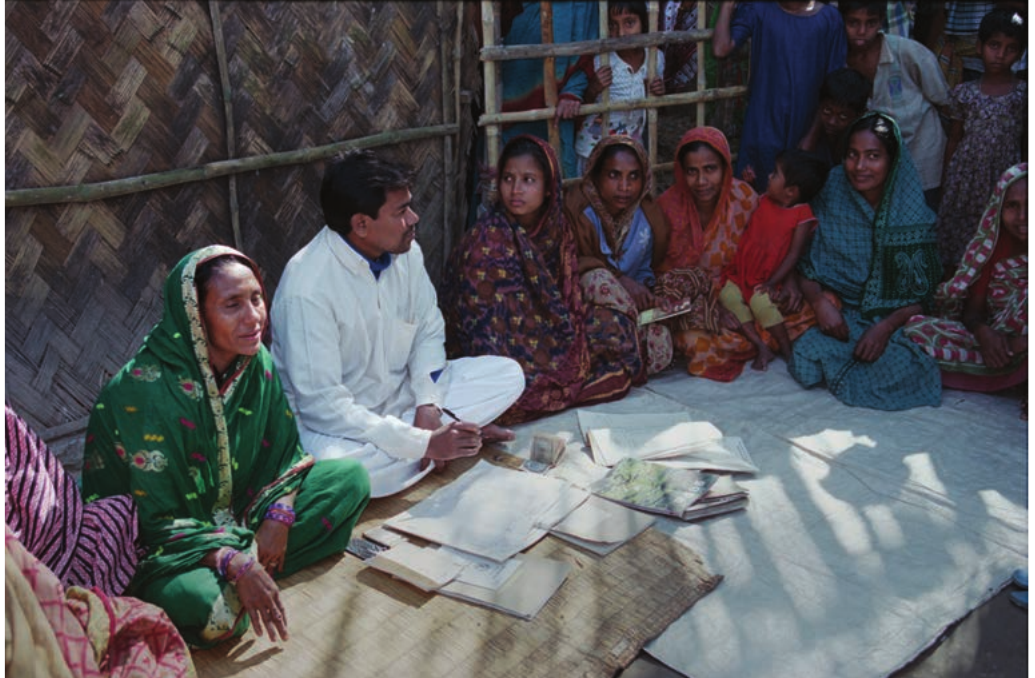
The Grameen Bank pioneered a group-lending model specifically designed for small-scale income-generating activities. Key features include:
- Loans are provided without requiring collateral (which poor people typically lack)
- Borrowers form groups of five people who share joint responsibility for repayments
- This joint responsibility minimises transaction costs and helps ensure repayment
- Interest rates are set close to formal commercial sector rates, much lower than informal moneylenders
- The bank has primarily focused on lending to female borrowers, who have proven to invest more carefully and repay more reliably
Important
Why Focus on Women?
The Grameen Bank's focus on female borrowers is based on evidence that women are more likely to use loans for productive purposes and invest in their families' welfare. Women have also demonstrated higher repayment rates compared to male borrowers, making them more reliable clients for microfinance institutions.
Success and impact
The Grameen Bank has achieved remarkable success:
- By May 1998, over $2.4 billion had been loaned through the scheme
- More than 2 million loans were provided for various purposes, including dairy cows, rickshaws, sewing machines, and small business activities
- By 2011, the bank had 8.349 million borrowers (97% women) across 81,379 villages
- Repayment rates have been impressive
- The model has been replicated in 59 countries across Africa, Asia, the Americas, Europe, and Papua New Guinea
The economic impact has been significant: loans have generated employment, reduced the number of economically inactive days for workers, and raised incomes, food consumption, and living standards for millions of families. Muhammad Yunus and the Grameen Bank were jointly awarded the Nobel Peace Prize in 2006 for their contributions to poverty reduction.
While attempts to replicate the Grameen model elsewhere have had mixed results, the concept has proven that providing credit to the poor can be both socially beneficial and financially sustainable.
ROSCAS
Other microfinance approaches include Rotating Savings and Credit Schemes (ROSCAS). In these schemes, groups of households pool their savings to accumulate funds for small-scale projects. Members take turns accessing the pooled funds, paying back the loan so the next person can have their turn.
Note
While ROSCAS have helped some successful enterprises, they have been less sustainable than Grameen-style arrangements and have sometimes been used for consumer purchases rather than productive investment.
Informal credit markets
In the absence of formal credit institutions, informal moneylenders operate in many developing countries, often charging very high interest rates. This partly reflects the high risk of borrowers defaulting, but it may also reflect the market power of moneylenders. The absence of insurance markets can also deter borrowing for productive investment, particularly in rural areas.
There is limited arbitrage between the formal and informal credit sectors, meaning formal institutions struggle to gain the information they would need to extend loans to informal sector borrowers safely.
Privatisation
Many developing countries have substantial numbers of state-owned enterprises. These are often inefficient and poorly managed. Consequently, international development institutions have often recommended privatisation as a way to improve efficiency and stimulate economic growth.
Important
Challenges of Privatisation
However, privatisation remains controversial. Many developing countries lack the managerial and entrepreneurial expertise needed to run privatised enterprises effectively. Furthermore, the administrative infrastructure required to monitor and regulate privatised companies is often insufficient. Without proper oversight, privatisation may not deliver the expected efficiency gains.
Remember!
Summary
Key Points to Remember:
- Foreign direct investment by transnational companies can provide developing countries with much-needed capital, technology, employment, tax revenue, and foreign exchange earnings
- FDI costs include potential employment issues, tax revenue losses through transfer pricing, profit repatriation, market power abuse, and urban-rural inequality
- Microfinance schemes like the Grameen Bank address market failure in rural credit provision by offering small loans to groups of borrowers without requiring collateral
- The Grameen Bank model focuses on lending to women in groups of five with joint responsibility, achieving high repayment rates and significant poverty reduction impacts
- Privatisation of state-owned enterprises may improve efficiency but faces challenges in developing countries due to limited managerial expertise and weak regulatory infrastructure