Trade Policy and Interventionist Strategies (Edexcel A-Level Economics A): Revision Notes
📚Revision Notes
Trade Policy and Interventionist Strategies
Introduction to interventionist strategies
When markets fail to work effectively, governments may need to adopt interventionist approaches to support economic growth and development. These strategies go beyond relying purely on market forces and involve active government participation in directing economic activity. This is particularly important in developing countries where market failures are more common and severe.
Note
Interventionist strategies represent a departure from pure free-market approaches, recognizing that in developing economies, market mechanisms alone may not be sufficient to achieve optimal outcomes for growth and development.
Development of human capital
Human resources play a crucial role in the growth and development process. Many developing countries have abundant labour relative to physical capital, but this potential often remains unrealised. Investing in human capital becomes essential for facilitating development and enabling countries to move up the value chain in production.
Education, training and healthcare
Raising agricultural productivity requires education and training programmes. A skilled labour force enables the growth of modern economic activities such as manufacturing industries and facilitates the adoption of new technologies. The absence of skilled labour represents a substantial obstacle to economic growth in many developing countries.
However, human capital development extends beyond formal education and training. For many developing countries, improved nutrition and healthcare provision can be equally important in raising worker productivity and directly contributing to quality of life improvements.
An important question in the development context is whether markets can be relied upon to ensure appropriate provision of education and healthcare, or whether market failures require government intervention.
Externality effects in education and healthcare
Both education and healthcare generate significant positive externality effects, meaning the social benefits exceed the private benefits to individuals.
Education externalities: When educated workers cooperate together, they become more productive because group members interact with each other. This creates spillover effects where the marginal social benefits of education exceed the marginal private benefits. Society gains from the way in which workers are able to work together more effectively.
Note
Healthcare externalities: Consider a vaccination programme against a communicable disease. An individual may perceive that the marginal benefit of vaccinating their child is relatively low if the probability of infection seems small. However, if everyone thinks this way, the likelihood of an epidemic increases substantially. The social benefits from a vaccination programme may exceed the private benefits, so without intervention, too few individuals will choose to be vaccinated.
During the COVID-19 pandemic, governments in many countries tried to highlight these externality effects by appealing to people's sense of social responsibility. This represented an example of nudge theory in action, attempting to influence behaviour without mandating it.
Information failures in education and healthcare
Market failures can also arise from information problems. Poor rural households may not perceive the full benefits of education, especially where uneducated parents make decisions on behalf of their children. They might decide to keep children out of school, believing that the benefits from child labour exceed the benefits of education.
Important
In many developing countries, there has been a tendency to keep female children away from school, as households may not see benefits from female education. Similarly, households may not understand the potential benefits from medical treatment, particularly preventative treatment, or may not perceive the value of good nutrition.
These information failures provide justification for some form of government intervention to ensure better take-up of education and healthcare services.
This might involve subsidising education, providing free primary school education, or implementing regulations such as enforcing a minimum school-leaving age.
The challenge for developing countries is raising the finances needed to improve education and healthcare provision, especially given problems with tax collection systems. For many developing countries, this has proved a major stumbling block.
Trade policy
Protectionism and import substitution
When a country faces a foreign exchange gap, it can adopt two broad approaches in developing its trade policy. One approach involves reducing reliance on imports to economise on foreign currency needs. This means producing goods at home that were previously imported. This strategy is known as import substitution, which depends on introducing protectionist measures.
The typical policy instrument used to achieve import substitution is the imposition of a tariff (a tax on imports). The idea is to boost domestic production of goods that were previously imported, thereby saving foreign exchange.
Note
Problems created by tariffs:
- Consumer welfare loss: Consumers must pay higher prices for goods, creating a deadweight loss to society
- Reduced competition: Domestic firms face less competitive pressure, potentially leading to inefficiency
- Tax revenue: While tariffs generate government revenue, this comes at the expense of consumer welfare
Some governments defend import substitution on the grounds that it allows countries to protect infant industries. The argument suggests that through encouragement and protection, new industries will eventually become efficient enough to compete in world markets.
Important
Two key problems with infant industry protection:
- Unless the domestic market is sufficiently large, local producers may never achieve economies of scale needed to compete globally
- Because domestic firms are never exposed to international competition under protection, they lack incentives to improve efficiency. This creates an inward-looking attitude that discourages firms from trying to compete in world markets. They remain content with the protection that provides them with producer surplus
Export promotion via primary industries or new activities
Export promotion requires a more dynamic and outward-looking approach, as domestic producers must compete with established producers in world markets. The choice of which products to promote is critical, as countries need to develop new patterns of comparative advantage to benefit from this strategy.
For primary producers, a tempting strategy involves moving along the production chain with existing products. However, this relies on gaining entry to markets that may already be dominated by experienced producers or face quality control regulations that are difficult to match.
Given the difficulty of developing new primary industries, can countries encourage the development of new economic activities that could fuel exports?
Example
The East Asian Tiger Economies:
The East Asian tiger economies pursued export promotion strategies successfully by ensuring their exchange rates supported the competitiveness of their products and that labour was appropriately priced. However, several factors contributed to their success:
- They expanded into export-led growth when world trade was booming
- Developed countries were beginning to move out of labour-intensive activities
- This created a niche for the tigers to fill
If many other countries had expanded exports simultaneously, it is uncertain that all would have been successful.
Challenges for other countries:
As time passes, it becomes more difficult for other countries to follow this policy. Countries that originally chose import substitution face particular difficulties because the inward-looking attitudes fostered by protectionist policies become deeply entrenched.
Important
There will always be dangers in trying to develop new kinds of economic activity that may involve sacrificing comparative advantage. This doesn't mean developing countries should remain primary producers forever, but it suggests that careful selection of new activities is important to exploit potential comparative advantage.
Buffer stock schemes
In some commodity markets, prices can exhibit significant volatility over time. This volatility arises because the supply of agricultural products varies from period to period due to changing harvest conditions. The supply curve shifts to the right when harvests are good, but shifts to the left in poor years caused by disease or blight.
Demand curves may also shift over time, with demand for some goods reflecting fluctuations in economic performance. Demand may shift left during recessions but right during boom periods.
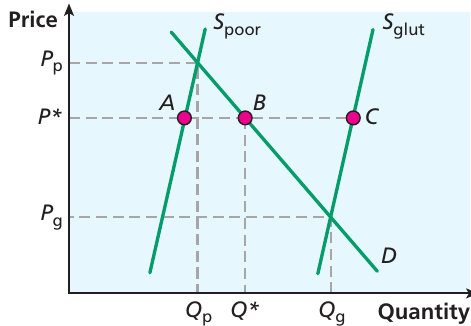
Suppose Figure 29.1 represents a market where demand is relatively stable between periods, but supply varies between when the harvest is poor and when the harvest is good. The price varies between and . This creates high uncertainty for producers, who find it difficult to form good expectations about future commodity prospects. Uncertain expectations make producers less likely to invest in productivity improvements because of uncertain future returns.
Example
How buffer stock schemes work:
A buffer stock is a scheme designed to stabilise commodity prices by buying excess supply in periods when supply is high, and selling when supply is low.
A scheme is set up whereby excess supply is bought up by the buffer stock in glut years to prevent prices from falling too low. In periods when harvest is poor, stocks of the commodity are released onto the market to maintain the price at the agreed level.
In Figure 29.1, suppose it is agreed to maintain the price at . When there is a glut year with supply at , there is excess supply at the agreed price (shown as amount BC), so this amount is bought up and stored by the buffer stock. If supply is at due to a poor harvest, there is excess demand, so the buffer stock releases the quantity AB onto the market, maintaining the price.
Limitations of buffer stock schemes:
Although buffer stocks stabilise prices at , there is a significant downside. If buffer stock members agree to maintain the price at too high a level relative to the actual average equilibrium price over time, the scheme runs into difficulties.
Important
If the price is set at in Figure 29.1, the buffer stock buys up more in glut years than it sells in poor harvest years. If this pattern repeats, the size of stocks to be stored rises over time. This is costly and eventually becomes unsustainable.
Real-world example:
The EU's Common Agricultural Policy (CAP) operated a buffer stock scheme for many years by offering a guaranteed target price to farmers for a range of products. This provided incentives for farmers to produce more output, resulting in an accumulation of products such as butter and wine that then had to be stored at enormous expense. The policy also had adverse environmental impacts. The CAP was eventually reformed and is now directed more towards providing farmers with incentives to produce in a more environmentally appropriate manner.
Note
Challenges for developing countries:
For developing countries, buffer stock schemes present many challenges:
- Storage costs can be substantial
- If a country is a relatively small producer in the global market, it has little influence on world prices
- The country remains subject to potentially large price fluctuations over which it has no control
Infrastructure
A potentially important interventionist strategy involves providing social infrastructure by improving transport and communication systems, or by providing market facilities that enable domestic and international markets to work more effectively.
Note
One obvious drawback is that governments of developing countries rarely have the resources to finance such investment independently, and must rely on external sources of funds. This creates dependency on foreign assistance and can lead to debt accumulation.
Managed exchange rates
Having observed the success of export-led growth strategies in some economies, another possible strategy to promote economic growth involves manipulating the exchange rate to improve the competitiveness of a country's exports.
China followed this path during its period of rapid export-led growth. The downside of this approach is that resources need to be diverted into the export sector to enable exports to expand. This could work for China as a centrally planned economy, as exports could be encouraged at the expense of domestic consumption. However, this approach would not work everywhere, and even in China could not be sustained indefinitely.
Promoting joint ventures with global companies
Could growth be stimulated by promoting joint ventures between local companies and transnational corporations (TNCs)? This has been attempted, but such arrangements face severe challenges.
Important
The TNC partner is likely to hold a dominant position in the partnership and may be wary of divulging too much information about its technology to local firms. This creates an unequal partnership where knowledge transfer remains limited and local firms struggle to develop their own capabilities independently.
Other strategies for growth and development
Industrialisation
Looking at countries that have succeeded in becoming developed, it is noticeable that very few have managed to achieve this by continuing to specialise in primary production (with Chile being a possible exception). This raises the question: is it possible for a developing country to develop through a process of industrialisation?
The Lewis model:
In an influential 1954 paper, Sir Arthur Lewis argued that agriculture in many developing countries was characterised by surplus labour. Farms were often operated on a household basis, with work and crops shared out between household members. If there was not enough work for all household members, then although all seemed to be employed, there would in fact be hidden unemployment or under-employment. Given the size of rural populations and their rapid growth, there could be almost unlimited surplus labour existing this way.
Note
Lewis pointed out that because the labour at the margin in agriculture was not contributing to output, it would be possible to transfer such surplus labour into the industrial sector without any loss of agricultural output. The remaining labour would be able to take up the slack. All that would be necessary is for the industrial sector to set a wage sufficiently higher than the rural wage to persuade workers to transfer. Industry could then reap profits that could be reinvested to allow industry to expand, without any need for the industrial wage to be pulled upwards to cause inflation.
Problems with the Lewis model in practice:
Unfortunately, the process did not prove as smooth as Lewis suggested. One major concern relates to human capital levels. Agricultural workers often do not have the skills or training that prepares them for employment in the industrial sector, so transferring them from agricultural to industrial work is not straightforward, especially if it is the least productive workers who choose to migrate.
Important
Furthermore, if migration to cities is rapid, urban infrastructure may not be able to cope, perhaps resulting in the development of shanty towns. These can be seen as a form of negative externality, creating social problems in urban areas.
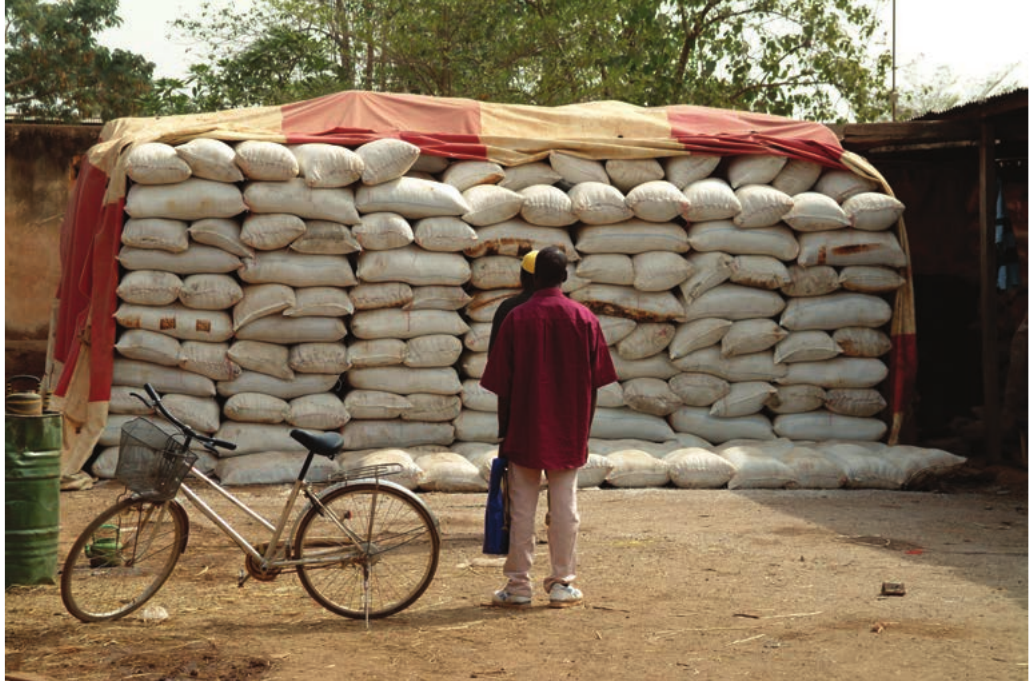
Additionally, expanding industry did not always reinvest the surplus to enable continuous expansion of the industrial sector. TNCs often repatriated profits, and in any case tended to use modern, relatively capital-intensive technology that did not require large pools of unskilled labour.
Long-term effects:
Perhaps more seriously, the Lewis model encouraged governments to think in terms of industry-led growth and to neglect the rural sector. This meant that agricultural productivity often remained low, and inequality between urban and rural areas grew. The model's emphasis on industrialisation led to policy biases that disadvantaged rural development.
Tourism
The analysis so far suggests that developing countries need to diversify away from primary production into new activities that do not require large amounts of capital. Preferably, these should involve producing goods or services that can earn foreign exchange and have a high income elasticity of demand. Tourism appears to fit these criteria well.
Benefits of tourism:
The income elasticity of demand for tourism is strongly positive. As real incomes rise in more developed countries, there will be an increase in demand for tourism. Within the domestic economy, tourism sector development has impacts on employment:
- In early stages, there will be demand for construction workers
- Later, there will be jobs in hotels, transport and other services
- Tourism has large multiplier effects on the domestic economy
Note
The World Bank has reported that visitor expenditures outside the hotel sector can range from half to nearly double the in-hotel spending. There is likely to be scope for small labour-intensive, craft-based activities to sell goods to visitors from abroad without actually having to enter the export business, as tourists come to the producers.
Tourism may also attract foreign direct investment if international hotel chains move in to cater for visiting tourists. This brings additional capital and expertise into the country.
Tourism will require improvements in infrastructure, such as road improvements and upgraded transport and communications facilities. However, such facilities not only help the tourist sector but also generate positive externality effects, in the sense that local businesses and residents benefit from the improvements as well.
From the government's perspective, tourism may generate flows of tax revenue. This may come partly from taxes on goods and services, but also from airport taxes and landing fees.
Drawbacks of tourism:
There are potential downsides to tourism development:
Important
Key concerns with tourism development:
- Current account effects: Tourists will demand goods that cannot be produced locally, creating a need to increase imports and adding to the current account deficit on the balance of payments
- Profit outflows: Foreign direct investment may lead to profit repatriation
- Environmental damage: Tourism can create negative externality effects from environmental erosion
- Cultural effects: Tourists may exhibit different lifestyles that alter the aspirations of the local population and encourage consumption of inappropriate (and perhaps imported) products
Opportunity costs:
It is important to keep opportunity costs in mind. The development of any new activity entails the sacrifice of some alternative. In deciding to develop tourism, some other option will have to be forgone. Resources used to improve transport and communications infrastructure cannot be used to improve education or healthcare.
Of course, tourism may prove so successful that it generates resources that can be devoted to education or healthcare, but opportunity costs are not an issue that can be ignored in the present.
Fair trade
Given the relatively weak position that developing countries hold when competing in global markets, there has been increasing interest in the notion of fair trade schemes. These had small beginnings, with a number of charities campaigning for small producers in developing countries to be given a 'fair' price for their products.
This movement has flourished and proliferated, to the extent that most supermarkets now stock items labelled as 'fair trade', often with a premium price. However, this can be difficult to judge because of quality differences between products. If consumers in rich countries are prepared to pay more for produce in the knowledge that a larger amount goes to the producer, then this may provide better incentives for farmers in developing countries.
Economic arguments underlying fair trade:
However, it is important to consider the economic arguments that underlie this sort of scheme. Two key questions arise:
- Are there good economic grounds for intervening by providing subsidies in fair trade schemes?
- What would be the effect of those subsidies?
Market failure arguments:
The market failure argument in this case is based on the abuse of market power. Small producers in developing countries may be unable to receive a 'fair' price for their output. This may partly reflect information failure, as small producers may not always be in a position to discover the going market price for the crops they produce.
Note
The increased use of mobile phones in some countries is helping to overcome this information failure, but there is a long way to go before it is eliminated. The problem is made worse by time lags involved in responding to market condition changes. It takes 3 to 4 years for a newly planted coffee plant to produce marketable coffee, so it is impossible to respond quickly to price increases. Given that prices are set in world markets and are subject to fluctuations, it is possible that a farmer may manage to increase output only to find that prices have plummeted.
Addressing different types of market failure:
If the issue is market power, then using the power of consumers to affect the bargaining power of small producers could potentially improve the distribution of gains from production and provide improved incentives for producers.
If the issue is information failure, then the appropriate targeted response would be to resolve that failure by providing better information to producers. A fair trade scheme may be able to help by providing advice and guidance to farmers.
If the issue is price fluctuations, then it is not clear how a fair trade scheme by itself can deal with the problems of gestation lags.
Important
Long-term concerns:
In the longer term, there are several unanswered questions to be addressed. Some critics have argued that providing subsidies to small producers can produce some anomalous and unintended effects. One danger is that farmers may be subsidised to continue production in a market where prices may already be on a downward spiral, rather than switching to alternative commodities with better long-term prospects.
Overseas aid
If developing countries could enter a phase of economic growth and rising incomes, one result would be an increase in world trade. This would benefit nations around the world, and more developed industrial countries would likely see an increase in the market for their products. This might be a reason for governments of more developed countries to help developing countries with the growth and development of their economies. Of course, there may also be a humanitarian motive for providing assistance to reduce global inequality.
Market failure arguments for aid:
Indeed, there may be market failure arguments for providing aid. For example, it may be that governments have better information about the riskiness of projects in developing countries than private firms have. In relation to education and healthcare provision, there may be externality effects involved. However, governments may not have the resources needed to provide sufficient education for their citizens. Similarly, some infrastructure may have public good characteristics that require intervention.
Official Development Assistance (ODA):
Official aid is known as Official Development Assistance (ODA), and is provided through the Development Assistance Committee (DAC) of the Organisation for Economic Co-operation and Development (OECD).
Note
At a meeting of the United Nations in 1974, industrial countries agreed that they would each devote 0.7% of their GNP to ODA. This goal has been reiterated regularly since then. Progress towards this target has not been impressive.
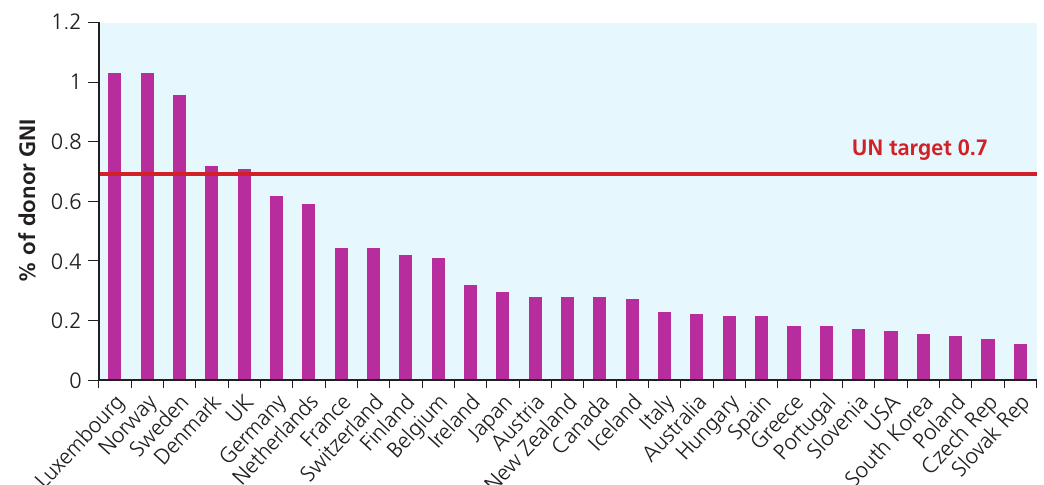
Figure 29.2 shows the performance of donor countries relative to the 0.7% UN target. Only five countries achieved the 0.7% UN target in 2019. The USA's share looks modest in this figure, but it should be borne in mind that in terms of US dollars, the USA is by far the largest contributor. It is also worth noting that Turkey (not a DAC member at this time) gave the highest proportion of GNI (1.15%).
The data for the COVID-19 period and its aftermath may be misleading, but for the majority of DAC members, the percentage of GNI donated rose between 2019 and 2021. An exception was the UK, whose giving fell from 0.704% in 2019 to 0.499% in 2021 following a conscious decision to reduce the target to 0.5% of GNI to balance the increase in spending associated with the COVID-19 pandemic. It is intended to return to the 0.7% target when public finances permit.
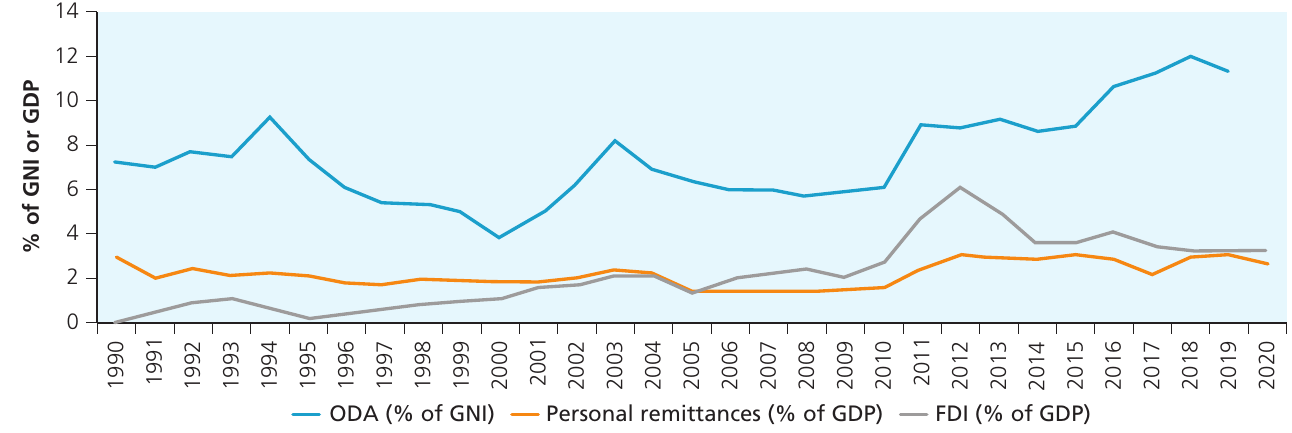
Figure 29.3 shows the relative size of financial flows into low-income countries since 1990. ODA flows declined in the second half of the 1990s, but increased in the early years of the twenty-first century. This was partly because ODA at this time included funds devoted to debt forgiveness, as brokered by the World Bank under the Heavily Indebted Poor Countries (HIPC) Initiative. The flows have increased since 2010, reaching approximately 12% of GNI by 2020.
The graph also shows personal remittances (money sent home by workers abroad) and Foreign Direct Investment (FDI) flows, both of which have remained relatively stable, though FDI showed a significant spike around 2012.
The effectiveness of aid
There has been much criticism of overseas aid, and its effectiveness has been questioned. There are many possible reasons for aid ineffectiveness:
Important
Reasons for aid ineffectiveness:
Resource limitations: Providing aid to the poorest countries may reduce its effectiveness, simply because the resources of such countries are so limited that the funding cannot be efficiently utilised.
Corruption and governance: In some cases, aid flows are received by governments that are inefficient or corrupt, so there are no guarantees that the funds are used wisely by these governments.
Insufficient scale: It might simply be that the flows of aid have not been substantial enough to have made a difference.
Tied aid: Some donor countries in the past have regarded aid as part of their own trade policy. By tying aid to trade deals, the net value of the aid to the recipient country is much reduced. For instance, offering aid in this way may commit the recipient country to buying goods from the donor country at inflated prices.
Project selection: In other cases, aid has been tied to use in specific projects. This may help to assure the donor that the funds are being used for the purpose for which they were intended. However, it is helpful only if appropriate projects were selected in the first place. There may be a temptation for donors to select prestige projects that will be favourably regarded by others, rather than going for a developing country's top-priority development projects.
Bilateral and multilateral aid
Another distinction is between overseas assistance that is given by one country to another (bilateral aid), and funds that are channelled through organisations such as the World Bank or the United Nations (multilateral aid). Multilateral aid is less likely to be tied to trade agreements, but in some cases may be made conditional on the recipient country implementing certain policies.
The effect on incentives
An important issue for all sorts of aid is that it should be provided in a way that does not damage incentives for local producers. For example, dumping cheap grain into developing markets on a regular basis would be likely to damage the incentives for local farmers by depressing prices.
Dutch disease
A final issue to notice is that in some cases, the acceptance of overseas aid by a country may result in a phenomenon known as Dutch disease. The discovery of a large natural gas field in the Netherlands in the late 1950s resulted in a revaluation of the currency, causing a loss of competitiveness in the manufacturing sector and an acceleration of the deindustrialisation process.
Note
It has been argued that a flow of foreign aid into a country can have a similar effect. If the receipt of aid causes the exchange rate to rise, this reduces the competitiveness of the country's exports. This represents another way in which aid might fail to achieve its intended objectives.
Summary
Key takeaways:
-
Interventionist strategies are necessary when market failures prevent effective development, particularly in areas like education, healthcare, and infrastructure where externality effects and information failures are common
-
Trade policy choices matter significantly - import substitution through protectionism can protect infant industries but often creates inefficiency and inward-looking attitudes, while export promotion requires dynamic approaches and careful selection of activities based on comparative advantage
-
Buffer stock schemes aim to stabilise volatile commodity prices but face challenges of cost and sustainability, particularly if target prices are set too high relative to long-run equilibrium levels
-
Industrialisation following the Lewis model has limitations - the transfer of surplus labour from agriculture to industry faces problems including skills mismatches, infrastructure constraints, and the development of shanty towns, while the model encouraged neglect of rural development
-
Tourism offers significant development potential with positive income elasticity of demand and large multiplier effects, but must be balanced against environmental concerns, current account effects, and opportunity costs of alternative investments
-
Fair trade schemes can address market power and information failures but may produce unintended effects if subsidies encourage production in declining markets rather than facilitating transition to more promising activities
-
Overseas aid through ODA can support development but faces effectiveness challenges including insufficient scale, corruption, tied aid reducing net value, inappropriate project selection, and potential Dutch disease effects where aid inflows reduce export competitiveness through exchange rate appreciation