The Balance of Payments: Overview (Edexcel A-Level Economics A): Revision Notes
📚Revision Notes
The Balance of Payments: Overview
What is the balance of payments?
The balance of payments is a comprehensive record that tracks all economic transactions between residents of a country and the rest of the world. For any economy engaged in international trade, monitoring these transactions is essential for understanding the country's position in the global economy.
Note
Think of it like a household budget, but on a national scale. Just as individuals need to track income and spending, countries must monitor their international transactions. Items purchased must be paid for through income, savings, or borrowing. Similarly, a country needs to account for all goods, services, and assets bought from or sold to other nations.
The structure of the balance of payments
The balance of payments consists of three main accounts:
- Current account: Records transactions in goods and services, plus income flows
- Financial account: Records transactions involving financial assets and liabilities
- Capital account: Records capital transfers and transactions in non-produced, non-financial assets
Note
Additionally, there is an item called errors and omissions. This acknowledges that when collecting vast amounts of data from different sources, some discrepancies will inevitably occur. This balancing item ensures that the overall balance of payments sums to zero.
The financial account
The financial account tracks transactions related to changes in ownership of financial assets and liabilities between UK residents and non-residents. Understanding this account is crucial as it reflects how a country finances its current account position.
Categories within the financial account
The financial account includes four main categories:
Foreign direct investment (FDI)
This is a particularly important component. It occurs when:
- UK investors make investments overseas (FDI outward)
- Overseas investors purchase assets in the UK (FDI inward)
The net flows of foreign direct investment form part of the financial account. However, note that the income received from these investments in future years will appear in the current account instead.
Portfolio investment
This category covers transactions in:
- Equities (shares)
- Securities (bonds and other financial instruments)
Other types of financial assets
These have become increasingly significant in modern financial markets and include:
- Financial derivatives such as options
- Financial futures
- Various other forms of financial instruments
Reserve assets
These include:
- Gold holdings
- Foreign exchange held by the Bank of England
Note
Reserve assets were particularly important under the fixed exchange rate system. However, transactions in reserve assets are now relatively infrequent in a system of floating exchange rates.
Surplus on the financial account
Since the trend towards globalisation accelerated in the 1990s, both inward and outward investment have increased substantially. Although there was a temporary dip after 2000, the financial account has generally shown a strong surplus in the early part of the twenty-first century.
Important
This surplus is partly driven by the deficit on the current account. When an economy runs a current account deficit, it can only do so by running a surplus on the financial account. In practical terms, this means that to fund the current account deficit, the UK has been selling assets to foreign investors and borrowing from abroad.
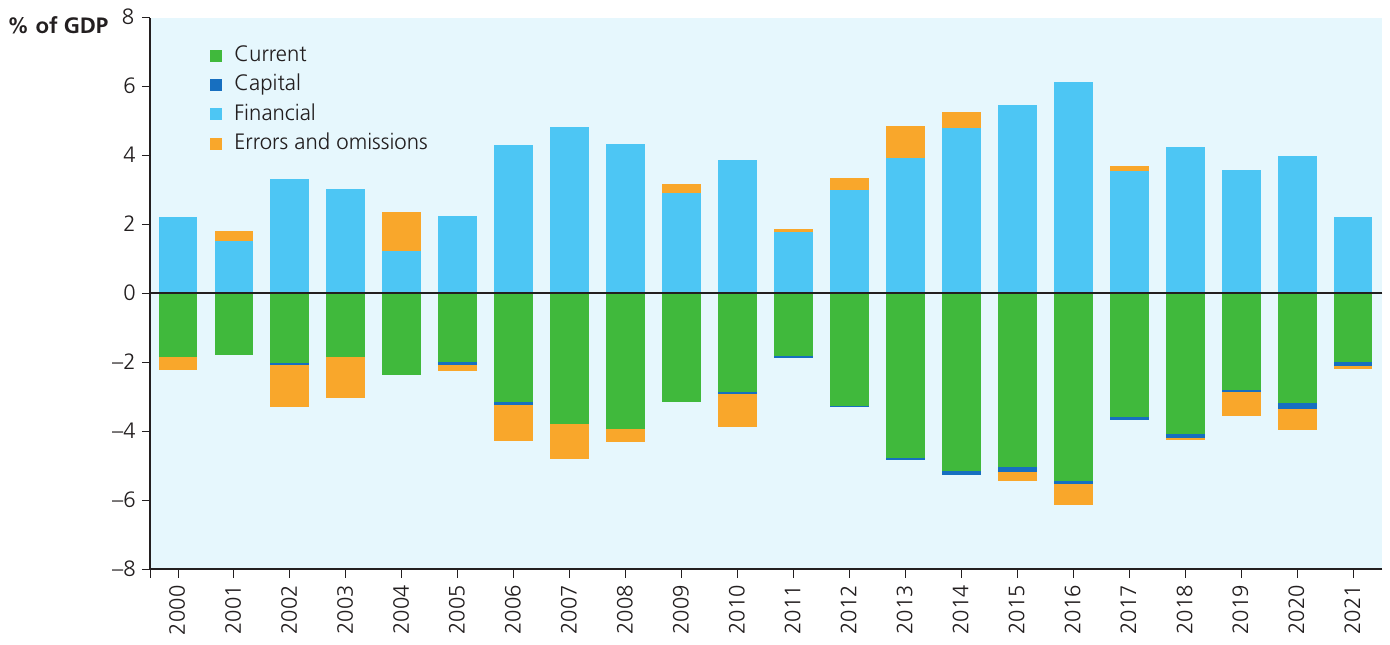
The chart above illustrates the UK's balance of payments components from 2000 to 2021 as a percentage of GDP. Notice the inverse relationship between the current account (consistently negative, shown in green) and the financial account (consistently positive, shown in light blue). The impact of the COVID-19 pandemic is visible in 2021, when activity on the balance of payments was notably lower.
Sustainability concerns
An important question arises about whether such global trade imbalances are sustainable in the long run. Selling assets or borrowing abroad creates future implications:
- There will be outflows of investment income in future periods
- Debt repayments will be required
If the authorities maintain high interest rates relative to the rest of the world, this may attract further investment inflows, but with additional future implications for the current account.
Note
Countries that run persistent current account surpluses face different challenges. They may focus resources on delivering exports at the expense of domestic consumption expenditure. China experienced this issue during periods when it was intent on maintaining a strong export position.
Investment flows
The balance of payments records transactions in each period, dealing with flows rather than stocks. However, for the financial account, the accumulated stocks of assets and liabilities are also important. This is monitored through the balance sheet of external assets and liabilities, known as the international investment position.
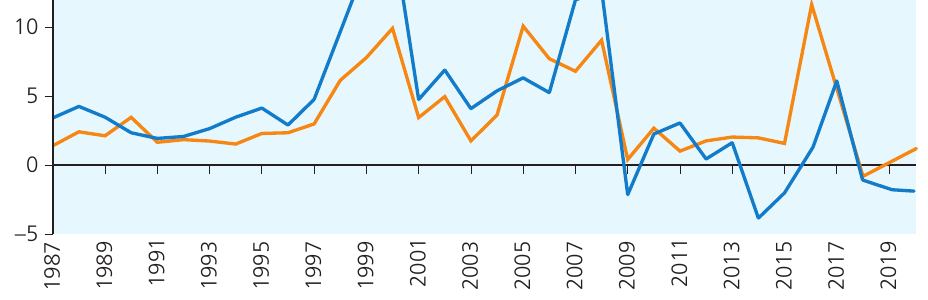
Foreign direct investment flows in the UK since 1987, expressed as a percentage of GDP, have been quite volatile. The flows both into and out of the UK have shown considerable variation since the late 1990s. This volatility arises partly because the flows tend to be dominated by large-scale mergers and acquisitions, which cause sudden changes in the size of flows.
Important
Exam tip: When analysing FDI data, remember that large spikes or dips may reflect individual major corporate transactions rather than underlying economic trends.
The capital account
The capital account is relatively small compared to the other components of the balance of payments. The largest item within this account relates to flows of capital associated with migration.
When someone migrates to the UK, their status changes from being a non-resident to being a resident. Their property then becomes part of the UK's assets, and this transaction must be recorded in the balance of payments accounts. There are also some items relating to various EU transactions.
Note
The balance on this account is very small compared to the other components and has never exceeded 0.1% of GDP.
Causes of current account deficits
The UK current account has been in deficit over long periods. Several factors can contribute to a current account deficit:
Weak competitiveness
If the competitiveness of domestic production relative to other countries is poor, demand for exports will be relatively low. This can occur if:
- Productivity at home is weak
- Domestic firms are producing poor-quality products
Inflation
If inflation in the home country is high relative to elsewhere, this will discourage exports and encourage imports. Rising labour costs associated with high inflation can fuel this process.
Rapid economic growth
Strong economic growth can draw in imports and contribute to a current account deficit. When the economy is growing rapidly, domestic demand for goods and services rises, and some of this increased demand is met through imports.
Note
Study tip: It's important to have a general understanding of trends in economic data over recent periods, but you don't need to memorise detailed statistics about the economy.
Remember!
Summary
Key Points to Remember:
- The balance of payments is a comprehensive record of all transactions between a country's residents and the rest of the world
- It consists of three main accounts: current account, financial account, and capital account, plus errors and omissions to balance the accounts
- The financial account records changes in ownership of financial assets and liabilities and includes FDI, portfolio investment, other financial assets, and reserve assets
- A persistent current account deficit must be matched by a surplus on the financial account, meaning the country is selling assets or borrowing abroad
- Foreign direct investment flows can be volatile, often driven by large-scale mergers and acquisitions
- The capital account is relatively small, with migration-related capital flows being the largest component