Policy Design and Implementation (Edexcel A-Level Economics A): Revision Notes
📚Revision Notes
Policy Design and Implementation
Introduction to macroeconomic policies in a global context
Governments around the world have various tools available to manage their economies, but they also face different challenges and priorities. Each country has unique resources, economic conditions, and policy goals. This means that different nations adopt different approaches to designing and implementing macroeconomic policies.
Note
The choice of policy mix depends on several interconnected factors that vary significantly between countries. Understanding these factors is crucial for evaluating why different nations pursue different economic strategies.
The choice of policy mix depends on:
- The specific objectives a government wants to achieve
- The economic challenges facing the country
- Available resources and constraints
- The stage of economic development
Objectives of policy
When designing economic policies, governments must consider several key objectives. Understanding these objectives is essential for evaluating policy effectiveness.
Economic growth
Economic growth increases the productive capacity of the economy, which allows living standards to improve over time. This is perhaps the most fundamental policy objective, pursued by governments worldwide. However, achieving economic growth often requires other conditions to be met first.
Key points:
- Growth raises productive capacity and improves living standards
- Some policy measures directly affect growth
- Other objectives may need to be met as preconditions for sustained growth
Alleviating poverty and inequality
For developing countries, economic growth may be essential for reducing poverty. Without increasing the quantity of available resources, improving conditions for those in poverty becomes extremely difficult. However, there is a counter-argument: addressing basic needs might actually be a prerequisite for growth to occur.
In more developed economies, inequality in income distribution remains a concern for governments wishing to influence how income is distributed within society. This can involve:
- Transfer payments: Moving income between groups (from rich to poor)
- Progressive taxation: Those on higher incomes pay a greater proportion in tax
- Social security benefits: Such as Universal Credit, which provide support to vulnerable groups
Important
Exam Tip: Be able to explain the difference between absolute poverty (lacking basic necessities) and relative poverty (having less than others in society). This distinction is frequently tested and essential for understanding poverty alleviation policies.
Macroeconomic stability
Instability in the macroeconomy hinders economic growth, so governments aim to provide a stable macroeconomic environment that facilitates growth. This objective is important for countries at all development stages.
Macroeconomic stability can be interpreted in several ways:
Monetary stability:
- From the 1970s onwards, focus was primarily on achieving low and stable inflation
- The reasoning: low inflation improves confidence in the economy's future
- Greater confidence encourages firms to invest
- Investment increases productive capacity, resulting in economic growth
Note
Financial stability:
The financial crisis of the late 2000s highlighted the need for sufficient and efficient liquidity flow in the economy. The bailout of failing banks emphasized the need for fiscal stability, and sudden increases in public sector borrowing raised awareness about the need to prioritize reducing fiscal deficits and national debt.
For countries like Greece, this became the dominant priority in policy design.
Accommodating external shocks:
- External shocks can come from many sources: oil price changes, financial crises spreading through globalized markets
- Domestic policy may be needed to maintain stability when facing such shocks
- Recent examples include the COVID-19 pandemic and the invasion of Ukraine by Russia
Full employment
Unemployment imposes significant costs on both society and individuals. From society's perspective, substantial unemployment represents wasted resources and indicates the economy is operating below full capacity.
Why full employment matters:
- Reduces waste of economic resources
- Prevents the social costs of unemployment
- Ensures the economy operates at or near full capacity
International competitiveness
As globalization increases interconnections between economies, maintaining international competitiveness becomes increasingly important. This involves achieving productivity growth in line with international competitors.
Note
Key concept: International competitiveness is partly about maintaining comparative advantage - the ability to produce goods and services at lower opportunity cost than competitors.
Balance of payments
Under a flexible exchange rate system, the overall balance of payments will always be zero because the exchange rate adjusts automatically. Nevertheless, maintaining a reasonable balance between the current account and financial account remains an objective.
Why it matters:
- Persistent current account deficit suggests the country is selling off assets to obtain goods for consumption
- Under a fixed exchange rate system, maintaining the exchange rate constrains economic growth and tends to increase imports, creating current account deficits
Maintaining a balanced budget
Even without considering bailout effects, UK public sector debt at the beginning of 2020 (before the pandemic) was 82.7% of GDP. This level is not sustainable in the long run because it involves large interest payments on government debt, reducing resources available for spending.
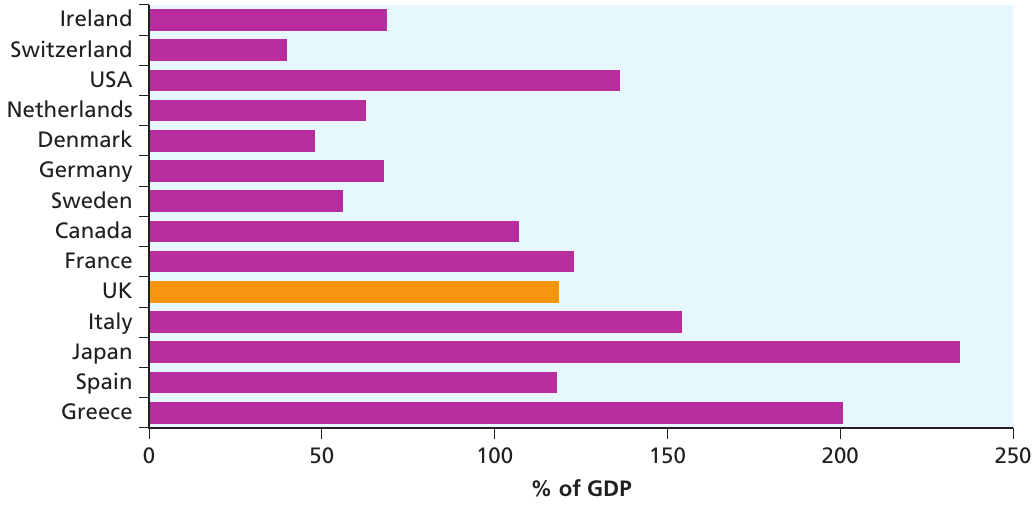
A long-run objective is to bring down national debt levels, though this can be challenging during periods of below-trend growth or when recovering from external shocks.
Note
The Golden Rule:
Governments should borrow only for investment, not for current expenditure. Borrowing should be averaged over the economic cycle. The commitment to keep public sector net debt below 40% of GDP did not survive the financial crisis and COVID-19 pandemic.
Important
Important context: As Figure 32.6 shows, in 2019, the UK's debt was more than 100% of GDP. This was still below countries like Japan, Greece, or Italy, but well above the 40% previously considered acceptable under the Golden Rule. This dramatic shift highlights how external shocks can fundamentally alter what is considered feasible in fiscal policy.
Environmental considerations
Sustainable growth means growth that does not prejudice consumption possibilities for future generations. Resources that contribute to living standards include not just economic goods but also environmental quality.
Policy priority: Look for sustainability in economic growth, recognizing that environmental considerations may act as a constraint on the rate of growth.
Correcting market failure
At the microeconomic level, policies are designed to address various forms of market failure. Examples include:
- Competition policy: Prevents firms from abusing monopoly power and improves resource allocation
- These policies operate at the microeconomic level but have consequences for macroeconomic objectives like economic growth
Note
For developing countries:
Dealing with market failure is a high priority because many markets are underdeveloped or missing. Attention has focused on:
- Improving financial market operations to enhance investment finance flows
- Measures needed to ensure effective marshalling of external finance inflows
- Better deals with transnational companies can help countries retain more benefits from foreign direct investment
Policy options
Governments can use various policy instruments to address their objectives. Each has strengths and weaknesses and is suited to achieving different objectives.
Monetary and financial policy
Monetary policy uses monetary variables like money supply and interest rates to influence aggregate demand. The main objective in recent times has been meeting inflation targets, seen as crucial for macroeconomic stability.
In the UK:
- Bank of England uses interest rates to keep inflation within its target range
- In Europe, the European Central Bank (ECB) performs this role
- In the USA, the Federal Reserve uses interest rates to create a stable environment
Note
Why interest rates instead of money supply control:
Money plays an important role in modern economies, but monetary authorities find it difficult to measure and monitor the amount of money directly. There are many sources of money in a modern, open economy - not just banknotes and coins in circulation. Therefore, authorities have turned to interest rates as the main instrument of monetary policy.
The financial crisis impact:
The period of relative calm (the 'Great Moderation') in the late 1990s and early 2000s was interrupted by rising commodity prices and financial crisis. The need to safeguard the financial system switched focus from monetary stability to financial stability.
In the UK:
- Inflation was allowed to rise above its target range
- Interest rates fell as far as possible
- Quantitative easing (expansion of money supply) was introduced to ensure adequate liquidity flow as some banks became reluctant to lend
Important
In developing countries:
Priorities for monetary policy have been rather different:
- Financial institutions are relatively underdeveloped
- Many rural communities lack access to formal financial markets
- Monetary policy has partly been used to improve financial market coverage and boost confidence
- Provision of microfinance attempts to provide credit access in rural areas
- Maintaining stability remains an important precondition for achieving economic growth
Fiscal policy
The term 'fiscal policy' covers policy measures affecting government expenditures and revenues through decisions on expenditure, taxation, and borrowing.
Uses of fiscal policy:
- Influence the level and structure of aggregate demand
- Affect income distribution within society
- Address issues of market failure
- Impact the balance between public and private sectors
Effectiveness concerns:
Using discretionary fiscal policy to combat unemployment by stimulating aggregate demand has been largely discredited. It was seen as ineffective in influencing aggregate demand under floating exchange rates. Nonetheless, fiscal policy plays a key role through its impact on the balance between public and private sectors.
Note
Developed countries:
Privatization of nationalized industries has reduced public sector size. The assumption is that exposing industries to competitive forces improves accountability and efficiency, resulting in better resource allocation. This assumes the private sector tends to be more efficient than the public sector.
Fiscal rules:
The development of fiscal rules intended to ensure that:
- Current taxation would be used primarily for the present generation
- Public borrowing would finance investment benefiting future generations
The need to provide bailout funding for banks was considered too significant to fail. This led to abandonment of rule-based systems, given that public sector borrowing could not be maintained within agreed limits. Bailouts also led to a sharp rise in public sector net debt, requiring fiscal policy redirection towards reducing debt - though this risked deepening and prolonging recession.
Important
For developing countries:
Challenges in raising revenue through taxation make it difficult to use fiscal policy to alleviate poverty and inequality, leading to over-reliance on flows of overseas assistance. This creates dependency issues and limits policy autonomy.
Exchange rate policy
Since the collapse of the Dollar Standard in the early 1970s, floating exchange rates have become the norm. The policy towards exchange rates has been to allow them to find their own equilibrium level in the foreign exchange market.
Implications:
- Countries cannot use exchange rate changes to influence the competitiveness of goods relative to the rest of the world
- To improve competitiveness, a more effective approach is finding ways to improve productivity
- Makes fiscal policy less effective but strengthens monetary policy's impact on aggregate demand
Note
The Eurozone example:
The Eurozone establishment could be seen as a drastic form of exchange rate policy. Members agreed to:
- Adopt the euro (common exchange rate against the rest of the world)
- Adopt a common monetary policy alongside it
- ECB sets a common interest rate across all Eurozone members
This made it difficult for individual countries to adopt differential responses to the financial crisis, with some members suffering much more severe recessions than others.
Supply-side measures
Supply-side policies are measures intended to have a direct impact on aggregate supply - specifically, on the potential capacity output of the economy. These measures are often microeconomic in character and designed to increase output and hence economic growth.
For the UK:
- Measures to increase provision of education and training
- Measures to improve market flexibility
- Promotion of competition
- Attempts to improve incentives faced by economic agents
- All intended to affect the position of the long-run aggregate supply curve and expand the productive capacity of the economy
Important
For developing countries:
Supply-side policies are crucial for growth and development. It is vitally important for developing countries to invest in human capital:
- Improved provision of education and skills
- Enhanced healthcare delivery with better nutrition
- These can have a dramatic impact on long-run growth by raising workforce productivity
- Markets can be made to work more effectively if transport and communications infrastructure can be improved, or if market facilities can be provided
Important note: Measures that improve health, nutrition, and education also have direct effects on poverty alleviation and (potentially) inequality, making them doubly important for developing countries.
Regulation and control
Sometimes, the range of policy measures may not be enough. Authorities may need to intervene directly through regulation or control. There may be a need to provide a legal and regulatory framework within which firm behaviour can be monitored to protect consumers.
Examples:
- A regulatory framework to promote competition (Competition and Markets Authority in the UK)
- Establishing appropriate legal frameworks with secure property rights for economies to operate effectively
- This is an essential underpinning for any economy
Note
For developing countries:
It is important to be in a position to negotiate with more experienced partners. When a transnational company (TNC) decides to locate in a country, it must agree terms with the host government. Given the economic (and perhaps political) power of TNCs compared with host governments, countries can too easily find themselves making excessive concessions to attract TNC investment.
International regulation:
Sometimes international bodies may be needed to regulate markets at a global level:
- Externalities that cross national boundaries may require worldwide agreements to combat global warming
- The World Trade Organization (WTO) exists partly to arbitrate on disputes between trading partners and enforce agreements on tariffs and trade conditions
Transfer pricing
One particular example is the need to regulate transfer pricing. Transfer pricing is a process by which a transnational company can minimize its global tax liability by manipulating internal prices for transactions between its branches in different countries.
TNCs spread their supply chain around the world, with different production stages located in different countries. The TNC undertakes many internal transactions between its branches and can set prices at which those transactions occur. This enables the company to minimize tax liability by manipulating internal prices to take profit in a country with a low tax rate.
Important
Controversy:
There is widespread agreement that such practices should be prohibited, but controversy surrounding companies like Google, Starbucks, and Amazon shows that intervention is no easy matter. Part of the problem is that TNCs operate globally, but governments only operate nationally.
Study tip: Keep alert for examples of contentious issues in the media, which could be useful as examples in your exam responses.
Problems in designing and implementing policy
Policy-makers face many problems when implementing their chosen policies.
Information inaccuracy
For a start, policy-makers need information on which to base their policy design. A key problem is that it takes time to collect data, so real-time data are not available. Policy-makers only have data about how the economy was performing at some point in the past, and even this may be inaccurate, provisional, or incomplete.
Note
Time lags in policy implementation:
Given the time that elapses in:
- Designing a policy
- Getting it approved
- Working its way through the system
A policy may only become effective after the need for it has passed.
Additional challenge: Even when data become available, there is no guarantee they will be accurate. Some data series often get updated after first publication as inaccuracies or omissions become apparent.
Risk, uncertainty and external shocks
The economic environment is always changing. Policy-makers must make policy decisions based on their best forecasts (or guesses) about the future, knowing this is characterized by high levels of risk and uncertainty. Additionally, the economy is open to the impact of sudden and unanticipated shocks that may render forecasts unreliable.
There is no better example than the events of the early 2020s that affected the global economy. Even before 2020, the economic environment had begun to change:
- The UK had decided to leave the European Union and Single Market
- Brexit impact was still working itself out (Northern Ireland protocol, fishing rights debates)
- In the USA, President Trump had introduced measures affecting the USA's place in the global economy
- These issues would soon fade into the background (though Brexit issues remained to be resolved)
The COVID-19 pandemic
In early 2020, economies around the world were hit by the COVID-19 pandemic, which infected millions globally, resulting in 6.7 million deaths by January 2023.
UK government response:
- Intense pressure on the National Health Service (NHS)
- Additional hospital spaces created through 'Nightingale Hospitals'
- Investment in vaccine development was an urgent priority
- Without vaccine protection, measures introduced to slow virus spread included lockdowns
- People told to stay home and avoid social contact
- Restrictions on travel
- Inevitable interruptions to supply chains
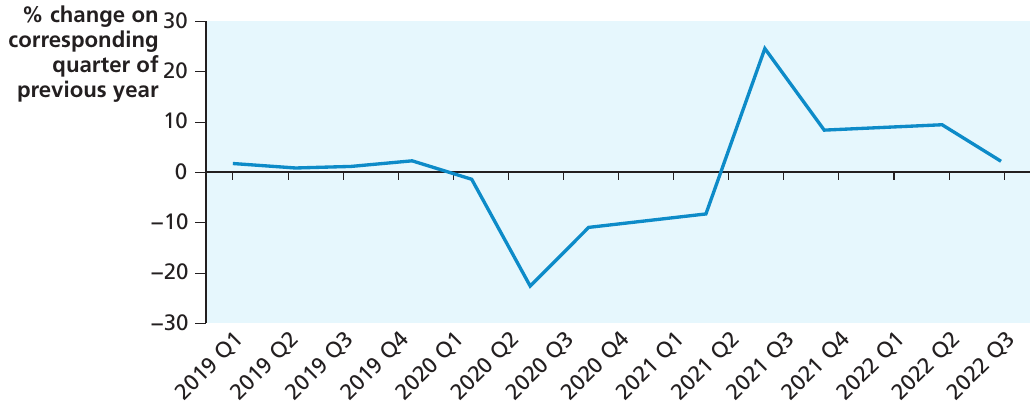
- Immediate impact on GDP
Note
The Coronavirus Job Retention Scheme ('furlough' scheme):
This scheme provided support for people unable to work due to lockdown. Its key objective was to protect the economy and help ease return to normal working at pandemic's end.
Side-effect: Although GDP was falling, unemployment did not rise as much as expected because workers on furlough were not classified as unemployed.
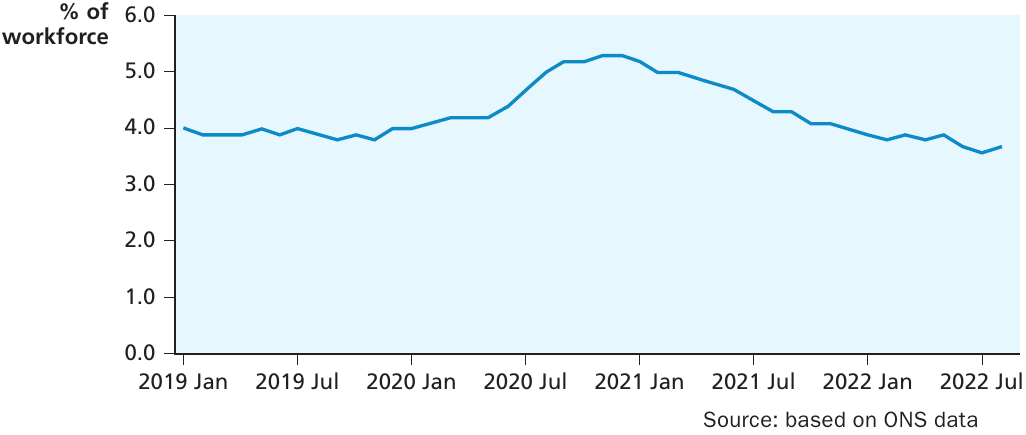
The unemployment rate shows a modest rise during 2020, clearly cushioned by the furlough scheme. Technology enabled many to continue working from home, helping secure employment. However, this had spillover effects on demand for hospitality, transport, and other sectors. By mid-2022, the unemployment rate was lower than before the pandemic, partly reflecting a rise in people registered as economically inactive, including those classified as long-term sick.
Financing the response:
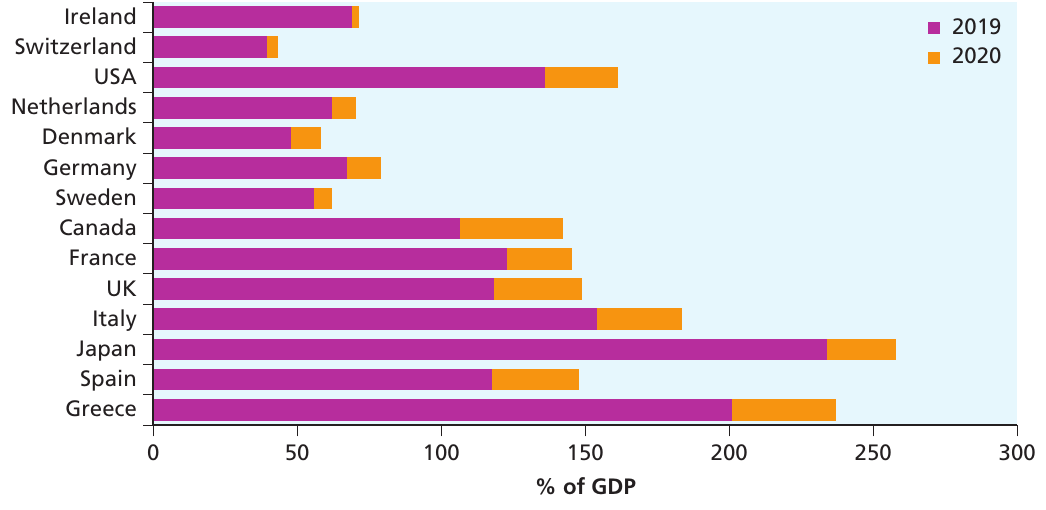
This substantial rise in government spending had to be financed somehow. As noted in Chapter 31, this was partially achieved through increased quantitative easing. Many countries setting out to cope with the pandemic faced similar issues.
Important
In the UK, it was noted that increased borrowing should not be seen as a long-term issue. With interest rates at such low levels, the costs of servicing the debt in the future would not be problematic. However, this assumption would later be challenged by rising interest rates in 2022.
The war in Ukraine
Just when the pandemic seemed to be in retreat, Russia invaded Ukraine in early 2022. This had further wide-ranging impact:
- Increased risk and uncertainty affecting business future planning
- Further disruption to supply chains already affected by Brexit and the pandemic
- Interruption to energy supplies was particularly significant
Countries in Europe had become reliant on importing oil and natural gas from Russia. Consequences of the war included:
- Oil prices increased by about 67% between end of 2021 and mid-June 2022
- Natural gas prices more than doubled over the same period
- Food prices also rose, partly due to disruption to grain exports from Ukraine
- Knock-on effects for cost of living in the UK
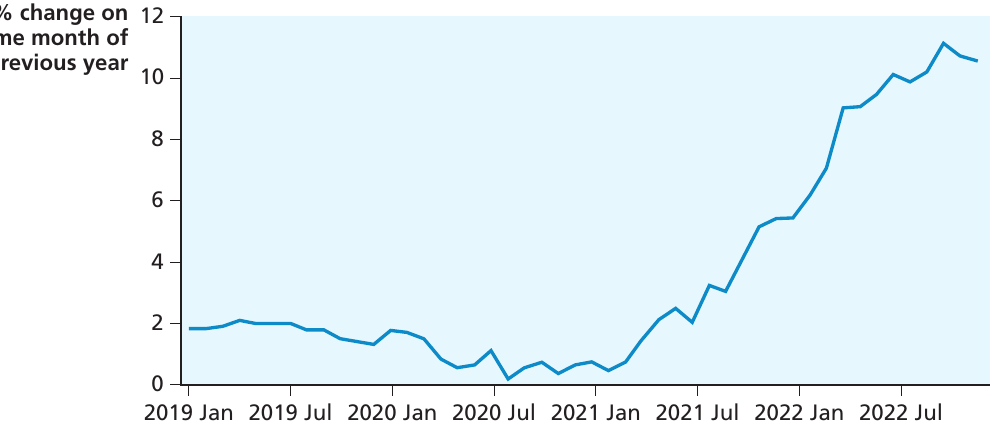
This clearly took inflation way beyond its target rate of 2%. From March 2022, the Bank of England began raising interest rates in an attempt to slow inflation. Remember that if interest rates continue rising, this would have a knock-on effect on the costs of servicing government debt.
Conflict between policies and objectives
A government needs to adopt a combination of policies that will enable it to achieve its objectives. However, conflicts may arise - both between policies and between objectives. The policy adopted to deal with one objective may endanger achievement of another.
Examples of conflicts:
- Authorities cannot adopt independent targets for money supply and interest rate if they want the money market to remain in equilibrium
- Targeting the exchange rate may mean it is not possible to use monetary policy to influence aggregate demand
- Introducing fiscal austerity to reduce public sector debt may prevent achievement of economic growth
- For developing countries, investing in healthcare or education may leave no funds for infrastructure like roads and communications
Note
By mid-2022, the UK faced a cost of living crisis, putting pressure on the government to intervene. This led to a proliferation of strike action in key sectors including railways, Royal Mail, NHS workers, university staff, and teachers. Employers resisted demands, sometimes looking for changes in working practices to bring productivity gains.
The government faced a dilemma given possible conflicts between policy objectives:
- Providing and protecting key aspects of the country's infrastructure and healthcare is important for wellbeing and promoting supply-side growth
- But adding to cost pressures already contributing to inflation would endanger the policy of maintaining stable prices
Important
Key insight: Given the range of policy objectives at both microeconomic and macroeconomic levels, the need to maintain appropriate balance demonstrates the importance of using economics to understand the complexities of a modern economy. There are rarely perfect solutions - only trade-offs between competing objectives.
Case study: The UK's national debt
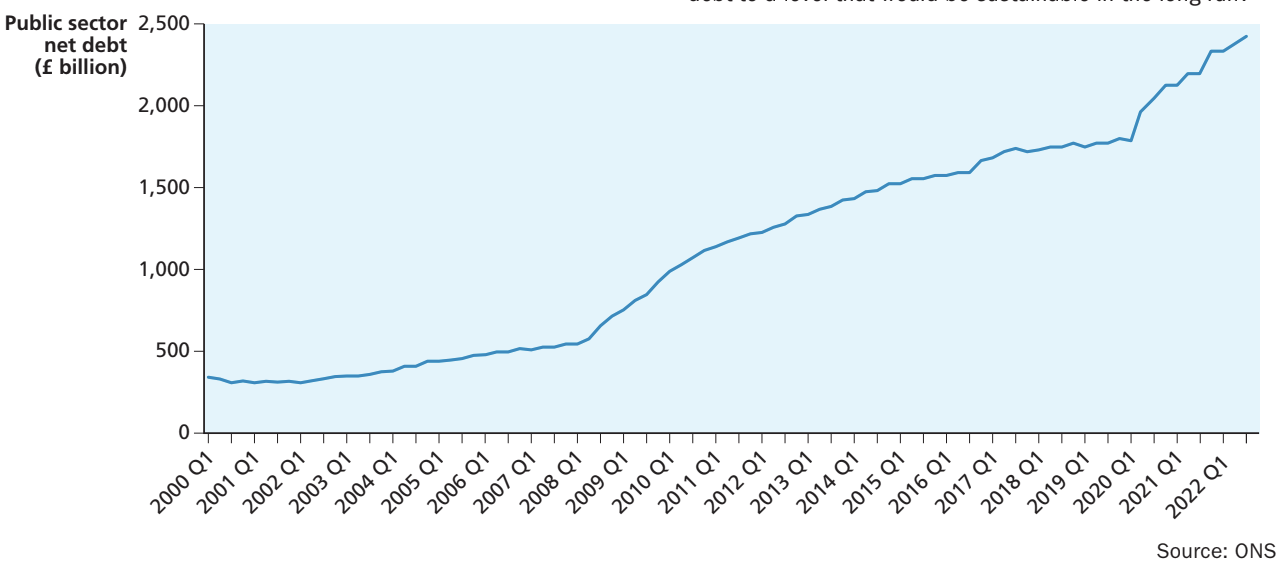
In the last quarter of 2007, the ONS reported that the UK's national debt amounted to £548.8 billion (40.8% of GDP). By the first quarter of 2020 (threshold of COVID-19 pandemic), the figure was £1,793 billion (82.7% of GDP). By the third quarter of 2022, national debt had risen further to £2,450.2 billion (98% of GDP).
Note
The data shown omit the effects of bank bailouts during the financial crisis. Even without bailouts, public sector net debt has increased substantially since the late 2000s crisis and COVID-19 pandemic.
Understanding the debt:
Part of this reflects the cyclical deficit caused by the recession following the financial crisis. However, the increase in structural deficit cannot be ignored, particularly caused by the demographic impact of an ageing population, which has long-term effects on the government budget deficit.
Measures taken to combat the pandemic resulted in further debt rise. The key question is whether the increase in national debt is sustainable in the long run. One effect of higher debt levels is the need to pay higher interest payments on debt in the future.
A stated objective: Bring the level of national debt back to a sustainable level. However, there is no consensus on what constitutes a desirable long-term ratio of debt to GDP.
Note
Historical context:
- In the days of the 1997 Labour government, the target rate was set at 40%
- That no longer appears a realistic objective under the European protocol on acceptable debt levels
- The guideline is that national debt should not exceed 60%
- Even this seems challenging given current circumstances
The way forward:
Interest rates began to rise during the Ukraine conflict in 2022, highlighting the importance of tackling debt to limit debt servicing requirements.
To reduce the debt ratio, it is necessary to either:
- Reduce spending, or
- Increase tax revenues
In June 2018, Theresa May pledged to increase spending on the NHS by £20 billion a year by 2023. Other factors that will increase spending include:
- New arrangements for student loan repayments mean increased spending
- Demographics will lead to future increases in spending on pensions and adult social care
Important
In July 2018, the Office for Budgetary Responsibility (OBR) noted that unless debt issues were addressed, national debt could reach 282.8% of GDP in 2067/68. The much-vaunted Brexit dividend would not suffice to deal with this. The subsequent increase in debt caused by pandemic measures and fall-out from the war in Ukraine add further pressure.
Later analysis: In November 2022, analysis suggested that given conditions at that time, public sector net debt as a percentage of GDP would peak around 2024/25 and then start to decline.
Key terms to remember:
- Cyclical deficit: Deficit that occurs due to the business cycle (during recessions)
- Structural deficit: Deficit that persists even when the economy is at full capacity
Summary
Key Points to Remember:
-
Governments have multiple policy objectives including economic growth, low unemployment, low inflation, balanced budget, environmental sustainability, and equity in income distribution.
-
Different policy instruments are available: monetary policy (interest rates), fiscal policy (government spending and taxation), supply-side measures, exchange rate policy, and regulation. Each has different strengths and is suited to achieving different objectives.
-
Policy-makers face significant challenges including information inaccuracy, time lags, risk and uncertainty, and external shocks like the COVID-19 pandemic and war in Ukraine.
-
Conflicts can arise between different policy objectives - for example, reducing government debt may conflict with promoting economic growth, or controlling inflation may conflict with supporting key workers' pay demands.
-
The UK's national debt increased dramatically from 40.8% of GDP in 2007 to 98% of GDP by 2022, largely due to the financial crisis, pandemic response, and demographic pressures. Managing this debt while meeting other policy objectives remains a significant challenge for policy-makers.