Public Expenditure and Fiscal Policy (Edexcel A-Level Economics A): Revision Notes
📚Revision Notes
Public Expenditure and Fiscal Policy
Introduction to fiscal policy
Fiscal policy refers to the range of government decisions concerning public spending, taxation, and borrowing. It is one of the main policy tools available to governments to influence the macroeconomy and achieve key objectives such as economic growth, low inflation, and reduced inequality.
Note
The government operates fiscal policy through three main channels:
- Government expenditure - spending on goods, services, and capital projects
- Taxation - raising revenue through direct and indirect taxes
- Borrowing - financing any deficit between spending and revenue
Each of these channels can be adjusted to influence aggregate demand and overall economic performance.
The effectiveness of fiscal policy depends on the overall economic environment in which it operates. It works alongside monetary policy (controlled by the Bank of England) and supply-side policies to influence economic performance.
Types of public expenditure
Governments undertake spending in several key areas, each serving different purposes:
Current expenditure
Government consumption expenditure (also called current or revenue expenditure) represents day-to-day spending on goods and services. This includes:
- Salaries and wages for public sector workers such as teachers, nurses, and civil servants
- Running costs of public services
- Spending on education and healthcare
Important
This type of spending provides immediate benefits but does not create lasting assets for future generations. Unlike capital expenditure, current spending is consumed in the present period and does not add to the economy's productive capacity.
Capital expenditure
Government capital expenditure involves spending on infrastructure and long-term projects that will benefit the economy in the future. Examples include:
- Building roads and transport networks
- Constructing hospitals and schools
- Investing in public facilities
Capital spending creates assets that can improve productivity and economic growth over many years.
Transfer payments
Transfer payments are payments made to provide protection for vulnerable households. These may be:
- Universal - paid to everyone (such as child benefit)
- Means-tested - paid only to those on low incomes
Transfer payments can take the form of cash benefits or payments in kind (such as free education or healthcare provision). They redistribute income within society without directly purchasing goods or services.
The changing size and composition of public expenditure
Trends in UK government spending
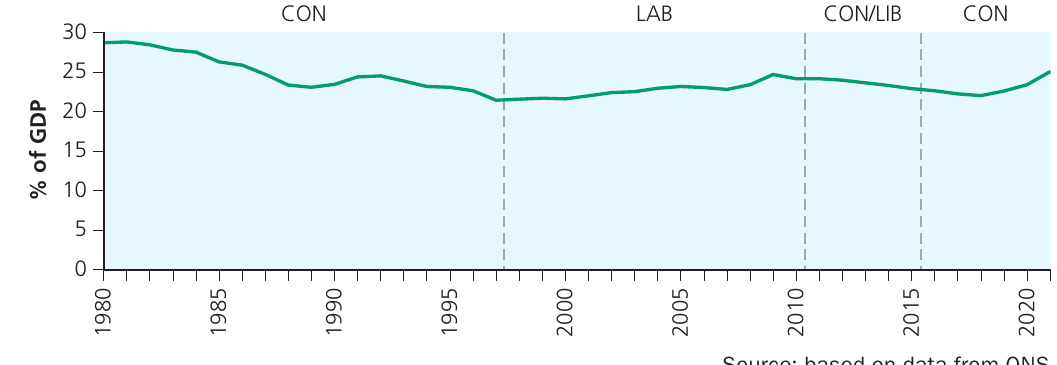
Government spending as a proportion of GDP has fluctuated significantly over time in the UK. During the 1980s under Conservative governments, there was a gradual downward trend as the public sector reduced its share of the economy. This trend halted after Labour came to power in 1997, and following the 2010 coalition government, the downward trend resumed until spending began to increase again around 2019.
International comparisons
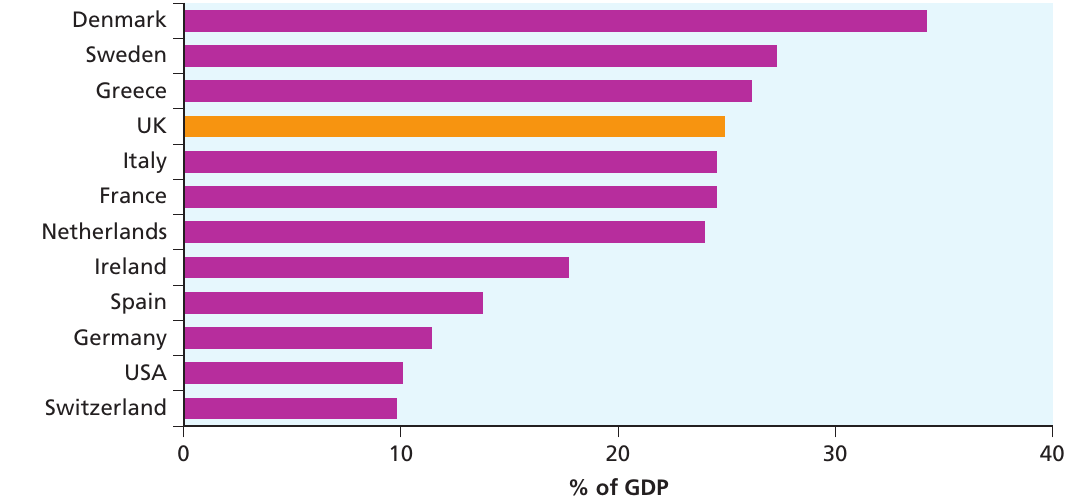
The role of government varies considerably between countries. Denmark, Sweden, and Greece have relatively high government consumption expenditure (over 25% of GDP), reflecting the greater role that government plays in providing services such as education and healthcare. In contrast, countries like Switzerland and the USA have much lower government consumption (around 15% of GDP or less), with the private sector taking a greater role, often through insurance markets.
Note
It's important to note that these figures show current expenditure only and do not include investment spending. The data are from 2019, before the large-scale increases in government expenditure initiated in response to the COVID-19 pandemic.
Factors driving changes in public expenditure
Several factors have influenced the size and composition of public expenditure over time:
Demographic changes: Many developed countries have experienced ageing populations and increased life expectancy. This has resulted in:
- Higher dependency rates
- Greater demand on healthcare systems (such as the NHS in the UK)
- Increased pension obligations
Rising expectations: Even before the COVID-19 pandemic, the NHS was under pressure due to the development of new treatments, which raised public expectations about the standard of healthcare that should be provided.
Important
Financial crises: The 2008 financial crisis had a dramatic effect on public expenditure. Governments had to bail out failing financial institutions in the UK, Greece, and other EU countries, which was not confined to the UK. The COVID-19 pandemic added further pressure on government budgets.
Technological changes: Advances in technology have created demands for investment in infrastructure such as improved equipment in schools and colleges.
The significance of high public expenditure
Why does it matter if government expenditure is high relative to GDP? There are important considerations on both sides of this debate.
Crowding out
If the economy is operating at full employment, then an increase in the size of the public sector can only occur at the expense of the private sector. This happens through two main channels:
Important
Labour market effects: If employment in the public sector increases, there will be fewer workers available to take jobs in private enterprises. Resources are diverted from private to public use.
Financial market effects: If an increase in government expenditure is financed through borrowing, this will increase interest rates. Higher interest rates raise the cost of borrowing for private firms, reducing the supply of funds available for productive investment.
This process is known as crowding out - where increased government expenditure 'crowds out' private sector activity by raising the cost of borrowing.
Productivity concerns
A second consideration relates to the relative efficiency of public versus private sectors. The public sector does not need to maximise profits or face competition, so the incentives to become efficient may not be as strong as in the private sector. This suggests that the public sector may be less efficient in its use of resources than private enterprise.
A switch in the balance of activity towards the public sector may therefore reduce the overall level of productivity in the economy. However, this argument has been contested, and the evidence is not conclusive.
National debt
An increase in the stock of public sector debt means an increase in future interest payments on that debt. This means that resources that could have been devoted to spending on public services must instead be used for repaying debt. High levels of national debt can become a burden on future generations who must service this debt through taxation.
The upside
Despite these criticisms, it is important to remember that there may also be benefits to government expenditure:
Infrastructure investment: If spending is on projects that improve the country's infrastructure, then this will promote efficiency and economic growth in the longer term. Improved transport and communication links can reduce vital parts of the costs faced by firms.
Human capital: Similarly, spending on healthcare and education has beneficial effects not only on the standard of living but also on productivity. It may improve the distribution of income and welfare, thus reducing inequality.
Note
Public goods and externalities: Some goods and services will not be adequately provided by markets alone, requiring government intervention. Without this intervention, the productive capacity of the economy would be lower.
Taxation
Public expenditure must be financed in some way. The revenue side of government finances is just as significant as the expenditure side. Taxation serves multiple purposes:
- Financing government expenditure
- Acting as a weapon against market failure
- Influencing the distribution of income
The choice between using direct or indirect taxes has important implications for these objectives.
Direct and indirect taxes
Direct taxes are taxes levied on income of various kinds, including:
- Personal income tax
- Corporation tax
- Capital gains tax
Direct taxes are designed to be progressive - they can be effective in redistributing income. For example, a higher income tax rate can be charged to those earning high incomes, taking a larger proportion of income from the wealthy.
Indirect taxes are taxes on expenditure, such as:
- Value Added Tax (VAT)
- Excise duties on specific goods (petrol, alcohol, tobacco)
Important
Indirect taxes tend to be regressive. Poorer households tend to spend a higher proportion of their income on items that are subject to excise duties, so a greater share of their income is taken up by indirect taxes. Even VAT can be regressive if higher-income households save a greater proportion of their incomes.
The effects of changes in taxes
Incentive effects
When Margaret Thatcher came to power in 1979, one of her first actions was to introduce a switch away from direct taxation towards indirect taxes.

VAT was increased and the rate of personal income tax was reduced. The argument was that if an income tax scheme becomes too progressive, it can provide a disincentive towards work effort. If people feel that a high proportion of their income is being taken in tax, their incentives to provide work effort are weak.
Note
Indeed, a switch from direct to indirect taxation is regarded as a sort of supply-side policy intended to influence the position of aggregate supply by affecting incentives to work.
Taxes and inequality
Perhaps the most important effect of a direct tax such as income tax is that it redistributes income from those on relatively high incomes to those on lower incomes. This occurs when the revenue raised is used to benefit lower-income groups through the provision of education and healthcare, or through social security payments for those in need.
Foreign direct investment
The relative level of corporation tax in the domestic economy compared with elsewhere may influence the direction of flows of foreign direct investment (FDI). Transnational companies may be looking to minimise their tax liabilities when deciding where to locate their investment.
Having a high rate of corporation tax may deter foreign firms from investing in the domestic economy, or encourage domestic firms to invest elsewhere. Many transnational companies have been able to negotiate tax holidays, leaving them free of taxation for a period after they bring in their investment.
Real output, employment and the balance of trade
High taxation may influence aggregate demand by reducing the disposable income of consumers. This could benefit the current account of the balance of payments by reducing the demand for imports. However, the potential multiplier effects of a reduction in income may result in lower real output and employment. This is a costly way of tackling a current account deficit.
The rate of indirect taxes such as VAT can also have an impact on the economy. When the UK economy faced recession in 2008, one of the steps taken to mitigate its effects was to reduce the rate of VAT (albeit temporarily). Steps were also taken to reduce the burden of VAT payments on the hospitality sector during the COVID-19 pandemic.
Tax revenue and the Laffer curve
Does an increase in the tax rate necessarily lead to a rise in tax revenue? Arthur Laffer argued that the answer to this was 'no'.
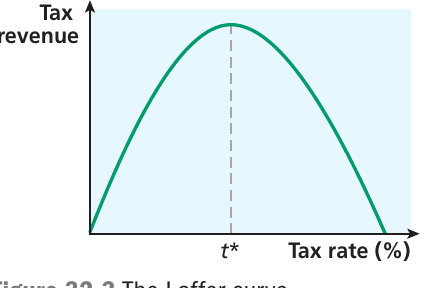
Laffer pointed out that changes in tax rates have two effects on tax revenue:
- The arithmetic effect: An increase in the tax rate will increase the tax revenue
- The economic effect: As tax rates rise, incentive effects come into play, tending to work against the arithmetic effect, as people have less incentive to supply labour at higher tax rates
Example
The Laffer Curve Explained
The relationship can be captured in the Laffer curve, an inverted U-shaped relationship between the tax rate and the amount of revenue raised.
At low rates of tax, revenue increases as the tax rate increases. However, beyond a certain point (), the revenue begins to fall. If an economy has been operating with a tax rate above , then a reduction in the tax rate would actually increase the revenue raised by the tax.
For instance, if a country has a top income tax rate of 70% and finds itself on the downward-sloping portion of the Laffer curve, reducing the rate to 50% could lead to:
- Greater work incentives
- Less tax avoidance
- Higher overall tax revenues
Note
It is worth noting that Laffer himself pointed out that he had not invented the concept. It can be found in the writings of Keynes, and even earlier in the work of Ibn Khaldun, a fourteenth-century Muslim philosopher.
Important
Key point: The Laffer curve shows that there is an optimal tax rate that maximises revenue. Beyond this point, higher tax rates lead to lower revenue due to disincentive effects.
Public sector finances
In terms of the impact that fiscal policy can have on aggregate demand, both expenditure and revenue are important. The key measure is the difference between them - the government budget deficit (or surplus).
Key definitions
Government budget deficit (surplus): The difference between government expenditure and government revenue. A deficit occurs when expenditure exceeds revenue.
Fiscal deficit: Occurs when government outlays exceed government receipts. This happens when the revenues raised through taxation are not sufficient to cover the government's various types of expenditure.
National debt: The total amount of government debt, based on accumulated previous deficits and surpluses. It represents the stock of accumulated past borrowing.
Cyclical deficit: A budget deficit that occurs during the downturn of the business cycle, but disappears in the upturn.
Structural deficit: A deficit that persists even when the economy is at full employment.
A fiscal deficit and the national debt
The way in which fiscal policy is conducted has implications for the overall size of the public sector in the economy. Traditionally, fiscal policy was used to affect the level of aggregate demand in the economy, influenced by Keynesian thinking.
The overall balance between government receipts and outlays affects the position of the aggregate demand curve, which is reinforced by multiplier effects. When government outlays exceed government receipts, the result is a fiscal deficit. The national debt is the accumulation of past borrowing resulting from these deficits.
Structural and cyclical deficits
Notice that as the economy goes through a business cycle, the deficit will tend to fluctuate:
Example
How Deficits Change Through the Business Cycle
During a downturn:
- Spending on benefits will rise
- Tax revenues will fall
- The fiscal deficit increases
During an upturn:
- Spending on benefits falls
- Tax revenues rise
- The deficit decreases
This cyclical element to the size of the deficit is known as a cyclical deficit, which fades away as the economy returns to its trend.
Important
Of more concern would be a situation in which the budget remains in deficit even with the economy at full employment. Such a structural deficit would need to be addressed, as it would not be sustainable in the long run.
Note
Study tip: Be very careful not to confuse the fiscal deficit with the national debt. The fiscal deficit is a 'flow' concept - the excess of government expenditure over revenues in the current period. The national debt is the 'stock' of accumulated past borrowing.
The fiscal deficit and fiscal policy
The overall size of the fiscal deficit may act as a constraint on the government's actions in terms of fiscal policy. In addition, the overall pattern of revenue and expenditure has a strong effect on the overall balance of activity in the economy.
A neutral government budget can be attained either with:
- High expenditure and high revenues, or
- Relatively low expenditure and low revenues
Such decisions affect the overall size of the public sector relative to the private sector. Over the years, different governments in the UK have taken different positions on this issue, and different countries throughout the world have adopted different approaches.
Note
In part, such issues are determined through the ballot box. In the run-up to an election, each political party presents its overall plans for taxation and spending. Typically, they adopt different positions as to the overall balance. It is then up to those voting to give a mandate to whichever party offers a package that most closely resembles their preferences.
Aggregate demand and supply and the government budget deficit
An important question concerns the extent to which a government budget deficit can be used to stabilise the macroeconomy by influencing aggregate demand.
The AD/AS model revisited
To analyse the impact of public expenditure on aggregate demand, we return to the model of aggregate supply and aggregate demand (AS/AD).
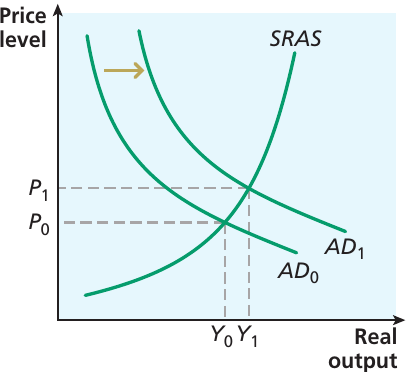
A shift in aggregate demand from to results in an increase in both real output and the price level as the economy moves to a new equilibrium - a movement along the short-run aggregate supply curve (SRAS). However, the SRAS is called a 'short-run' aggregate supply curve for a reason, and there is no guarantee that the equilibrium shown can be sustained.
Note
For example, notice that the new equilibrium entails a higher overall price level. In time this will feed back into the costs faced by firms, causing the SRAS to shift back to the left. Of more importance, therefore, is the long-run aggregate supply curve.
Different views on aggregate supply
The monetarist/classical view: There was a natural rate of output, corresponding to full employment. The economy would adjust rapidly to this equilibrium position, so the authorities would not need to intervene. With this view, the aggregate supply curve is vertical, and policies affecting aggregate demand have an impact only on prices, leaving real output unaffected.
The Keynesian view: The economy could get caught in an equilibrium position below full employment, and adjustment back to full employment could be slow. This difference of opinion was reflected in the shape of the long-run aggregate supply curve, which in the Keynesian view slopes upwards over a range.
The impact of a budget deficit
Shifting the aggregate demand curve affects only the overall price level in the economy when the aggregate supply curve is vertical. With a Keynesian aggregate supply curve, a key issue for a government considering the use of fiscal policy is knowing whether there is spare capacity in the economy. Otherwise, an expansion in aggregate demand from increased government spending will push up prices but leave real output unchanged.
Important
Under the multiplier, any increase in autonomous spending leads to a multiplied increase in equilibrium output. The idea of the multiplier is that if there is an increase in government expenditure, this provides income for workers, who will then spend that income and create further expenditure streams. The size of these induced effects will depend on the marginal propensity to withdraw.
In terms of the AD/AS diagram, the existence of the multiplier means that if there is an increase in government expenditure, the AD curve moves further to the right than it otherwise would have done. However, this does not mean that equilibrium income will increase by the full multiplier amount.
Fiscal policy and crowding out
Looking more closely at what is happening, you can see that there are some forces at work that are acting to weaken the multiplier effect of an increase in government expenditure.
One way in which this happens is through interest rates. If the government finances its deficit through borrowing, a side-effect is to put upward pressure on interest rates. This may cause private sector spending - by households on consumption and by firms on investment - to decline, as the cost of borrowing has been increased.
Important
This process is known as the crowding out of private sector activity by the public sector. It limits the extent to which a government budget deficit can shift the aggregate demand curve, especially if the public sector activity is less productive than the private sector activity that it replaces.
Note
Crowding in: In principle, there could also be a crowding in effect if the government runs a surplus and thus puts downward pressure on interest rates. This would 'crowd in' private sector activity by lowering the cost of borrowing.
When crowding out occurs, the public sector is effectively displacing private sector activity, so it affects the relative size of the public and private sectors.
Automatic and discretionary fiscal policies
It is important to distinguish between automatic and discretionary changes in government expenditure.
Automatic stabilisers
Some items of government expenditure and receipts vary automatically with the business cycle. They are known as automatic stabilisers.
Example
How Automatic Stabilisers Work
For example, if the economy enters a period of recession:
- Government expenditure will rise because of increased payments of unemployment and other social security benefits
- Government revenues will fall because fewer people are paying income tax
- Receipts from VAT are falling
This helps to offset the recession without any active intervention from the government. These changes occur automatically as the economy moves through the business cycle, thereby helping to stabilise the economy without any conscious intervention from government.
Discretionary fiscal policy
More important is the question of whether the government can or should make use of discretionary fiscal policy in a deliberate attempt to influence the course of the economy.
Important
The key issue is whether or not the economy has spare capacity. Attempts to stimulate an economy that is already at full employment will merely push up the price level. There are many examples of how excessive government spending can create problems for the economy, especially in terms of high inflation.
For example, the collapse of the economy of Zimbabwe was accompanied by inflation at such a high level that the printing presses could not keep up with the need for banknotes. Inflation in Zimbabwe peaked in November 2008, when some estimates put the annual inflation rate at almost 100% per day. By the early 2010s, inflation had settled down, but the World Bank recorded an annual inflation rate of 557% in 2020.
Note
Both economic analysis and UK experience support the view that fiscal policy should not be used as an active stabilisation device. However, this does not mean that there is no role for fiscal policy in a modern economy. Decisions about the size of government expenditure and revenue influence the overall balance between the public and private sectors, which can have an important effect on the overall level of economic activity and on economic growth.
Balance between the public and private sectors
An important theme that runs through much economic analysis is that governments may be justified in intervening in the economy in order to correct market failure. Some of this intervention requires the use of fiscal policy.
Infrastructure and market failure
Take infrastructure as an example. Infrastructure covers a range of goods that are crucial for the efficient operation of a market economy:
- Businesses need good transport links and good communication facilities
- Households need good healthcare, education and sanitation facilities
- These are needed not only for a good standard of life, but also to create a productive labour force
This may be especially important for developing countries.
Note
Both public goods and externality arguments come into play in the provision of infrastructure. There needs to be appropriate government intervention to ensure that such goods are adequately provided. The consequence of failing to do this will be to lower the productive capacity of the economy below what would otherwise have been possible. In other words, the aggregate supply curve will be further to the left than it need be.
The dangers of excessive intervention
On the other hand, too much government intervention may also be damaging. One of the most compelling arguments in favour of privatisation was that when the managers of public enterprises are insufficiently accountable for their actions, X-inefficiency becomes a major issue. Public sector activity tends to be less efficient than private sector enterprise.
Important
By this argument, too large a public sector may have the effect of lowering aggregate productive capacity below its potential level. These arguments suggest that an important role for fiscal policy is in affecting the supply side of the economy, ensuring that markets operate effectively to make the best possible use of the economy's resources.
Income distribution and inequality
Another key role for fiscal policy is in affecting the distribution of income within society. Taxes and transfers can have a large effect on income distribution and inequality. This in turn may have an impact on the economy by affecting the incentives that people face in choosing their labour supply.
Achieving a balance of taxation between direct and indirect taxes is an important aspect of the government's redistributive policy. A switch in the balance from direct to indirect taxes will tend to increase inequality in a society.
Important
The incentive effects must also be kept in mind. High marginal tax rates on income can have a disincentive effect: if people know that a large proportion of any additional income from work they undertake will be taxed away, they may be discouraged from providing more work effort.
In other words, cutting income tax can encourage work effort by reducing marginal tax rates. This is yet another reminder of the need for a balanced policy - one that recognises that whilst some income redistribution is needed to protect the vulnerable, disincentive effects may arise if the better-off are over-taxed.
It may be important to avoid over-stressing the likely impact of these incentive effects. In her brief ill-fated spell as prime minister, Liz Truss argued that the route to economic growth was to cut taxes in order to improve incentives and fuel economic growth. Her focus on cutting taxes (alongside spending cuts) was to reduce taxes in a way that mainly benefited the better-off.
The policy may have affected economic growth in the long run, but in the midst of rising national debt and a cost of living crisis, there was a negative reaction from the public and from financial markets, leading to a rapid U-turn in the policy and Truss's demise as prime minister.
The role of the government in different countries
In an international context, there are significant differences between countries in relation to the role of the government in the economy. Political ideology plays a part in this - countries with socialist governments tend to see a stronger role for the state in intervening in the economy. However, this is not the only important factor.
Challenges for developing countries
For many developing countries, tax collection is a challenge, with no effective administrative system in place. The situation is compounded when many people in the country are living on low incomes or in absolute poverty. Furthermore, where subsistence activity is significant, taxation cannot be effectively implemented.
Note
As a consequence, governments may have to play a relatively limited role in the economy, or try to raise finance for government expenditure by other means. Options include:
- Levying taxes on international trade
- Funding expenditure by printing money (though this has disastrous consequences for inflation, as seen in Zimbabwe in the late 2000s)
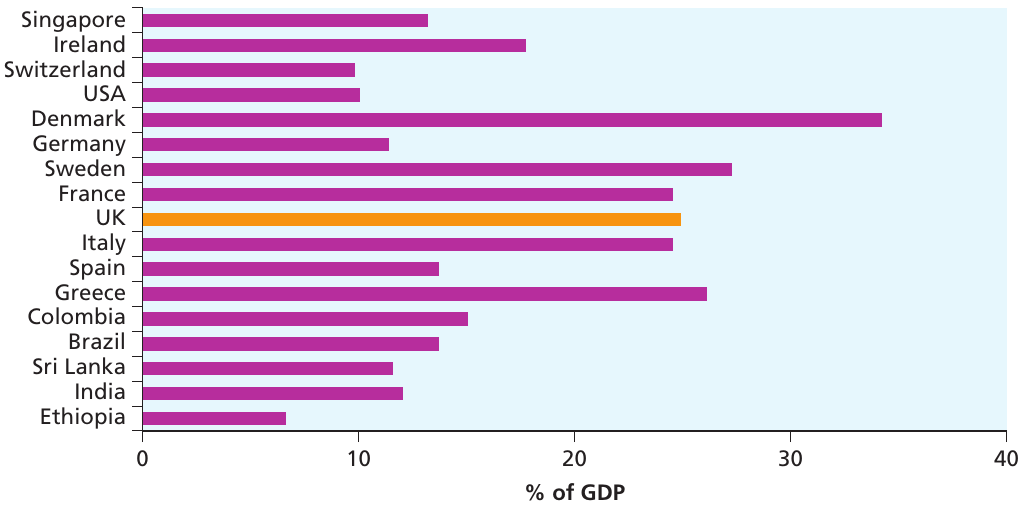
The figure shows tax revenue as a percentage of GDP for selected countries around the world, ranked in descending order of GDP per capita in PPPs. Some important patterns emerge:
Lower-income countries: Display relatively low tax revenue relative to GDP. This is important because if the government has a limited capacity to raise tax revenue, this may limit the extent to which it is able to introduce policies to combat poverty, or to provide social infrastructure needed to encourage economic growth.
The UK and USA difference: Notice the difference between the UK and the USA. The UK collects around 27% of GDP in tax revenue, while the USA collects only around 20%. This reflects different attitudes towards the role of government in the economy.
Corporate tax competition
Governments have also been aware that transnational companies may take account of relative tax rates in different countries when deciding where to locate their investment. Countries that are keen to attract foreign direct investment may feel pressured to keep corporate tax rates relatively low in the hope of attracting inflows of investment.
Indeed, many transnational companies have been able to negotiate tax holidays, leaving them free of taxation for a period after they bring in their investment.
Sustainability of fiscal policy
Another important issue that came to the fore during the 1990s concerned the sustainability of fiscal policy. This is wrapped up with the notion that current taxpayers should only have to fund expenditure that benefits their own generation. Future taxpayers should make their own decisions, and not have to pay for past government expenditure that has been incurred for the benefit of earlier generations.
The concept of sustainability
In this context, what is significant is the overall balance between receipts and outlays through time. If outlays were always larger than receipts, the spending programme could be sustained only through government borrowing, thereby shifting the burden of funding the deficit to future generations. This could be a problem if:
- It made it more difficult for the private sector to obtain funds for investment
- It added to the national debt
The Golden Rule of fiscal policy
The Labour governments of 1997-2010 introduced a so-called Golden Rule of fiscal policy, which stated that, on average over the economic cycle, the government should borrow only to invest and not to fund current expenditure.
Note
This was intended to help achieve equity between present and future generations. It should perhaps be noted that this was a self-imposed guideline, so there was no penalty for breaking the rule other than loss of political credibility.
The need to bail out commercial banks in order to safeguard the financial system rendered the Golden Rule impossible to follow. The further increases in government spending during the COVID-19 pandemic kept the Golden Rule well out of reach.
Managing the economic cycle
If receipts and outlays more or less balance over the economic cycle, the economy is not in a position whereby the current generation is forcing future generations to pay for its consumption. However, as the economy does go through a business cycle, it is not practical to impose this rule at every point in time. The so-called Golden Rule was intended to apply over the cycle as a whole.
Important
There was also a commitment to keep public sector net debt below 40% of GDP - again, on average over the cycle. Figure 15.5 (referenced from an earlier chapter) showed data for this on a quarterly basis since 1997.
The financial support offered to Northern Rock and other banks in the bailout of 2008 had a noticeable effect on public sector net debt. Even without the financial sector interventions, net debt rose over the 40% mark in the last quarter of 2008 and kept rising thereafter. This reflected other measures taken by the government to try to mitigate the effects of the recession.
One example was the reduction in the rate of VAT from 17.5% to 15%. This is tantamount to a fiscal expansion, but when it was introduced, it was made clear that it was intended as a temporary boost for a specified period. This statement enabled the government to maintain that it was not breaching its long-term fiscal commitment. The rate of VAT returned to 17.5% in January 2010, and was increased to 20% in January 2011.
Remember!
Summary
Key Points to Remember:
-
Fiscal policy encompasses government decisions about public expenditure, taxation, and borrowing to influence the macroeconomy and achieve policy objectives.
-
Types of public expenditure include:
- Current expenditure (day-to-day spending)
- Capital expenditure (infrastructure investment)
- Transfer payments (social protection)
-
Direct taxes (such as income tax) are progressive and redistribute income, while indirect taxes (such as VAT) tend to be regressive and may disincentivise consumption.
-
The Laffer curve demonstrates that beyond an optimal tax rate (), higher tax rates lead to lower revenue due to disincentive effects on work and economic activity.
-
Fiscal deficits and national debt must be carefully managed - distinguishing between cyclical deficits (temporary, linked to the business cycle) and structural deficits (persistent, even at full employment) is crucial.
-
Crowding out occurs when government borrowing raises interest rates, reducing private sector investment, while automatic stabilisers help smooth economic fluctuations without active policy intervention.
-
The balance between public and private sectors affects overall economic efficiency, with the optimal balance depending on factors such as productivity, infrastructure needs, and income distribution goals.