Droughts: Causes and impacts (Edexcel A-Level Geography): Revision Notes
📚Revision Notes
Droughts: Causes and impacts
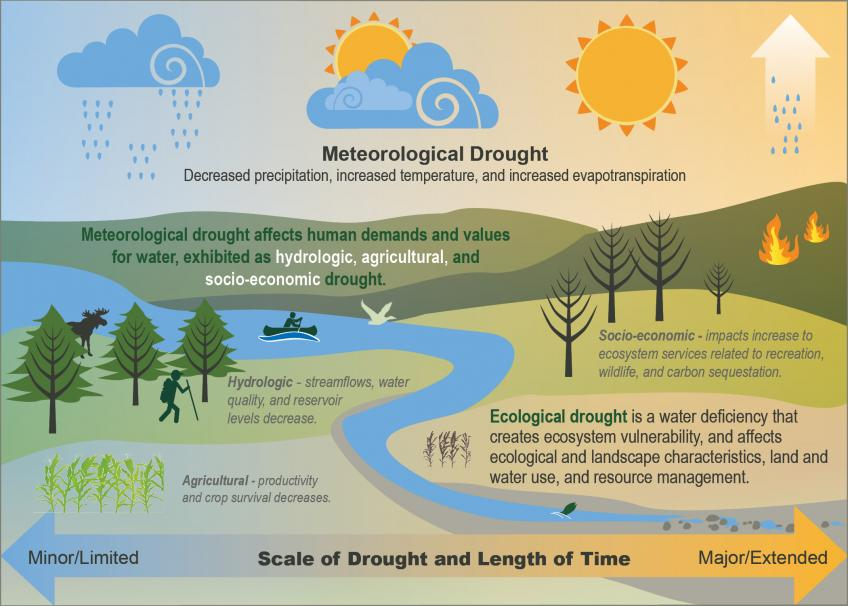
Three Types of Major Drought
- Meteorological Drought → Shortfalls in precipitation as a result of short-term variability or longer-term trends which ↑ the duration of the dry period
- Precipitation deficiency usually combined w/ high temps, winds, strong sunshine and low relative humidity (all ↑ evaporation)
- Causes of rainfall deficiency can be natural variation in atmospheric conditions or desiccation caused by deforestation, or longer term.
- Agricultural Drought → Rainfall deficiency from meteorological drought leads to deficiency of soil moisture and soil water availability, which has knock on effect on plant growth and ↓ biomass
- Farming practices such as overgrazing can lead to accelerated onset of agricultural drought
- Hydrological Drought → Associated with reduced stream flow and groundwater levels, which decrease because of reduced inputs of precipitation and continued high rates of It results in reduced storage in lakes and reservoirs, often with marked salinisation and poorer water quality
- Major threat to wetlands and other wildlife habitats
- Linked to ↓ water supplies for Urban areas ∴ measures have to be put in place (hose pipe ban) Additional type of drought → Famine drought
A humanitarian crisis in which the widespread failure of agricultural systems leads to food shortages and famines with severe social, economic and environmental impacts
Droughts are known as creeping hazards as they typically have a long period of onset, making it difficult to determine whether a drought has begun or whether it is just a dry period
Three Types of Major Drought
Measures of Drought
- Palmer Drought Severity Index [PDSI] ⇒ Applies to long-term drought. Uses current data as well as that of the preceding months, as drought is dependent on previous conditions. Focuses on monitoring the duration & intensity of large-scale, long-term, drought-inducing atmospheric circulation
- Crop Moisture Index [CMI] ⇒ Measure of short-term drought on a weekly scale and is useful for farmers to monitor water availability during the growing season
- Palmer Hydrological Drought Index [PHDI] ⇒ The Hydrological system responds slowly to drought, both in reacting to drought and recovering from it, so different models need to be developed for rivers, lakes,
Meteorological & Hydrological Causes of Drought (Short, Medium & Long Term)
| Short-term | Blocking anticyclones In mid-latitude areas, the polar front jet stream may move N, allowing subtropical high pressure areas to also move N. This brings dry and hot weather. |
|---|---|
| Reduced soil moisture May not be enough precipitation to soak into soil as plants use it quickly during growing season or there is v high EVT due to drier air | |
| Medium-term | ENSO cycles (El Nino, La Nina) El Nino: Warm water moves closer to the Americas, ↓ rainfall in the W Pacific. Causes ↑ rainfall in Peru area, while Australia experiences drought. La Nina: Warm water moves to the W of the Tropical Pacific (dramatic), ↓ rainfall in Peru, ↑ rainfall in America |
| Hydrological ↓ amount of water in rivers or ground may occur if precipitation is ↓ in mountainous areas over several years | |
| Long-term | Global atmospheric circulation Descending air between the Hadley and Ferrel cells and between Polar cells creates hot and cold deserts respectively. Areas near these can also subsequently experience semi-arid conditions |
| Climate change ↑ temperatures = more EVT, rainfall more extreme but over shorter periods of time |
Teleconnection → Refers to climate anomalies which relate to each other at large distances (has an impact on other places) Desertification → Land degradation in arid, semi-arid and dry sub-humid regions resulting from various factors, including climatic variations and human activities
Human Causes of Drought
| Over-abstraction of surface water | Taking too much water out of streams, lakes and rivers ↓ amount stored/transferred to areas downstream. If precipitation not enough, the stores are not replenished |
|---|---|
| Over-abstraction of groundwater | Taking too much water out of aquifer stores ↓ the water table & may cause the water table to dry up |
| Deforestation | ↓ interception, absorption and EVT so that water is lost from local areas, making them drier and more susceptible to drought |
| Climate change | Emissions of greenhouse gases are accelerating global warming which is changing precipitation patterns, making some areas + likely to experience drought |
Ecological Impacts of Drought
Wetlands → Areas of marsh, fen, peatland or water, whether natural or artificial, permanent or temporary, with water that is static or flowing, fresh, brackish or salt
Key functions of wetlands:
-
Act as temporary water stores within the hydrological cycle, thus mitigating river floods downstream, protecting land from destructive erosion by acting as washlands, and recharging aquifers
-
Chemically, wetlands act like giant water philtres by trapping and recycling nutrients, as well as pollutants, which helps to maintain water quality
-
Have a very high biological productivity and support a very diverse food web, providing nursery areas for fish and refuges for migrating birds How drought destroys wetlands:
-
Less precipitation = ↓ vegetation ∴ ↓ interception = ↓ in infiltration & percolation to groundwater stores ∴ water table levels fall
-
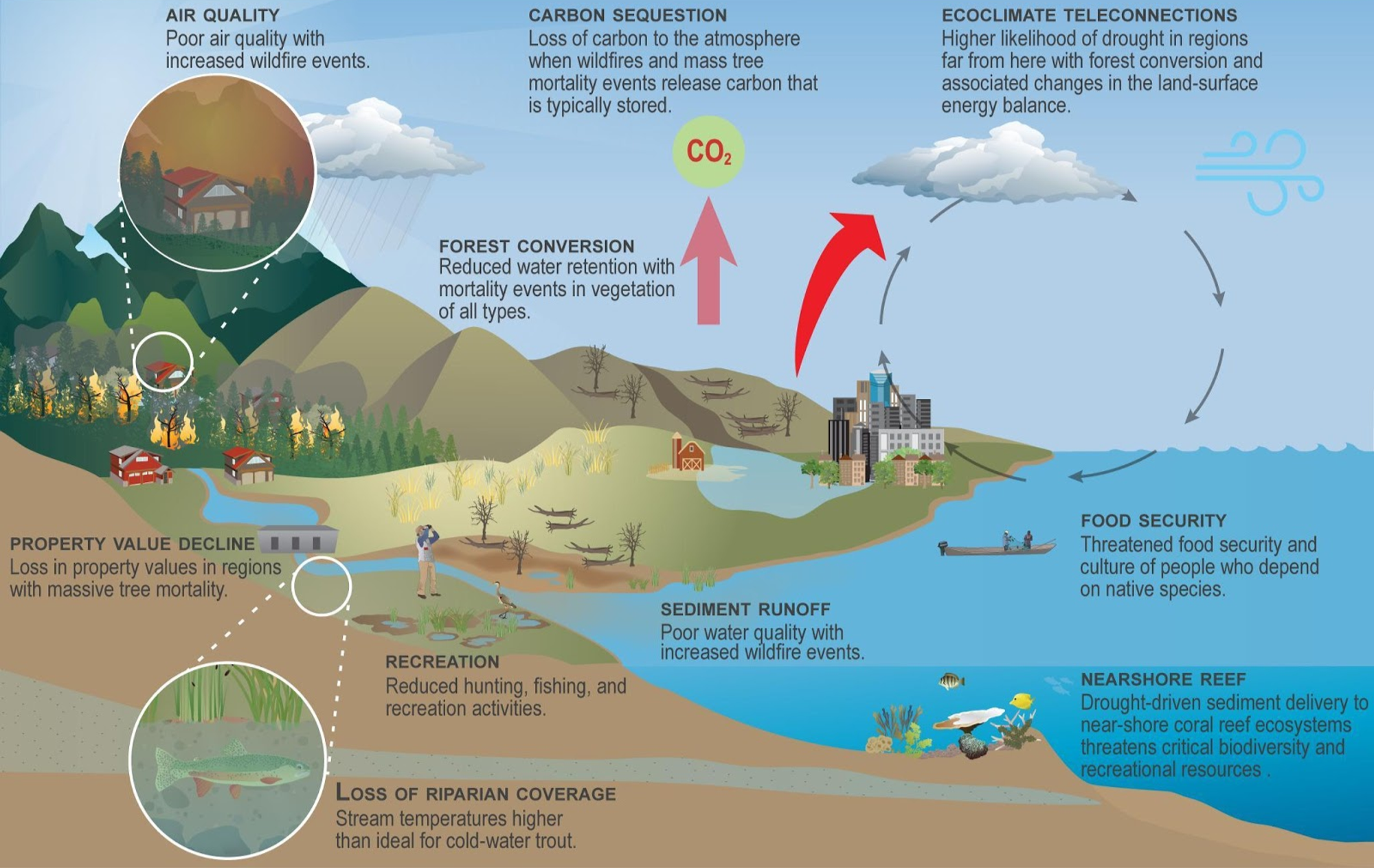
Desiccation can also accelerate destruction by wildfires
-
Some species will leave the area
Ecological Impacts of Drought