Linear Simultaneous Equations - Elimination (Edexcel A-Level Mathematics): Revision Notes
📚Revision Notes
2.3.1 Linear Simultaneous Equations - Elimination
Simultaneous Equations
Simultaneous equations are a system of two or more sets of equations which have a fixed set of solutions or are unsolvable.
Note
Example: Solve the system
Solving by Elimination
- Eliminate one variable:
- Multiply Equation by :
- Multiply Equation by :
- Subtract the new equations:
- Substitute y back into one of the original equations to find :
- Substitute into Equation :
Using a Calculator
These equations can also be easily solved using a calculator if in the form:
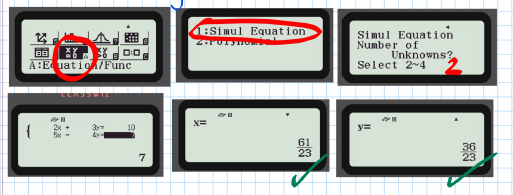
where .
- Select the "Simultaneous Equation" mode.
- Input the coefficients for the equations.
- The calculator will display the solutions for and :
Example Problem:
Solve the following simultaneous equations:
Step-by-Step Solution:
Note
Step 1: Make one variable's coefficients equal
We want to eliminate one variable. To do that, we can make the coefficients of one variable the same in both equations.
Let's eliminate . In equation (1), the coefficient of is 1, and in equation (2), it's . To match these, we can multiply equation (1) by 2, so that both equations have a coefficient of involving 2.
Multiply equation (1) by 2:
This gives:
Step 2: Add or subtract the equations
Now, we will add equations (3) and (2) to eliminate .
Simplifying this:
Step 3: Solve for
Now, solve for by dividing both sides by 7:
So:
Step 4: Substitute back into one of the original equations
Now, substitute into one of the original equations to solve for . Let's use equation (1):
Substitute :
This simplifies to:
Now, subtract from both sides:
Convert 7 into a fraction:
Now simplify:
So:
Final Answer:
The solution to the system of equations is:
Or approximately: